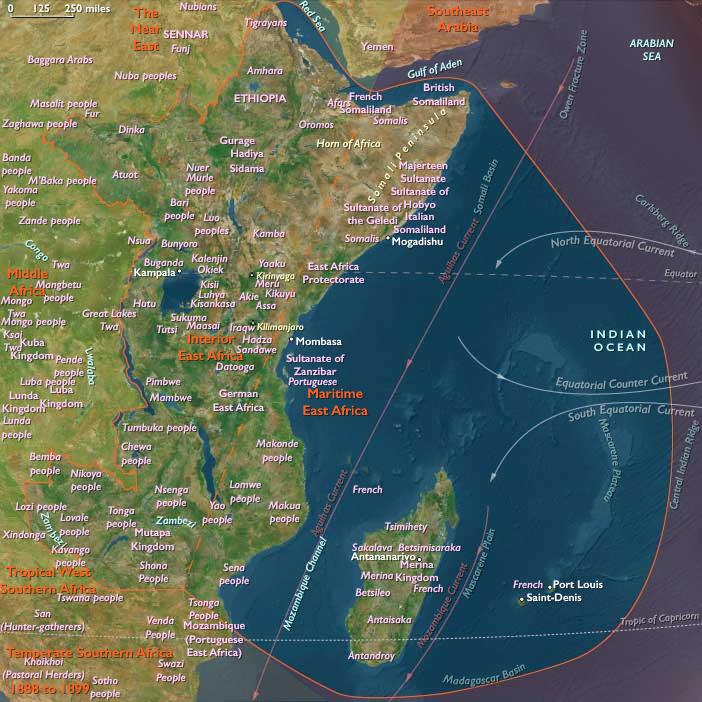
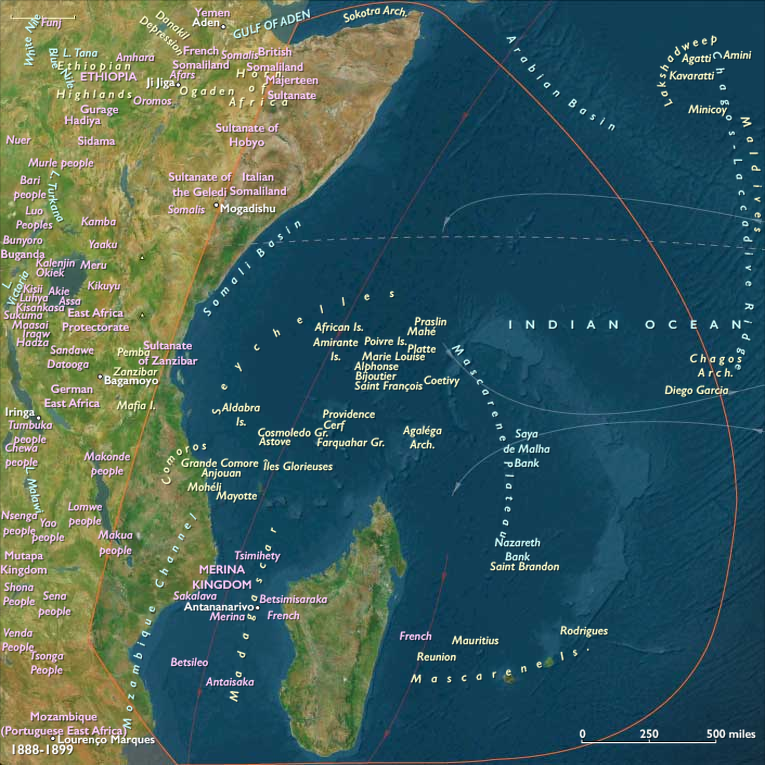
France makes Madagascar a Protectorate in 1895.
Years: 1895 - 1895
France makes Madagascar a Protectorate in 1895.
Locations
Groups
Topics
Subjects
Regions
Subregions
Related Events
Filter results
Showing 10 events out of 9391 total
All women had become eligible to vote for the Parliament of South Australia in the Constitutional Amendment Act 1894, and they do so in South Australia's 1895 elections; propertied women in the colony of South Australia had been granted the vote in 1861.
Britain creates the colony of the Federated Malay States—a federation of four protected states in the Malay Peninsula—Selangor, Perak, Negeri Sembilan and Pahang—in 1895; rubber plantations are established and tin mining begins.
In 1873, the British had intervened militarily in a civil war in Sungai Ujong to preserve British economic interests, and placed the country under the control of a British Resident.
Jelebu followed in 1886, and the remaining states in 1895.
When the Federated Malay States (FMS) is established, Sungai Ujong and Jelebu are reunited to the confederation of small states and the whole, under the old name of the Negeri Sembilan, is placed under a single Resident and becomes a member of the FMS.
China’s troubles with Japan in the nineteenth century reach a nadir with the Sino-Japanese War of 1894–1895, resulting in the loss of Taiwan to Japan, the recognition of Korean independence and the granting of concessions to Japan and the European powers.
Japan’s small but modernized forces handily defeat the larger Chinese army in Korea.
The April 1895 Treaty of Shimonoseki forces China to recognize Korean independence and transfers Taiwan (Formosa), the Pescadorees and Manchuria’s Liaotung Peninsula to Japanese control.
European pressure results in the return of the Liaodong Peninsula to China in return for China’s granting of concessions to Japan and the European powers.
The victorious Japanese begin an occupation of newly independent Korea.

Lenin and several other members of the Marxist organization known as the Union of Struggle are arrested, imprisoned, and sent in exile to Siberia in 1895.
In this painting, Munch shows a naked woman with her head thrown back in ecstasy, her eyes closed, and a red halo-like shape above her flowing black hair.
This may be understood as the moment of conception, but there is more than a hint of death in the woman's beautiful face.
In Munch's art, woman is an "other" with whom union is desperately desired, yet feared because it threatens the destruction of the creative ego.
He adds to the Frieze the painting Jealousy (The Munch Museum / The Munch-Ellingsen Group).
If isolation and loneliness, always present in his work, are especially emphasized in these pictures, they are equally apparent in Death in the Sick Room (Nasjonalgalleriet, Oslo), one of his many paintings about death.
Here the focus is not on the dying child, who is not even visible, but on the living, each wrapped in their own experience of grief and unable to communicate or offer each other any consolation.
The claustrophobically enclosed space and the steeply rushing perspective of the floor heighten the picture's power.
Neurologist Sigmund Freud, his interest in hysteria stimulated by Joseph Breuer’s successful use of therapeutic hypnosis and by Freud’s studies with celebrated French neurologist Jean Martin Charcot in Paris, takes up Breuer’s “cathartic method".
In 1895, Freud and Breuer publish their findings in Studies in Hysteria , which outlines their “talking cure” and inaugurates psychoanalysis.
Freud describes the evolution of his clinical method and sets out his theory of the psychogenetic origins of hysteria, demonstrated in several case histories,
The worst atrocity takes place in Urfa, where Ottoman troops burn the Armenian cathedral, in which three thousand Armenians have taken refuge, and shoot at anyone who tries to escape.
Stefan Stambolov is gunned down on the streets of Sofia on July 3, 1895; the assassins appear to be some of the Macedonian radicals earlier persecuted by Stambolov.
The new administration is mainly conservative, and Prince Ferdinand becomes the dominant force in Bulgarian policy making.