
France in Crisis (1422): The Dual Monarchy, …
Years: 1422 - 1422
France in Crisis (1422): The Dual Monarchy, Civil War, and the Work of Alain Chartier
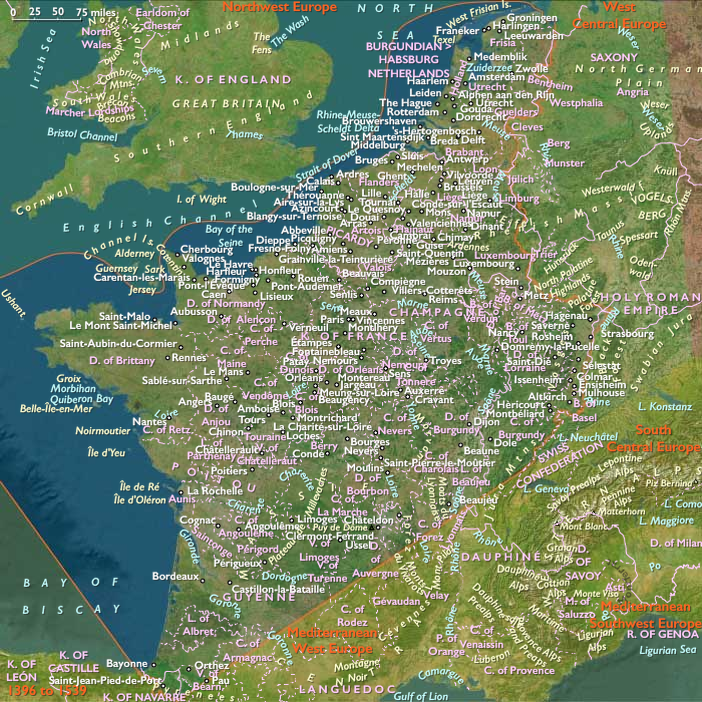
By 1422, France was in a state of devastation, still reeling from the disaster at Agincourt (1415) and the subsequent English conquest of Normandy. The civil war between the Armagnacs and the Burgundians showed no sign of resolution, further weakening French resistance.
Following the deaths of both Henry V of England and Charles VI of France within two months of each other in 1422, an infant, Henry VI of England, became the nominal king of both England and France, in accordance with the 1420 Treaty of Troyes. Meanwhile, the Dauphin Charles was recognized in southern France as Charles VII but remained uncrowned and politically weak.
I. The Political Situation in France and England (1422)
- King Charles VI of France died on October 21, 1422, at age fifty-three, leaving his kingdom divided.
- The Treaty of Troyes (1420) had disinherited the Dauphin Charles, granting the French throne to Henry V of England and his heirs.
- However, Henry V had died unexpectedly on August 31, 1422, just two months before Charles VI, leaving his infant son, Henry VI, as the nominal ruler of both England and France.
- John of Lancaster, Duke of Bedford, was declared Regent of France, focused on consolidating English control and ensuring Henry VI's claim to the French throne.
- Meanwhile, Humphrey, Duke of Gloucester, acted as Lord Protector of England, creating a power struggle within the English court.
II. France’s Internal Struggles and the Uncrowned Charles VII
- The Armagnac-Burgundian Civil War continued, preventing a unified French resistance against England.
- The Dauphin Charles VII, though recognized in the south, remained uncrowned, lacking the political and military strength to assert his rule.
- France was in a desperate situation, with large portions of the country occupied by the English and their Burgundian allies.
III. Alain Chartier: A Voice for French Unity and Reform
- Alain Chartier (b. c. 1385 in Bayeux) was a poet, diplomat, and political writer, born into a distinguished family.
- He studied at the University of Paris, as did his elder brother Guillaume Chartier, who later became Bishop of Paris (1447).
- Chartier became a loyal supporter of Charles VII, serving as clerk, notary, and financial secretary.
His Key Works and Their Significance
- Livre des quatre dames (1416) – A poetic lament on the aftermath of Agincourt, told through the voices of four noblewomen affected by the war.
- Débat du reveille-matin (1422–1426?) – A dialogue-based political commentary on France’s struggles.
- La Belle Dame sans Mercy (1424) – A celebrated lyrical poem, influencing later French and English courtly literature.
Le Quadrilogue Invectif (1422): A Call for National Unity
- In 1422, Chartier wrote Le Quadrilogue Invectif, a highly original prose work analyzing France’s political plight during the Anglo-French conflict.
- The dialogue features four interlocutors:
- France herself, personified as a suffering mother.
- The Nobility, accused of selfish ambition and failing to defend the kingdom.
- The Clergy, criticized for corruption and neglect of spiritual duty.
- The Common People, portrayed as the primary victims of war and civil strife.
- Key Themes:
- The abuses of the feudal military system and the suffering of the peasantry.
- The need for unity between warring factions to fight the English invaders.
- The argument that France’s cause, while desperate, was not yet lost—if internal divisions could be resolved.
IV. The Impact of Chartier’s Work
- Chartier’s writings helped shape early French nationalism, calling for an end to factionalism in favor of a united resistance against England.
- His vision of reform influenced the court of Charles VII, especially during the later campaigns of Joan of Arc (1429–1431).
- Le Quadrilogue Invectif remains one of the most important political treatises of the Hundred Years' War, reflecting the despair and hope of early 15th-century France.
V. Conclusion: A Nation in Crisis but Not Yet Defeated
- France’s situation in 1422 seemed dire, with:
- An uncrowned Dauphin, Charles VII.
- English occupation of most of the north.
- Continued civil war between the Armagnacs and Burgundians.
- However, Chartier’s writings argued that France could still be saved, provided its leaders set aside their rivalries and worked toward a common cause.
The Treaty of Troyes and the succession of Henry VI in 1422 marked the height of English ambitions in France, but French resistance, inspired by figures like Chartier, was far from over.
Locations
People
- Alain Chartier
- Charles VI of France
- Charles VII of France
- Henry V of England
- Henry VI of England
- Humphrey of Lancaster, 1st Duke of Gloucester
- John of Lancaster
- Philip the Good
Groups
- Normandy, Duchy of
- Burgundy, Duchy of
- Scotland, Kingdom of
- France, (Valois) Kingdom of
- England, (Plantagenet, Lancastrian) Kingdom of
Topics
- Hundred Years' War
- Renaissance literature
- Armagnac-Burgundian Civil War
- Hundred Years' War: Resumption of the war under Henry V
Commodoties
Subjects
Regions

Subregions
Related Events
Showing 10 events out of 42162 total
Years: 1422 - 1422
Locations
People
- Alain Chartier
- Charles VI of France
- Charles VII of France
- Henry V of England
- Henry VI of England
- Humphrey of Lancaster, 1st Duke of Gloucester
- John of Lancaster
- Philip the Good
Groups
- Normandy, Duchy of
- Burgundy, Duchy of
- Scotland, Kingdom of
- France, (Valois) Kingdom of
- England, (Plantagenet, Lancastrian) Kingdom of
Topics
- Hundred Years' War
- Renaissance literature
- Armagnac-Burgundian Civil War
- Hundred Years' War: Resumption of the war under Henry V
Commodoties
Subjects
Regions
Subregions