
France has evolved from a feudal country …
Years: 1456 - 1456
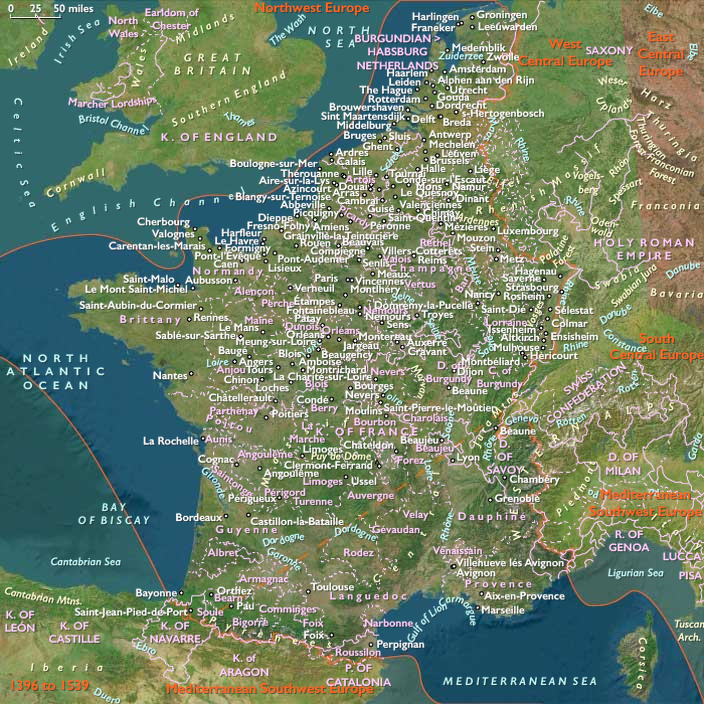
France has evolved from a feudal country to an increasingly centralized state (albeit with many regional differences) organized around a powerful absolute monarchy that rely on the doctrine of the Divine Right of Kings and the explicit support of the Gallican Church.
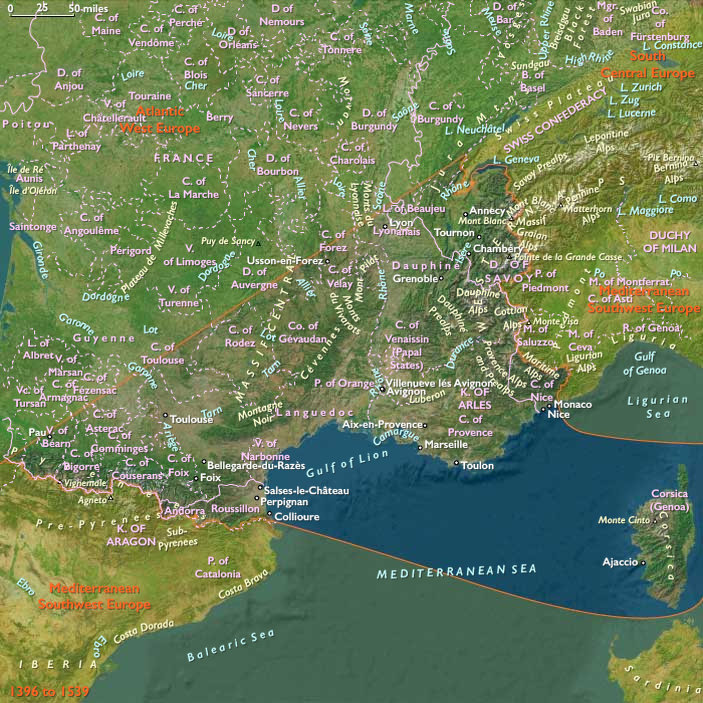
Mid-fifteenth century France is significantly smaller than it is today, and numerous border provinces (such as Roussillon, Cerdagne, Calais, Béarn, Navarre, County of Foix, Flanders, Artois, Lorraine, Alsace, Trois-Évêchés, Franche-Comté, Savoy, Bresse, Bugey, Gex, Nice, Provence, and Brittany) are autonomous or foreign-held (as by the Holy Roman Empire); there are also foreign enclaves, like the Comtat Venaissin.
In addition, certain provinces within France are ostensibly personal fiefdoms of noble families (like the Bourbonnais, Marche, Forez and Auvergne provinces held by the House of Bourbon.)
The Duke of Burgundy has assembled a large territory including his native duchy and the Burgundian Netherlands.
Le Dauphin, the son of France’s King Charles VII, has ruled efficiently in the Dauphiné, but in 1456 his father seizes the land and drives his son into exile at the Burgundian court.
Their respective advisors, in purposely encourage the misunderstandings between father and son, enable the continuation of the feud.
Locations
People
Groups
- Navarre, Kingdom of
- Flanders, County of
- Burgundy, Duchy of
- Béarn, Viscountcy of
- Franche-Comté
- Lorraine, (second) Duchy of
- Artois, County of
- Foix, County of
- Comtat Venaissin (Papal enclave)
- France, (Valois) Kingdom of
- Netherlands, Burgundian
- Savoy, Duchy of
Subjects
Regions
Subregions
Related Events
Filter results
Showing 10 events out of 41409 total
The cooling of the climate, confirmed by a detailed tree ring study near Hokitika, shows a significant, sudden and long-lasting cooler period from 1500.
This coincides with a series of massive earthquakes in the South Island Alpine fault, a major earthquake in 1460 in the Wellington area, tsunamis that destroy many coastal settlements, and the extinction of the moa and other food species.
These are likely factors that lead to sweeping changes to the Māori culture, which develops into the most well-known "Classic" period that is in place when European contact is made.
This period is characterized by finely made pounamu weapons and ornaments, elaborately carved canoes—a tradition that will later extend to and continue in elaborately carved meeting houses (wharenui), and a fierce warrior culture, with fortified hillforts known as pā, frequent cannibalism, and some of the largest war canoes ever built.
East Europe (1456–1467 CE): Muscovite Authority and Regional Consolidation
Political and Military Developments
Deepening of Muscovite Centralization
Between 1456 and 1467 CE, Muscovy further deepened its central governance and political control, solidifying authority across its expanded territories. Enhanced administrative structures fostered greater political stability and regional cohesion.
Effective Management of External Relations
Muscovy continued to adeptly manage its external relations, negotiating strategic alliances and minimizing conflicts with neighboring principalities. Diplomatic initiatives reinforced Muscovy’s influential role across East Europe.
Ongoing Integration of Ethnic Groups
The integration of diverse ethnic communities, including the Mari, Mordvins, Udmurts, Komi, and Vepsians, into Muscovite administrative frameworks advanced significantly, further strengthening regional stability and cultural cohesion.
Economic and Technological Developments
Economic Prosperity and Market Development
Economic prosperity continued to expand, driven by sustained growth in domestic trade and robust international commerce. Urban centers, notably Moscow, Novgorod, and Tver, further solidified their roles as thriving economic hubs.
Technological Innovations in Military Defense
Muscovy continued its technological advancements, particularly in military infrastructure, fortifications, siege capabilities, and cavalry techniques. These developments enhanced regional security and territorial integrity.
Cultural and Artistic Developments
Cultural Flourishing and Artistic Innovation
The synthesis of Rus', Mongol, and various ethnic traditions led to ongoing cultural flourishing. Notable developments in architecture, religious iconography, and secular artistic expression highlighted this era.
Vibrant Intellectual and Literary Activity
Literary and intellectual pursuits remained dynamic, with chroniclers and scholars extensively documenting historical, religious, and cultural developments. These activities preserved cultural heritage and supported regional intellectual continuity.
Settlement Patterns and Urban Development
Continued Urban Expansion and Sophistication
Cities such as Moscow sustained demographic and economic expansion, benefiting from strategic infrastructure investments and sophisticated urban governance. These efforts supported enhanced administrative effectiveness and commercial growth.
Advanced Urban Defense Systems
Urban centers continued upgrading defensive infrastructure, improving strategic fortifications and ensuring protection from external threats, thereby reinforcing regional stability.
Social and Religious Developments
Increased Social Cohesion and Diversity Integration
Social structures further evolved to effectively incorporate and harmonize diverse ethnic groups, fostering a cohesive and stable society under centralized Muscovite rule.
Orthodox Church's Continued Central Role
The Orthodox Church maintained its influential societal position, shaping educational standards, cultural values, and community interactions, significantly contributing to social stability and continuity.
Long-Term Consequences and Historical Significance
The period from 1456 to 1467 CE significantly advanced Muscovite centralization, economic prosperity, and cultural vibrancy. These developments reinforced the essential foundations for a unified and culturally rich Russian state, setting the stage for future historical trajectories.
A fragile peace between Muscovy and Kazan is broken in 1467, when Ivan III of Russia decides to support his ally Qasim's claims to the Tatar throne and declares war on the ruling khan Ibrahim.
Northeast Europe (1456–1467 CE): Intensifying Union Discord, Teutonic Decline, and Diplomatic Realignments
Between 1456 and 1467 CE, Northeast Europe grappled with growing internal divisions, notably within the Kalmar Union, sustained pressures upon the Teutonic Order, and increasingly assertive diplomatic and territorial moves by the Polish–Lithuanian Union. These dynamics significantly influenced the region’s political stability, economic resilience, and strategic alliances.
Increasing Strife Within the Kalmar Union
The Kalmar Union, under King Christian I, experienced escalating internal tensions as Swedish factions increasingly opposed Danish control. Swedish nobility and influential merchant groups resisted centralized authority, leading to administrative challenges, weakened governance, and persistent friction. These developments significantly undermined union cohesion, setting the stage for intensified confrontations and eventual fragmentation.
Continued Weakening of the Teutonic Order
The Teutonic Order faced ongoing internal turmoil and economic hardship, exacerbating vulnerabilities within their territories in Prussia and Estonia. Financial strain from previous conflicts and diplomatic isolation further eroded the Order’s stability and territorial integrity. Efforts to stabilize key urban centers such as Königsberg and Reval (Tallinn)only partially mitigated these pressures, leaving the Order increasingly susceptible to external encroachments, particularly from Poland-Lithuania.
Polish–Lithuanian Union's Growing Regional Influence
Under the leadership of King Casimir IV Jagiellon, the Polish–Lithuanian Union further solidified its position as a dominant regional power. Strategic diplomacy, territorial expansion, and robust military capabilities allowed Poland-Lithuania to assert increased influence, effectively countering the declining authority of the Teutonic Order and reshaping regional geopolitics.
Stability and Autonomy in the Livonian Confederation
The Livonian Confederation, governed from the economically resilient city of Riga, successfully navigated the region’s turbulent geopolitical climate. Through effective internal governance, strategic diplomacy, and fortified urban centers, the Confederation maintained its political autonomy, economic prosperity, and regional relevance.
Reinforced Swedish-Finnish Integration
Despite heightened internal tensions within the Kalmar Union, Sweden continued reinforcing its governance in southern Finland, fortifying defenses, enhancing administrative effectiveness, and expanding ecclesiastical institutions. These efforts ensured cohesive integration, political stability, and regional security, strengthening Finland’s strategic importance within Sweden's broader geopolitical interests.
Economic Prosperity in Major Urban Centers
Key cities, notably Reval (Tallinn), Riga, Königsberg, and Visby on Gotland, continued to experience significant economic growth through expanded maritime trade and commercial networks. Urban resilience provided essential regional stability, significantly offsetting ongoing political disruptions and fostering broader economic prosperity.
Ecclesiastical Influence and Cultural Continuity
Ecclesiastical institutions, particularly influential regional bishoprics and the Teutonic Order, maintained their essential roles in education, governance, and social cohesion. Continued promotion of Latin Christian traditions offered social stability, cultural continuity, and regional unity amidst broader geopolitical uncertainty.
Strategic Diplomatic Maneuvering
Diplomatic interactions among the Kalmar Union, Teutonic Order, Livonian Confederation, and Polish–Lithuanian Union remained critical. These diplomatic engagements aimed at managing territorial disputes, regional rivalries, and internal political challenges through strategic alliances, negotiations, and compromises, thereby stabilizing regional geopolitics.
Legacy of the Era
The era from 1456 to 1467 CE significantly shaped Northeast Europe’s geopolitical landscape through intensified internal union struggles, declining Teutonic influence, and sustained diplomatic realignments. These developments established patterns and tensions influencing future territorial boundaries, political structures, and regional identities, profoundly impacting Northeast Europe’s subsequent historical trajectory.
East Central Europe (1456–1467 CE): Siege of Belgrade, Ascendancy of Matthias Corvinus, Bohemian Kingship of George of Poděbrady, and the Thirteen Years' War
Between 1456 and 1467 CE, East Central Europe experienced pivotal developments marked by critical Ottoman confrontations, significant shifts in Hungarian leadership under Matthias Corvinus, dynastic consolidation in Bohemia under George of Poděbrady, and crucial transformations resulting from the Thirteen Years' War between the Teutonic Order and the Polish-Lithuanian Union. These events dramatically reshaped regional politics, fortifying defenses against external threats while significantly altering internal power dynamics and political alliances.
Political and Military Developments
Siege of Belgrade and Rise of Matthias Corvinus in Hungary (1456–1458)
-
In 1456, the Ottoman Empire, led by Sultan Mehmed II, launched a massive siege against the strategic Hungarian stronghold of Belgrade. The siege was famously repelled by Hungarian noble John Hunyadi, who died shortly after his remarkable victory, deeply mourned and celebrated as a national hero.
-
Following internal struggles and political maneuvering after Hunyadi’s death, his young son, Matthias Corvinus, was elected King of Hungary in 1458, initiating one of Hungary’s most prosperous and culturally influential reigns. Matthias effectively reorganized military and administrative structures, vigorously defending Hungary’s frontiers while enhancing internal stability.
Bohemian Stability under George of Poděbrady (1458–1471)
-
In 1458, George of Poděbrady ascended peacefully to the Bohemian throne, becoming the first non-dynastic, native Czech king since the Přemyslid dynasty. His reign emphasized political stability, economic recovery, religious moderation (balancing Catholic and moderate Hussite factions), and diplomatic outreach throughout Europe, notably proposing a pan-European league for peace against Ottoman expansion.
Polish-Lithuanian Triumph in the Thirteen Years’ War (1454–1466)
-
The protracted Thirteen Years' War between the Teutonic Order and the Polish-Lithuanian Union reached critical phases during this period. Polish forces steadily gained control, supported by cities and nobility within the Prussian Confederation, an alliance formed by Prussian towns and nobles in opposition to Teutonic domination.
-
This conflict decisively weakened the Teutonic Order, setting the stage for significant territorial realignments and bolstering Polish-Lithuanian influence over vital Baltic territories, notably the crucial trade hubs around Gdańsk (Danzig) and Toruń (Thorn).
Internal and Dynastic Tensions in the Holy Roman Empire Territories
-
Within imperial territories such as Brandenburg, Saxony, and Austria, local and regional dynastic tensions persisted. The Duchies of Saxony, Mecklenburg, Bavaria, and Brandenburg underwent internal consolidation and realignment, managing political competition and negotiating external alliances, significantly influencing East Central Europe’s broader geopolitical balance.
Economic and Technological Developments
Economic Recovery and Urban Prosperity under Matthias Corvinus
-
Under Matthias Corvinus, Hungary experienced substantial economic revitalization, driven by improved agricultural output, commercial trade networks, and increased mining activities, especially silver mining in Upper Hungary (modern Slovakia).
-
Bohemia under George of Poděbrady and Poland under Kazimierz IV experienced similar economic recoveries, significantly improving regional trade networks, infrastructure, and urban prosperity.
Baltic Trade Realignments Following the Thirteen Years' War
-
With Polish-Lithuanian victory and territorial gains, cities like Gdańsk, Toruń, and Elbląg thrived economically, deepening integration into Baltic maritime trade networks and significantly strengthening Poland-Lithuania’s economic foundations.
Cultural and Artistic Developments
Cultural Renaissance under Matthias Corvinus (Hungarian Renaissance)
-
Matthias Corvinus actively patronized arts, science, and scholarship, fostering the Hungarian Renaissance’s cultural flourishing. His royal court in Buda became a vibrant center of Renaissance humanism, attracting notable Italian scholars, artists, and architects.
-
Corvinus’s renowned Bibliotheca Corviniana emerged as one of Europe’s finest Renaissance libraries, significantly enhancing Hungary’s cultural prestige.
Bohemian Cultural Resurgence
-
Under George of Poděbrady, Bohemian culture flourished, blending traditional Czech influences with evolving Renaissance trends. Prague sustained its reputation as a major cultural and intellectual center, marked by architectural projects, literature, and intellectual discourse promoting peace and European unity.
Settlement and Urban Development
Fortifications and Defensive Urbanization
-
Hungary significantly strengthened urban defenses, particularly border cities like Belgrade, Esztergom, and Temesvár, fortifying them against Ottoman threats.
-
Polish-Lithuanian cities, notably Gdańsk and Toruń, expanded rapidly, fortified defenses, and improved civic infrastructure, driven by post-war economic growth.
Social and Religious Developments
Continued Religious Diversity and Moderate Hussitism in Bohemia
-
George of Poděbrady maintained religious tolerance, upholding moderate Hussite traditions alongside traditional Catholic practices. This policy fostered Bohemia’s distinctive cultural and religious pluralism.
Social Strengthening of Nobility and Urban Classes
-
In Hungary, Poland-Lithuania, and Bohemia, aristocratic privileges and noble autonomy strengthened, particularly in territories acquired from the Teutonic Order. Urban elites also gained considerable economic and political influence through expanded commerce and civic development.
Long-Term Consequences and Historical Significance
The era 1456–1467 CE was a critical juncture in East Central Europe, decisively shaping the region’s medieval trajectory. Matthias Corvinus’s reign established a strong Hungarian monarchy, culturally vibrant and militarily resilient, deeply influencing subsequent Hungarian history. The Bohemian kingship of George of Poděbrady solidified internal peace, cultural vitality, and diplomatic innovations, impacting broader European political thought. Polish-Lithuanian triumph in the Thirteen Years' War profoundly reconfigured Baltic geopolitical dynamics, bolstering Polish regional dominance and significantly diminishing Teutonic power. Collectively, these developments transformed East Central Europe’s political landscape, fortifying regional resilience against external threats and laying essential foundations for future stability, cultural flourishing, and political complexity.
Eastern Southeast Europe (1456–1467 CE): Ottoman Consolidation and Regional Resistance
Settlement and Migration Patterns
Ottoman Expansion in Serbia and Bosnia
From 1456 to 1467, the Ottoman Empire continued its consolidation over significant territories in Eastern Southeast Europe, particularly in Serbia and Bosnia. The Siege of Belgrade (1456) was a major event, temporarily checking Ottoman expansion. Led by Hungarian regent John Hunyadi, Hungarian and Serbian defenders secured a significant victory, delaying Ottoman advancement and allowing these northern regions temporary autonomy.
Stabilization of Ottoman Rule in Bulgaria
The Ottoman administrative system further entrenched itself in Bulgaria, with settlements increasingly managed by Ottoman officials. Urban areas, including the former Bulgarian capital of Veliko Tărnovo, adapted to Ottoman administrative frameworks, while rural populations faced adjustments under new timar (land-grant) structures.
Economic and Technological Developments
Integration into Ottoman Economic Networks
Eastern Southeast European regions were increasingly integrated into the Ottoman Empire’s expansive economic networks. Towns such as Adrianople (Edirne) thrived as administrative and commercial hubs, linking trade from Anatolia to central European markets. Agriculture and artisanal production remained robust, facilitating the flow of Balkan goods throughout the empire.
Military Infrastructure and Fortifications
Following the difficulties at Belgrade, the Ottoman military enhanced infrastructure across Eastern Southeast Europe. Strategic fortifications, roads, bridges, and military supply lines improved, enabling more efficient control and rapid military responses within the region.
Cultural and Artistic Developments
Ottoman Cultural Expansion in Adrianople
Adrianople (Edirne) flourished culturally as one of the empire’s major provincial centers. The Ottomans erected mosques, madrasas, public baths, and marketplaces that symbolized the Islamic character of their rule while integrating local architectural influences.
Persistence of Orthodox Traditions
Despite Ottoman rule, Orthodox Christianity continued to thrive across the region, particularly in Serbia, Bosnia, and Bulgaria. Orthodox monasteries and religious communities preserved their traditions, contributing to the continuity of cultural and religious identities under Ottoman governance.
Social and Religious Developments
Ottoman Administrative and Social Structures
The Ottoman devshirme (child-levy) system became fully institutionalized, drafting Christian youths from the Balkan provinces for conversion to Islam and lifetime service to the sultan, often in the prestigious Janissary corps. This social and military institution significantly shaped regional society, integrating local populations into the imperial framework.
Orthodox Church under Ottoman Authority
The Orthodox Church, particularly in Serbian and Bulgarian territories, retained a degree of autonomy through the millet system, allowing the preservation of religious leadership and social organization. These Orthodox institutions became crucial for maintaining local communal identity amid Ottoman dominance.
Political Dynamics and Regional Rivalries
Hungarian-Ottoman Rivalries
The defense of Belgrade (1456) under Hungarian leadership was significant for shaping regional power dynamics, marking the boundary of effective Ottoman control. Hungarian influence in northern Serbia persisted, creating ongoing friction and military tension in the region.
Fragmentation and Resistance in Serbia and Bosnia
Serbia, following its defeat at Kosovo (1389) and subsequent battles, fragmented into smaller, often competing principalities and despotates, such as the Serbian Despotate. This internal fragmentation made unified resistance challenging but allowed localized centers of autonomy to occasionally resist full Ottoman integration.
Long-Term Consequences and Historical Significance
From 1456 to 1467 CE, Eastern Southeast Europe underwent decisive changes under continued Ottoman expansion and regional resistance. While Ottoman dominance became increasingly entrenched, episodes like the Siege of Belgrade demonstrated that local powers, notably Hungarian-influenced Serbian territories, could effectively resist, shaping long-term cultural resilience and national identities in the region. The period laid significant foundations for subsequent Ottoman governance structures, setting the stage for centuries of complex interaction between Ottoman authorities and the diverse cultures of Eastern Southeast Europe.
Walachia and Moldavia slide into decline after Mircea's death in 1418.
Succession struggles, Polish and Hungarian intrigues, and corruption produce a parade of eleven princes in twenty-five years and weaken the principalities as the Ottoman threat waxes.
In 1444 the Ottomans rout European forces at Varna in contemporary Bulgaria.
When Constantinople succumbs in 1453, the Ottomans cut off Genoese and Venetian galleys from Black Sea ports, trade ceases, and the Romanian principalities' isolation deepens.
At this time of near-desperation, a Magyarized Romanian from Transylvania, Janos Hunyadi, becomes regent of Hungary.
Hunyadi, a hero of the Ottoman wars, mobilizes Hungary against the Turks, equipping a mercenary army funded by the first tax ever levied on Hungary's nobles.
He scores a resounding victory over the Turks before Belgrade in 1456, but dies of plague soon after the battle.
In one of his final acts, Hunyadi installs Vlad Tepes (1456-62) on Walachia's throne.
Vlad takes abnormal pleasure in inflicting torture and watching his victims writhe in agony.
He also hates the Turks and defies the sultan by refusing to pay tribute.
In 1461 Hamza Pasha tries to lure Vlad into a trap, but the Walachian prince discovers the deception, captures Hamza and his men, impales them on wooden stakes, and abandons them.
Sultan Mehmed later invades Walachia and drives Vlad into exile in Hungary.
Although Vlad eventually returns to Walachia, he dies shortly thereafter, and Walachia's resistance to the Ottomans softens.
The Middle East: 1456–1467 CE
Shifts in Power and Intellectual Flourishing
Ottoman Consolidation and Expansion
Following the decisive victory at Varna, Mehmed II, son of Murad II, consolidates Ottoman power and initiates a period of vigorous territorial expansion. In 1458, the Ottomans capture Athens, reinforcing their dominance in southeastern Europe. Mehmed's efforts significantly enhance the empire's military strength and administrative cohesion, preparing the stage for further conquests, including future ambitions towards Constantinople.
Kara Koyunlu and Aq Qoyunlu Rivalries
The stability of the Kara Koyunlu under Jahan Shah begins to show signs of strain due to emerging rivalries with the Aq Qoyunlu, another Turkmen confederation. These conflicts foreshadow significant shifts in regional power dynamics. Despite these challenges, Jahan Shah continues his patronage of Persian culture, ensuring Tabriz remains a vibrant cultural hub amid growing political tensions.
Georgian Cultural Continuity Amid Challenges
The Kingdom of Georgia faces mounting external pressures, yet maintains its cultural resilience. Although intermittent conflicts with neighboring Muslim states create instability, Georgian society continues to produce significant works of literature, religious art, and architecture, preserving its status as a crucial cultural nexus in the region.
Timurid Decline and Intellectual Achievement
In Samarkand, the intellectual legacy of Ulugh Beg endures even as political instability marks the decline of Timurid power. Astronomical and scholarly pursuits initiated during Ulugh Beg's reign continue to influence scientific thought across the Islamic world. Despite weakened central authority, the scholarly achievements fostered by Ulugh Beg persist, underscoring the lasting cultural impact of the Timurids.
Legacy of the Era
The era from 1456 to 1467 witnesses significant shifts in regional power, with Ottoman expansionism under Mehmed II, emerging rivalries among Turkmen dynasties, continued Georgian cultural vitality, and the intellectual legacy of Timurid scholarship. These developments collectively highlight the Middle East's dynamic political landscape and enduring intellectual resilience during a time of significant transformation
Interior East Africa (1456–1467 CE): Zara Yaqob's Cultural and Religious Achievements
Foundation of Debre Birhan
Emperor Zara Yaqob (reigned 1434–1468), widely recognized as one of Ethiopia’s most influential rulers since the era of Aksumite greatness under Ezana, marked this period by establishing the city of Debre Birhan in central Ethiopia in 1456. According to historical records, Zara Yaqob founded this settlement following an extraordinary celestial event, widely believed by modern historians to have been the appearance of Halley's Comet, visible in Ethiopia that year. Interpreting this phenomenon as divine approval for his recent actions—including the stoning to death of a group of heretics—he commissioned a major religious and administrative complex on the site.
Construction and Expansion
Zara Yaqob ordered the immediate construction of a prominent church at Debre Birhan, subsequently followed by the development of an extensive palace complex. This religious and political center quickly became central to Zara Yaqob’s administrative operations and symbolized the intertwined nature of religious orthodoxy and royal authority in his reign. A second church, dedicated to Saint Cyriacus, was also built, further enhancing Debre Birhan’s prestige as a spiritual and imperial capital.
Reinforcement of Religious Orthodoxy
The events leading to the city's foundation underscored Zara Yaqob’s unwavering dedication to religious orthodoxy and his willingness to enforce doctrinal conformity through severe measures. His active involvement in church affairs continued to promote theological unity, reinforcing Ethiopian Orthodox Christianity against internal dissent and external threats.
Literary and Scholarly Patronage
During Zara Yaqob’s reign, Debre Birhan emerged not only as a political hub but also as a prominent center of scholarly activity. The city attracted theologians, scribes, and artists, contributing significantly to the flourishing of Ge’ez literature, religious scholarship, and artistic expression that characterized this era. Zara Yaqob himself authored numerous theological and philosophical treatises, further cementing his role as a key figure in Ethiopian intellectual history.
Key Historical Developments
-
Foundation of the city of Debre Birhan following the celestial event of Halley's Comet in 1456.
-
Construction of important religious and imperial structures, including the main church and palace complex.
-
Continued reinforcement of religious orthodoxy through the suppression of heretical movements.
-
Emergence of Debre Birhan as a vibrant center of scholarship, culture, and literary production.
Long-Term Consequences and Historical Significance
Zara Yaqob's establishment of Debre Birhan during the period from 1456 to 1467 not only provided Ethiopia with a new imperial center but also solidified the link between royal power and religious authority. The cultural and intellectual achievements fostered under his patronage profoundly influenced subsequent Ethiopian historical and religious developments, ensuring Zara Yaqob’s lasting legacy as a transformative figure in the empire’s history.
Mediterranean Southwest Europe (1456–1467 CE): Artistic Achievements and Political Struggles
The era 1456–1467 CE in Mediterranean Southwest Europe witnesses remarkable artistic accomplishments, particularly in the work of Antonio di Pietro Averlino (Filarete), alongside turbulent political struggles, notably in Genoa, as France and Aragon vie for dominance in the region.
Artistic Contributions of Filarete
Antonio di Pietro Averlino, better known as Filarete, whose name means “a lover of virtue,” possibly began his artistic career in Florence under the renowned sculptor Lorenzo Ghiberti, who reputedly bestowed upon him this name. Filarete’s career experiences controversy when, accused of attempting to steal the head of John the Baptist, he is expelled from Rome. Subsequently, he moves to Venice and eventually settles in Milan, where he becomes a ducal engineer.
In Milan, from 1452 onwards, Filarete works under Francesco Sforza, contributing to significant architectural projects such as the Castello Sforzesco and the Ospedale Maggiore, where he serves as superintendent. Earlier, commissioned by Pope Eugene IV, Filarete completes the bronze central doors for Old St. Peter's Basilica in Rome over a span of twelve years, finishing in 1445. Despite being crafted during the Renaissance, these doors distinctly reflect Byzantine influences and echo medieval stylistic traditions. According to his biographer Vasari, Filarete's impactful career ends with his death in Rome around 1469.
Genoa’s Political Turmoil
During this era, the Republic of Genoa finds itself deeply embroiled in the geopolitical rivalry between France and Aragon, significantly affecting its independence and prosperity. Pietro di Campofregoso, grandson of Tommaso di Campofregoso and vassal of the Visconti, is elected Doge on September 8, 1450, succeeding his cousin Lodovico di Campofregoso. Pietro's tenure proves disastrous for Genoa’s eastern colonies, marked by the loss of important territories such as Pera in Turkey, Caffa in Crimea, and Chios in Greece, significantly undermining Genoese trade and influence.
Under persistent threat from Alfonso V of Aragon and facing internal pressures from the Ghibelline faction, Pietro seeks support from King Charles VII of France in 1458. This decision effectively transforms Genoa into a French protectorate, the Duchy of Genoa, under the governorship of John II, Duke of Lorraine. Pietro’s unpopular alliance with France provokes rebellion; he is stoned to death near Porta Soprana on September 14, 1459.
Despite a successful restoration of the Republic in 1461, Genoa remains politically unstable. With Milanese support, Genoa revolts against French control, only to fall under Milanese dominance in 1464, becoming a fief of the French crown. Notably, Christopher Columbus is born in Genoa during this turbulent period, but he will ultimately pursue his ambitions elsewhere.
Legacy of the Era
The era 1456–1467 CE in Mediterranean Southwest Europe is characterized by exceptional artistic contributions and significant political upheavals. Filarete's enduring architectural and sculptural innovations contribute profoundly to Renaissance art, while Genoa’s struggles highlight the complexities of regional politics, ultimately influencing the broader geopolitical landscape of the Mediterranean.
Years: 1456 - 1456
Locations
People
Groups
- Navarre, Kingdom of
- Flanders, County of
- Burgundy, Duchy of
- Béarn, Viscountcy of
- Franche-Comté
- Lorraine, (second) Duchy of
- Artois, County of
- Foix, County of
- Comtat Venaissin (Papal enclave)
- France, (Valois) Kingdom of
- Netherlands, Burgundian
- Savoy, Duchy of
Subjects
Regions
Subregions