
The Scottish-French Alliance and the Prelude to …
Years: 1423 - 1423
The Scottish-French Alliance and the Prelude to the Battle of Cravant (1423)
By 1423, France was in desperate need of soldiers to resist English and Burgundian advances during the Hundred Years’ War. To reinforce the diminished French army, Scotland—France’s traditional ally—provided critical military aid, forming what became known as the ‘Army of Scotland’.
The first large contingent of Scottish troops, around 6,000 men under John Stewart, 2nd Earl of Buchan, had arrived in 1419, quickly proving their worth by contributing to the French victory at the Battle of Baugé (1421)—England’s first major defeat since Agincourt.
However, the mood of optimism collapsed in the early summer of 1423, as French and Scottish forces prepared for another major confrontation.
I. The French-Scottish Army Assembles to Invade Burgundy (1423)
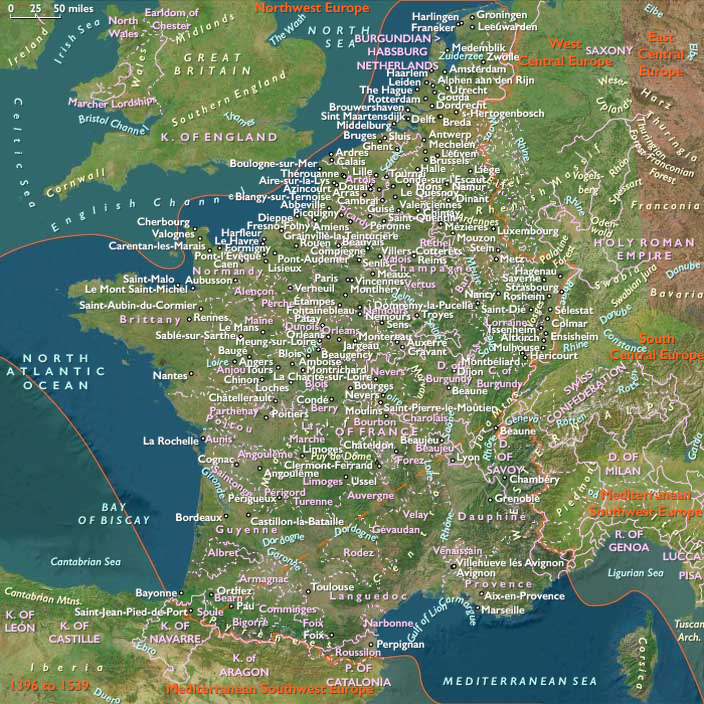
- In 1423, the French Dauphin Charles assembled an army at Bourges, preparing to invade Burgundian-held territory.
- The army contained a large Scottish contingent, commanded by Sir John Stewart of Darnley, who was given overall command of the combined force.
- The army also included:
- French troops, led by the Comte de Vendôme (second-in-command).
- Spanish (Aragonese) and Lombard mercenaries, supplementing the force.
- The Dauphinist army was numerically superior, outnumbering the Anglo-Burgundian force by two or three to one.
II. The Siege of Cravant and the Anglo-Burgundian Response
- The French-Scottish army laid siege to Cravant, a Burgundian-held town, aiming to secure a foothold in Burgundian territory.
- The garrison of Cravant, under siege, requested help from the Dowager Duchess of Burgundy, who raised troops and sought English assistance.
- The English, allied with the Burgundians, quickly responded, and the two armies united at Auxerre on July 29, 1423.
III. The Anglo-Burgundian War Council and Battle Preparations
- On July 29, 1423, the Anglo-Burgundian commanders gathered at Auxerre Cathedral to plan their strategy.
- Their order of battle was carefully structured, emphasizing:
- A dismounted battle formation, with horses sent to the rear.
- Archers prepared anti-cavalry stakes to counter French and Scottish charges.
- Strict discipline orders to prevent disorder during the engagement.
- That night, the army was ordered to pray for victory, and marching orders were set for the following morning at 10:00 AM.
IV. Forces on the Battlefield
1. The French-Scottish Army (Dauphinist Forces)
- Commander: Sir John Stewart of Darnley
- Second-in-command: Comte de Vendôme
- Composition:
- A majority of the force was Scottish.
- French troops formed a sizable portion.
- Aragonese and Lombard mercenaries provided additional reinforcements.
- Estimated Strength: Two to three times larger than the Anglo-Burgundian army.
2. The Anglo-Burgundian Army
- Composition:
- English troops, led by experienced commanders.
- Burgundian forces, supporting their English allies.
- Strategy:
- A tactically disciplined approach, emphasizing defensive positions and coordinated attacks.
V. Conclusion: The Battle is Set
With the Dauphinist forces numerically superior, yet the Anglo-Burgundians better organized, the stage was set for the Battle of Cravant, which would be one of the most decisive confrontations of 1423.
The outcome of the battle would determine whether the French-Scottish alliance could continue its resurgence against English occupation or whether Anglo-Burgundian forces would maintain dominance in northern France.
Locations
People
Groups
- Normandy, Duchy of
- Burgundy, Duchy of
- Scotland, Kingdom of
- France, (Valois) Kingdom of
- England, (Plantagenet, Lancastrian) Kingdom of
Topics
- Hundred Years' War
- Armagnac-Burgundian Civil War
- Hundred Years' War: Resumption of the war under Henry V
Commodoties
Subjects
Regions
Subregions
Related Events
Showing 10 events out of 111 total
Years: 1423 - 1423
Locations
People
Groups
- Normandy, Duchy of
- Burgundy, Duchy of
- Scotland, Kingdom of
- France, (Valois) Kingdom of
- England, (Plantagenet, Lancastrian) Kingdom of
Topics
- Hundred Years' War
- Armagnac-Burgundian Civil War
- Hundred Years' War: Resumption of the war under Henry V
Commodoties
Subjects
Regions
Subregions