
The Encyclopédie had originally been conceived as …
Years: 1749 - 1749
The Encyclopédie had originally been conceived as a French translation of Ephraim Chambers's Cyclopaedia (1728).
Ephraim Chambers had first published his Cyclopaedia, or an Universal Dictionary of Arts and Sciences in two volumes in London in 1728, following several dictionaries of arts and sciences that had emerged in Europe since the late seventeenth century.
This work has become quite renowned, and four editions had been published between 1738 and 1742.
An Italian translation appears between 1747 and 1754.
In France a member of the banking family Lambert had started translating Chambers into French, but in 1745 the expatriate Englishman John Mills and German Gottfried Sellius were the first to actually prepare a French edition of Ephraim Chambers's Cyclopaedia for publication, which they entitled Encyclopédie.
Early in 1745 a prospectus for the Encyclopédie had been published to attract subscribers to the project.
This four page prospectus was illustrated by Jean-Michel Papillon and accompanied by a plan stating that the work would be published in five volumes from June 1746 until the end of 1748.
The text was translated by Mills and Sellius, and it was corrected by an unnamed person, who appears to have been Denis Diderot.
The prospectus was reviewed quite positively and cited at some length in several journals.
The Mémoires pour l'histoire des sciences et des beaux arts journal was lavish in its praise: "voici deux des plus fortes entreprises de Littérature qu'on ait faites depuis long-tems" (here are two of the greatest efforts undertaken in literature in a very long time).
The Mercure Journal in June 1745, had printed a twenty-five-page article that specifically praised Mill's role as translator; the Journal introduced Mills as an English scholar who had been raised in France and who spoke both French and English as a native.
The Journal reported that Mills had discussed the work with several academics, was zealous about the project, had devoted his fortune to support this enterprise, and was the sole owner of the publishing privilege.
However, the cooperation fell apart later on in 1745.
André Le Breton, the publisher commissioned to manage the physical production and sales of the volumes, had cheated Mills out of the subscription money, claiming for example that Mills's knowledge of French was inadequate.
In a confrontation, Le Breton physically assaulted Mills.
Mills took Le Breton to court, but the court decided in Le Breton's favor.
Mills returned to England soon after the court's ruling.
For his new editor, Le Breton settled on the mathematician Jean Paul de Gua de Malves.
Among those hired by Malves were the young Étienne Bonnot de Condillac, Jean le Rond d'Alembert, and Denis Diderot.
Within thirteen months, in August 1747, Gua de Malves was fired for being an ineffective leader.
Le Breton then hired Diderot and d'Alembert to be the new editors.
Diderot will remain as editor funtil 1773, seeing the Encyclopédie through to its completion; d'Alembert will leave this role in 1758.
As d'Alembert works on the Encyclopédie, its title expands.
As of 1750, the full title is Encyclopédie, ou Dictionnaire raisonné des sciences, des arts et des métiers, par une société de gens de lettres, mis en ordre par M. Diderot de l'Académie des Sciences et Belles-Lettres de Prusse, et quant à la partie mathématique, par M. d'Alembert de l'Académie royale des Sciences de Paris, de celle de Prusse et de la Société royale de Londres. ("Encyclopedia: or a Systematic Dictionary of the Sciences, Arts, and Crafts, by a Company of Men of Letters, arranged by M. Diderot of the Academy of Sciences and Belles-lettres of Prussia: as to the Mathematical Portion, arranged by M. d'Alembert of the Royal Academy of Sciences of Paris, to the Academy of Sciences in Prussia and to the Royal Society of London.")
The title page will be amended as d'Alembert acquires more titles.
Ephraim Chambers had first published his Cyclopaedia, or an Universal Dictionary of Arts and Sciences in two volumes in London in 1728, following several dictionaries of arts and sciences that had emerged in Europe since the late seventeenth century.
This work has become quite renowned, and four editions had been published between 1738 and 1742.
An Italian translation appears between 1747 and 1754.
In France a member of the banking family Lambert had started translating Chambers into French, but in 1745 the expatriate Englishman John Mills and German Gottfried Sellius were the first to actually prepare a French edition of Ephraim Chambers's Cyclopaedia for publication, which they entitled Encyclopédie.
Early in 1745 a prospectus for the Encyclopédie had been published to attract subscribers to the project.
This four page prospectus was illustrated by Jean-Michel Papillon and accompanied by a plan stating that the work would be published in five volumes from June 1746 until the end of 1748.
The text was translated by Mills and Sellius, and it was corrected by an unnamed person, who appears to have been Denis Diderot.
The prospectus was reviewed quite positively and cited at some length in several journals.
The Mémoires pour l'histoire des sciences et des beaux arts journal was lavish in its praise: "voici deux des plus fortes entreprises de Littérature qu'on ait faites depuis long-tems" (here are two of the greatest efforts undertaken in literature in a very long time).
The Mercure Journal in June 1745, had printed a twenty-five-page article that specifically praised Mill's role as translator; the Journal introduced Mills as an English scholar who had been raised in France and who spoke both French and English as a native.
The Journal reported that Mills had discussed the work with several academics, was zealous about the project, had devoted his fortune to support this enterprise, and was the sole owner of the publishing privilege.
However, the cooperation fell apart later on in 1745.
André Le Breton, the publisher commissioned to manage the physical production and sales of the volumes, had cheated Mills out of the subscription money, claiming for example that Mills's knowledge of French was inadequate.
In a confrontation, Le Breton physically assaulted Mills.
Mills took Le Breton to court, but the court decided in Le Breton's favor.
Mills returned to England soon after the court's ruling.
For his new editor, Le Breton settled on the mathematician Jean Paul de Gua de Malves.
Among those hired by Malves were the young Étienne Bonnot de Condillac, Jean le Rond d'Alembert, and Denis Diderot.
Within thirteen months, in August 1747, Gua de Malves was fired for being an ineffective leader.
Le Breton then hired Diderot and d'Alembert to be the new editors.
Diderot will remain as editor funtil 1773, seeing the Encyclopédie through to its completion; d'Alembert will leave this role in 1758.
As d'Alembert works on the Encyclopédie, its title expands.
As of 1750, the full title is Encyclopédie, ou Dictionnaire raisonné des sciences, des arts et des métiers, par une société de gens de lettres, mis en ordre par M. Diderot de l'Académie des Sciences et Belles-Lettres de Prusse, et quant à la partie mathématique, par M. d'Alembert de l'Académie royale des Sciences de Paris, de celle de Prusse et de la Société royale de Londres. ("Encyclopedia: or a Systematic Dictionary of the Sciences, Arts, and Crafts, by a Company of Men of Letters, arranged by M. Diderot of the Academy of Sciences and Belles-lettres of Prussia: as to the Mathematical Portion, arranged by M. d'Alembert of the Royal Academy of Sciences of Paris, to the Academy of Sciences in Prussia and to the Royal Society of London.")
The title page will be amended as d'Alembert acquires more titles.
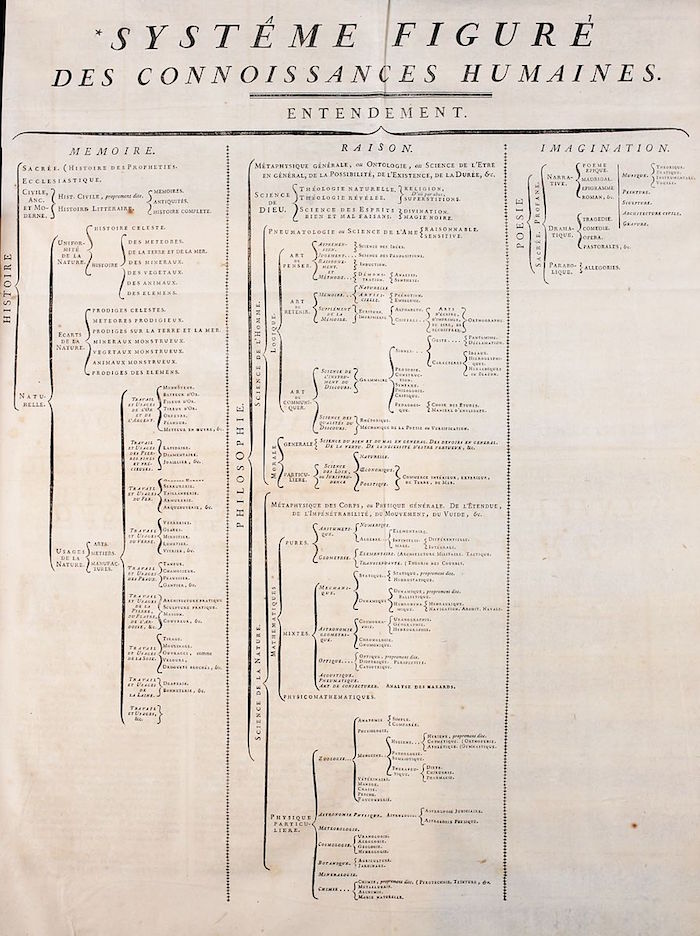
"Figurative System of organization of human knowledge" from the Encyclopédie.
Locations
People
Groups
Topics
Subjects
Regions
Subregions
Related Events
Showing 10 events out of 26995 total
Years: 1749 - 1749
"Figurative System of organization of human knowledge" from the Encyclopédie.
Locations
People
Groups
Topics
Subjects
Regions
Subregions