
Fra Bartolommeo, the foremost painter in Florence …
Years: 1517 - 1517
Fra Bartolommeo, the foremost painter in Florence after Leonardo da Vinci dies on October 31, 1517.
Andrea del Sarto, who, through his contact with Leonardo, Bartolommeo, Raphael's paintings, contemporary sculpture (especially that of Jacopo Sansovino, with whom he has collaborated), and the prints of Durer, has by now established a style characterized by greater use of sfumato and classical interests.
His popular “Madonna of the Harpies” altarpiece features the classical formal harmony, intense colors, and noble sweetness associated with Sarto’s mature work.
Considered his major contribution to High Renaissance art, it is a depiction of a dark-eyed Madonna and child on a pedestal, flanked by angels and two saints (Saint Bonaventure or Francis and John the Evangelist).
Originally completed in 1517 for the convent of San Francesco dei Macci, the altarpiece now resides in the Uffizi.
The figures have a Leonardo-like aura, with a pyramid shaped composition.
Leonardo’s unfortunate experiment with a new fresco technique in his great Last Supper, painted in the late 1490s for the refectory of the ducal church of Santa Maria delle Grazie, begins to show the first signs of decay in 1517.
For this work, Leonardo had sought a greater detail and luminosity than could be achieved with traditional fresco.
He painted The Last Supper on a dry wall rather than on wet plaster, so it is not a true fresco.
Because a fresco cannot be modified as the artist works, Leonardo instead chose to seal the stone wall with a double layer of dried plaster.
Then, borrowing from panel painting, he added an undercoat of white lead to enhance the brightness of the oil and tempera that was applied on top.
This was a method that had been described previously, by Cennino Cennini in the fourteenth century.
However, Cennini had recommended the use of secco for the final touches alone.
These techniques were important for Leonardo's desire to work slowly on the painting, giving him sufficient time to develop the gradual shading or chiaroscuro that was essential in his style.
Because the painting was on a thin exterior wall, the effects of humidity were felt more keenly, and the paint failed to properly adhere to the wall.
Because of the method used, soon after the painting was completed on February 9, 1498, it began to deteriorate.
As early as 1517, the painting was starting to flake.
Due to the methods used, and a variety of environmental factors, as well as intentional damage, very little of the original painting remains today, despite numerous restoration attempts, the last being completed in 1999.
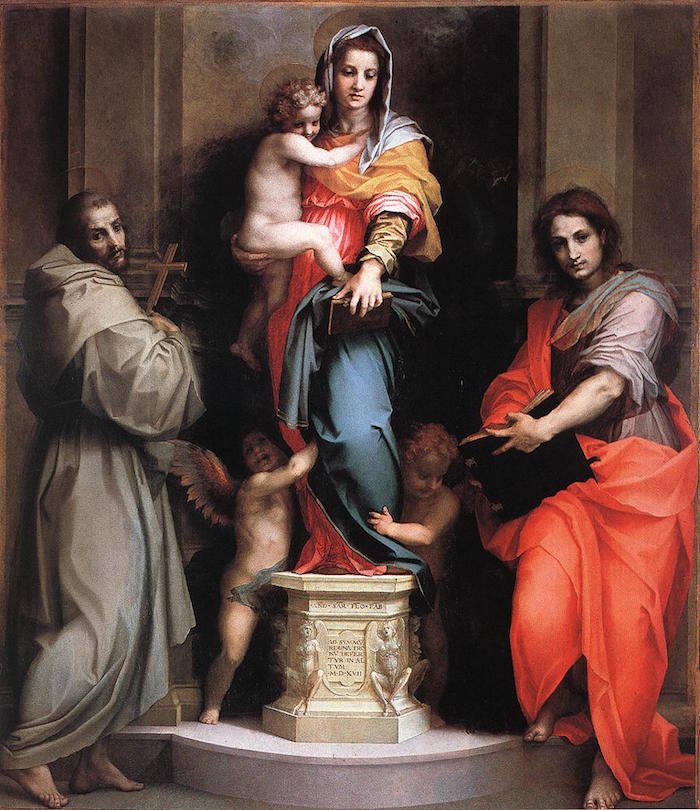
Andrea del Sarto: Madonna of the Harpies (1517); oil on panel, 208 cm (81.9 in). Width: 178 cm (70.1 in); Uffizi Gallery
Locations
People
Groups
Topics
Subjects
Regions
Subregions
Related Events
Showing 1 events out of 1 total
Years: 1517 - 1517
Andrea del Sarto: Madonna of the Harpies (1517); oil on panel, 208 cm (81.9 in). Width: 178 cm (70.1 in); Uffizi Gallery
Locations
People
Groups
Topics
Subjects
Regions
Subregions