Four principalities are meanwhile besieging the Qi …
Years: 154BCE - 154BCE
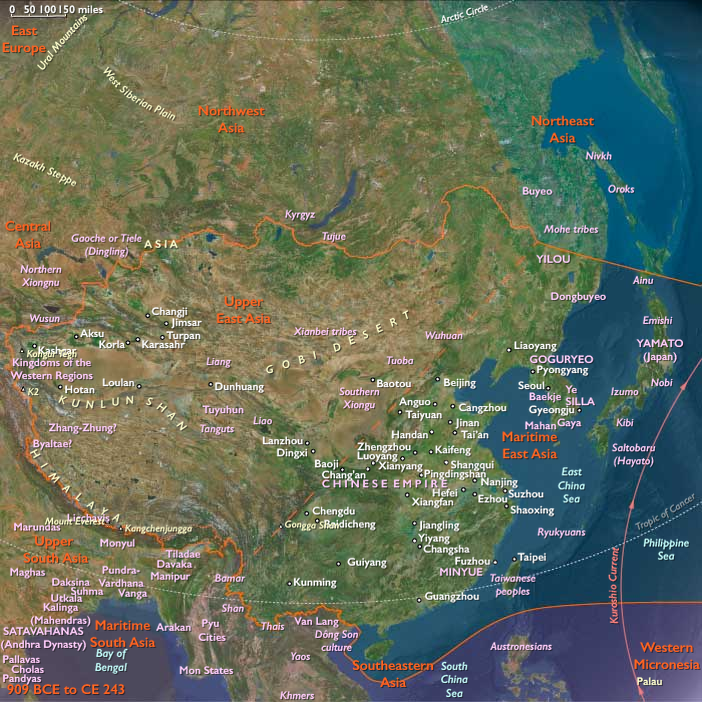
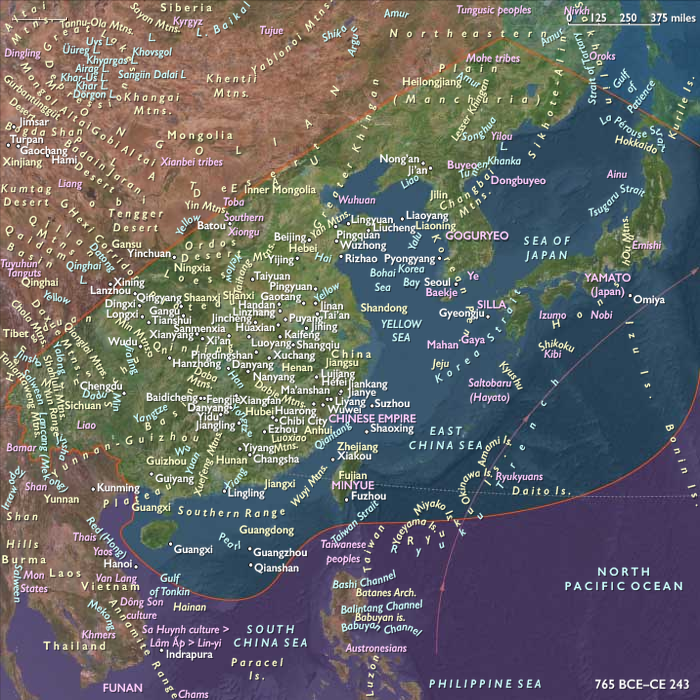
Four principalities are meanwhile besieging the Qi capital Linzi (in modern Zibo, Shandong).
Liu Jianglü, the Prince of Qi, considers surrendering, but his resolve to resist is strengthened when his messenger Lu, who had been captured by the four princes, tells him from under the walls of the capital to resist (even though he is under threat from the four princes to persuade Prince Jianglü to surrender).
Eventually, Luan Bu and Cao Qi, the Marquess of Pingyang, arrive and defeat the four principalities, but at the same time also discover that Qi had initially been part of the conspiracy.
Unable to explain himself, Prince Jianglü commits suicide, but Emperor Jing, with compassion for him, permits his son Liu Shou to inherit the principality.
Not so fortunate are the princes of the four rebelling principalities.
Locations
People
Groups
Topics
Subjects
Regions
Subregions
Related Events
Filter results
Showing 10 events out of 63184 total
Liu Bang—Emperor Gaozu of Han—had at the beginning of the Han dynasty created princely titles for many of his relatives in certain territories that accounted for between approximately one-third to one-half of the empire.
This had been an attempt to consolidate Liu family rule over the parts of China that were not ruled directly from the capital under the prefecture system.
These princes were still setting their own laws during the reign of Emperor Wen, but in addition they were minting their own coins (albeit with Emperor Wen's approval) and collecting their own taxes.
Many princes were effectively ignoring the imperial government's authority within their own principalities.
The rich principality of Wu was especially domineering hen Emperor Jing became emperor in 157 BCE.
Emperor Jing already had an inimical relationship with his cousin-once-removed Liu Pi, Prince of Wu, the nephew of his grandfather, Han founder Emperor Gaozu.
The principality of Wu enjoys abundant copper and salt supplies, among other natural resources.
Liu Pi's heir apparent, Lu Xian, had been on an official visit to the capital Chang'an when Emperor Jing was still Crown Prince Qi, and the two competed in a liubo board game.
During arguments over the game, Liu Xian had offended Crown Prince Qi, who threw the liubo board at him, which resulted in the death of the former.
Liu Pi hates Emperor Jing for causing the death of Lu Xian.
Emperor Jing's key advisor Chao Cuo had suggested that he cut down the sizes of the principalities to make them less threatening, using as excuses offenses that the princes had committed that had generally been ignored by Emperor Wen.
Chao had explicitly contemplated the possibility that Wu and other principalities might rebel, but had justified the action by asserting that if they were going to rebel, it would be better to let them rebel earlier than later when they might be more prepared.
Emperor Jing, in 154 BCE, thus orders the following punishments:
He carves out the prefecture of Donghai from the principality of Chu (modern northern Jiangsu and northern Anhui), based on Liu Wu, Prince of Chu, having had sexual relations during the mourning period for Empress Dowager Bo.
He carves out the prefecture of Changshan from the Principality of Zhao (modern central and southern Hebei), based on an unspecified offense.
He carves out six counties from the principality of Jiaoxi (roughly modern Weifang, Shandong), based on Liu Ang, the Prince of Jiaoxi, embezzling funds from the sales of titles intended for paying border patrol costs.
He carves out the prefectures of Huiji and Yuzhang from the Principality of Wu, based on various offenses by Liu Pi, the Prince of Wu.
In response to these actions, Liu Pi organizes a rebellion.
The seven actively participating princes are Liu Pi, Prince of Wu; Liu Wu, Prince of Chu; Liu Ang, Prince of Jiaoxi; Liu Xiongqu, Prince of Jiaodong (roughly modern Qingdao, Shandong); Liu Xian, Prince of Zichuan (roughly part of modern Weifang, Shandong); Liu Piguang, Prince of Jinan (roughly modern Jinan, Shandong); and Liu Sui, Prince of Zhao.
Two other principalities agree to join—Qi (modern central Shandong) and Jibei (modern northwestern Shandong)—but neither actually do.
Liu Jianglü, Prince of Qi, changes his mind at the final moment and chooses to resist the rebel forces; Liu Zhi, Prince of Jibei, is put under house arrest by the commander of his guards and prevented from joining the rebellion.
Three other princes—Liu An, Prince of Huainan (roughly modern Lu'an, Anhui); Liu Ci, Prince of Lujiang (roughly modern Chaohu, Anhui); and Liu Bo, Prince of Hengshan (roughly part of modern Lu'an, Anhui), are persuaded to join but either later refuse or merely do not join.
The seven princes also request help from the southern independent kingdoms of Donghai (modern Zhejiang) and Minyue (modern Fujian), and the powerful Northern Xiongnu.
Donghai and Minyue send troops to participate in the campaign, but the Northern Xiongnu, after initially promising to do so, do not.
The seven princes claim that Chao Cuo is aiming to wipe out the principalities and that they will be satisfied if Chao is executed.

The four principalities on the periphery of Qi aim to conquer Qi and divide it.
Zhao forces head west but stay within the borders to wait for Wu and Chu forces, which are considered the main force in the rebellion.
Liu Pi, the Prince of Wu, has several strategies suggested to him that he considers: A suggestion by Tian Lubo to have two main forces—one to be led by Liu Pi himself, attacking the Principality of Liang (modern eastern Henan), and one to be led by Tian that would head west by the Yangtze River and the Han River to make a surprise attack directly on the capital Chang'an.
A suggestion by a General Huan to ignore all cities on the way and leapfrog to attack Luoyang and seize the plentiful food and weapons supply near Luoyang.
A suggestion (probably by Liu Pi's heir apparent Liu Ju) to concentrate the forces to attack Liang and destroy it first.
Liu Pi accepts the final suggestion, concerned that if he gives Tian a large force he might rebel, and that Huan's plan is too dangerous.
Wu and Chu forces therefore concentrate against Liang, against Emperor Jing's younger brother Liu Wu, the prince of Liang, whose forces initially suffer devastating defeats, forcing Liu Wu to withdraw to his capital of Suiyang (present-day Shangqiu in Henan), which the Wu and Chu forces then proceed to besiege.
Emperor Jing, in accordance with instructions left by Emperor Wen, commissions Zhou Yafu as the commander of his armed forces to face the main rebel force—the joint forces of Wu and Chu.
He commissions Li Ji, the Marquess of Quzhou, to attack Zhao, and General Luan Bu to try to relieve the siege of Qi.
Dou Ying is put in command of Li and Luan's forces, to coordinate them at his headquarters set at Yingyang (in modern Zhengzhou, Henan).
However, Emperor Jing soon panics at the prospect of losing, and at the suggestion of Chao Cuo's enemy Yuan Ang, he executes Chao to try to appease the seven princes.
Chao's immediate family is also executed. (Chao's father, who had seen the likelihood of this happening, had committed suicide a few months earlier.)
Emperor Jing sends Yuan and Liu Pi's nephew Liu Tong, the minister for imperial clan affairs, to try to persuade Liu Pi to end the rebellion.
Liu Pi, whose claim that he was only seeking Chao's execution had been mere propaganda, does not call off the rebellion but instead imprisons Liu Tong and Yuan. (He tells Liu Tong and Yuan that his actual aim is to be the "Eastern Emperor.")
Yuan is, however, able to escape soon after.
Wu and Chu forces continue their fierce attack on Liang's capital Suiyang.
Zhou Yafu suggests to Emperor Jing that the proper strategy is not to engage Wu and Chu forces head on because, in particular, Chu forces are known for their ferocity and excellent mobility.
Rather, his plan is to let Liang take the brunt of the attack, bypass Liang, and cut off the Wu and Chu supply lines to starve the rebel forces.
Emperor Jing agrees, and Zhou sets out from the capital Chang'an to join his main forces, already gathered at Yingyang.
Wu and Chu prepare assassins on the way between Chang'an and Yingyang to assassinate Zhou, but Zhou, having been warned by the soldier Zhao She, goes by a circuitous route and avoided the assassins.
After taking command of his forces, Zhou heads toward Changyi (in modern Jining, Shandong) to prepare to cut off the Wu and Chu supply routes.
At this time Liang appears to be in great danger, and Prince Liu Wu sends a series of messengers to seek immediate assistance from Zhou, which Zhou ignores.
Emperor Jing, concerned for his brother, orders Zhou to head to Liang immediately to save it.
Zhou refuses, and instead sends a cavalry force to cut off the Wu and Chu supply lines.
The strategy is effective.
Wu and Chu, unable to capture Liang quickly due to the strong defense put up by the prince's generals Han Anguo and Zhang Yu, head northeast to attack Zhou.
Zhou refuses to engage in a direct battle with Wu and Chu forces, but rather concentrates on defending his camp.
After failing to gain a decisive victory over Zhou, the Wu and Chu forces begin to suffer from starvation and collapse.
Liu Pi flees to the court of Donghai, which kills him and seeks peace with Han.
Liu Wu, the prince of Chu, commits suicide.
The Wu forces engage in only one other theater, a small one.
Liu Pi's guest Zhou Qiu is looked down on by Liu Pi, but he, with Liu Pi's approval, has some successes with a surprising plan he hatches.
He heads to his home town Xiapei (in modern Xuzhou, Jiangsu) and, under the guise of being an imperial messenger, has the county magistrate killed and takes over the county's militia.
He then persuades the people of the county to join the rebellion, and they head north and have victories over the forces of the Principality of Chengyang (modern southeastern Shandong).
However, after hearing that Liu Pi has been defeated, Zhou is so taken by anxiety that he dies.
Han Tuidang, the Marquess of Gonggao, writes a letter to Liu Ang, the Prince of Jiaoxi, threatening him with utter destruction if he does not surrender.
Prince Ang does so and is allowed to commit suicide.
The other three princes are captured and executed.
The four principalities are seized by the central government.
The final principality to be destroyed is Zhao.
While Li Ji had initially been unable to prevail in besieging the Zhao capital of Handan (modern Handan, Hebei), Zhao's hopes are virtually lost when Xiongnu forces, realizing Zhao is about to be defeated, choose not to join in the battle.
When Luan returns from Qi he attacks Handan with Li and ias able to capture it by breaking a levee to flood the walls of Handan.
Liu Sui, the Prince of Zhao, commits suicide.
Liu Zhi, the Prince of Jibei, who initially wished to join the rebellion, does not share their fate.
His official Gongsun Huo is able to persuade Liu Wu, the prince of Liang, that Liu Zhi had only pretended to join the rebellion and had in fact contributed to the rebellion's defeat.
With Liu Wu's intercession, Prince Zhi is spared and he is instead given the Principality of Zaichuan.
The rebellion, initially ferocious, had lasted only three months.
Had the seven princes prevailed in this conflict, in all likelihood the Han Dynasty would have collapsed into a loose confederation of states.
Emperor Gaozu had invested the Liu princes with independent military powers with an eye to having them protect the dynasty from outside, but their refusal to follow the imperial government's laws and orders was already creating problems by the time of Emperor Jing.
In the aftermath of the rebellion, while the principality system will be maintained, the powers of the princes will be gradually reduced and the sizes of the principalities reduced as well, under Emperor Jing and his son Emperor Wu.
With the longevity of the Han Dynasty evolves the Chinese mindset of it being normal to have a unified empire rather than divided states.
Prusias had joined with the King of Pergamon, Eumenes II, in a war against King Pharnaces I of Pontus from 181–179 BCE.
He later invaded the territories of Pergamon, now ruled by Attalus II, in 156, only to be defeated in 154.
The Pergamenes insist on heavy reparations.
Mithridates IV of Pontus is first mentioned in 179 BCE in association with Pharnaces I in a treaty concluded by the latter King of Pergamon, Eumenes II, in a manner that would lead one to suppose he was already admitted to some share in sovereign power.
The date of Mithridates’ accession to the Pontian throne is utterly mysterious, since we first hear of him as ruler in 154 BCE, when he is mentioned as sending an auxiliary force to the assistance of King of Pergamon, Attalus II Philadelphus, against the King of Bithynia, Prusias II.
This moment is an important event, since it signals the start of a policy of friendship of the Kingdom of Pontus with the Roman Republic and her allies that is to continue until the time of Mithridates VI Eupator.
Orophernes' business affairs are on the decline.
Fearing that his soldiers might mutiny over unpaid wages, he plunders an ancient temple of Zeus to pay them off.
Orophernes is forced at the end to return to Syria, where he enters into a conspiracy with the people of Antioch to dethrone Demetrius.
Demetrius throws Orophernes into chains, but spares his life that he might still keep Ariarathes in alarm with his pretensions.
Euergetes, not content with Cyrenaica alone, has journeyed to Rome twice to ask for Cyprus also.
In 155, he had taken the step of bequeathing the kingdom of Cyrene to the Romans in the event of his premature death.
The Senate finally decides to grant the brother's request; Philometor, however, delays the Romans by clever diplomacy and in 154 defeats his brother, who had attempted to seize Cyprus by force.
Nevertheless, Philometor restores his brother to Cyrenaica, marries a daughter to him, and grants him a grain subsidy.
The Roman statesman Cato the Elder, deploring the continuous intrigues, praises Ptolemy VI as a good and beneficent ruler.
At last, Philometor's Hellenistic Egyptian kingdom becomes relatively secure.