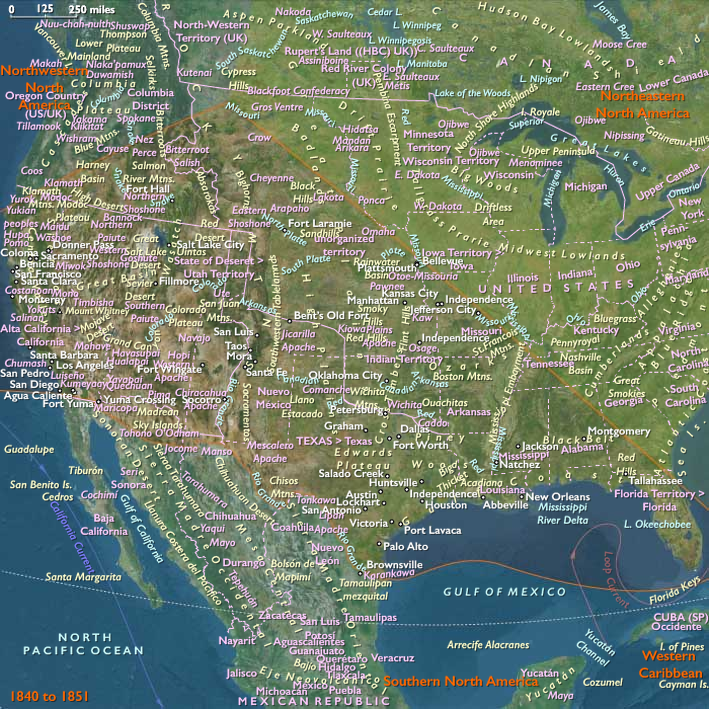
The Crows trade at Fort Alexander opposite …
Years: 1842 - 1851
The Crows trade at Fort Alexander opposite the mouth of the Rosebud from 1842 to around 1852.
Locations
Groups
Subjects
Regions
Subregions
Related Events
Filter results
Showing 10 events out of 17408 total
Abel Aubert Dupetit-Thouars, made Rear-Admiral (French: Contre-amiral) on July 12 ,1841, in charge of the Pacific Naval Division, had been ordered to take possession of the Marquesas Islands.
In Tahiti, he had confronted Queen Pōmare IV, and the English missionary and Consul George Pritchard (1796–1883).
He has managed to expel Pritchard and establish a French protectorate over Tahiti and the Marguesas Islands, which continues as of 2018.
He will be initially denounced for his actions by the French government, which fears a conflict with Great Britain.
Relations between France and Great Britain will sour considerably during the reign of Louis-Philippe, due to this so-called "Pritchard Affair".
Shedra meaning "place of teaching" but specifically refers to the educational program in Tibetan Buddhist monasteries and nunneries.
The Tenpō Reforms, an array of economic policies introduced in 1842 by the Tokugawa Shogunate in Japan, are efforts to resolve perceived problems in the nation’s military, economic, agricultural, financial and religious systems.
The changes are intended to address problems in local politics, but they are also addressed more broadly to "domestic unease."
The perceived need for change leads to the arrest of many prominent political figures and writers.
The reforms become a precursor of reforms that will be initiated after the Meiji Restoration two decades later.
New coinage is issued and commodity price controls are lifted.
Immigration to Edo is prohibited and the formation of societies is also banned.
Rangaku (”Dutch Learning”) is banned.
An annual calendar (nenchuu gyouji) is set up during this period to bring order to Japanese society.
Families are required to register themselves at the nearest Shinto shrine annually on the 16th of the first and seventh months.
A Shinto festival (muramura jingi), meeting (jingi kasihuu) or pilgrimage (muramura kamimoude) is scheduled once a month.
The popular Obon festival is rewritten as Sensosai, the Ancestor Festival, and is to be held twice a year.
Buddhism is written out of this religious calendar; the government revokes its support for existing Buddhist institutions.

China is forced to cede Hong Kong to Britain in 1842.
Britain is also granted extraterritoriality.
Other Western Powers, such as France and the United States, will soon extract similar privileges from China.
Under the 1842 Treaty of Nanjing that ends the Opium War, five Chinese ports—Guangzhou (Canton), ...
Steen Steensen Blicher publishes what will soon become his most celebrated prose work, an amalgam of tales entitled The Knitting Room, written in Denmark's Jutland dialect and full of verse and anecdotes, in 1842.
Until the 1830s, orchestral performance in Vienna was done by ad hoc orchestras, consisting of professional and (often) amateur musicians brought together for specific performances.
In 1833, Franz Lachner formed the forerunner of the Vienna Philharmonic, the Künstlerverein—an orchestra of professional musicians from the Vienna Court Opera (Wiener Hofoper, now the Vienna State Opera); it gave four concerts, each including a Beethoven symphony.
The Vienna Philharmonic itself arises nine years later, hatched by a group who meet regularly at the inn 'Zum Amor', including the poet Nikolaus Lenau, newspaper editor August Schmidt, critic Alfred Becker, violinist Karlz Holz, Count Laurecin, and composer Otto Nicolai who was also the principal conductor of a standing orchestra at a Viennese theater.
Mosco Carner will write in The New Grove Dictionary of Music and Musicians that "Nicolai was the least enthusiastic about the idea, and had to be persuaded by the others; he conducted the first [concert] on 28 March 1842."
The orchestra is fully independent, consists of members of the Hofoper orchestra, and makes all of its decisions by a democratic vote of its members; it has its day-to-day management handled by a democratically elected body, the administrative committee.
His last large orchestral work, it forms an important part of the violin repertoire and is one of the most popular and most frequently performed violin concertos in history.
A typical performance lasts just under half an hour.
Mendelssohn had originally proposed the idea of the violin concerto to David, a close friend and then concertmaster of the Leipzig Gewandhaus Orchestra.
Although conceived in 1838, the work had taken another six years to complete until 1845.
During this time, Mendelssohn had maintained a regular correspondence with David, who had gave him many suggestions.
The work itself is one of the foremost violin concertos of the Romantic era and will influence many other composers.
The Amistad mutineers return home to Sierra Leone, arriving at Freetown in January 1842, along with five missionaries and teachers who intend to establish a Christian mission.