
Fort King is reopened. Former secretary of …
Years: 1835 - 1835
March
Fort King is reopened.
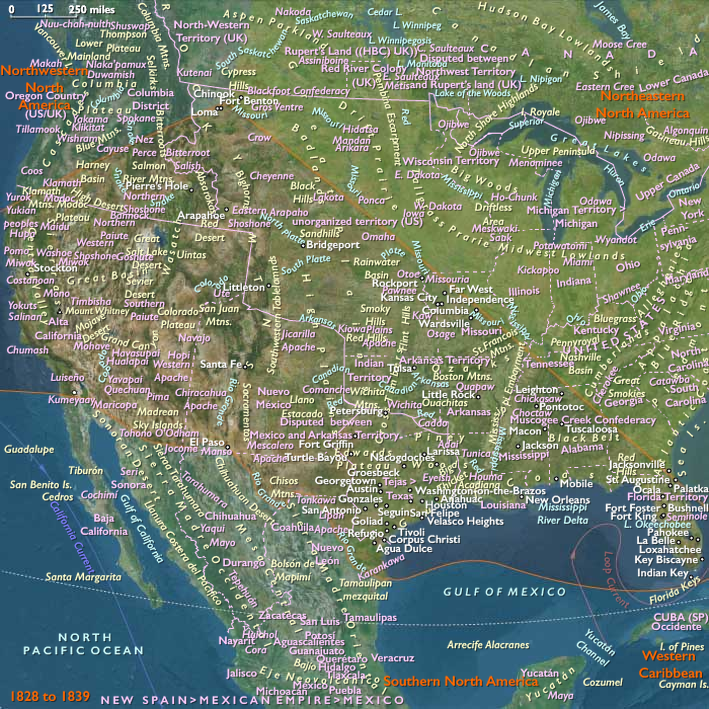
Former secretary of war John Eaton had been appointed governor of the Territory of Florida in 1834, and in April of that year, the United States Senate had finally ratified the Treaty of Payne's Landing, which had given the Seminoles three years to move west of the Mississippi.
The government interprets the three years as starting in 1832 and expects the Seminoles to move in 1835.
Locations
People
Groups
- Seminole (Amerind tribe)
- United States of America (US, USA) (Washington DC)
- Florida, Territory of (U.S.A.)
- Indian Territory
Topics
- Party System, Second (United States)
- Jacksonian Democracy (United States)
- Indian Removal (United States)
- Seminole War, Second
Commodoties
Subjects
Regions
Subregions
Related Events
Filter results
Showing 10 events out of 18580 total
The area that is now central and northern Melbourne is explored in May and June 1835 by John Batman, a leading member of the Port Phillip Association in Van Diemen's Land (now known as Tasmania), who claims to have negotiated a purchase of six hundred thousand acres (2twenty-four hundred square kilometers) with eight Wurundjeri elders.
Batman selects a site on the northern bank of the Yarra River, declaring that "this will be the place for a village".
Batman then returns to Launceston in Tasmania.
In early August 1835 a different group of settlers, including John Pascoe Fawkner, leaves Launceston on the ship Enterprize.
Fawkner is forced to disembark at Georgetown, Tasmania, because of outstanding debts.
The remainder of the party continues and arrives at the mouth of the Yarra River on August 15, 1835.
On August 30, 1835, the party disembarks and established a settlement at the site of the current Melbourne Immigration Museum.
Batman and his group arrive on September 2, 1835, and the two groups ultimately agree to share the settlement.
Initially the settlement has the native name Dootigala.
Batman's Treaty with the Aborigines is annulled by the New South Wales governor (who at this time governed all of eastern mainland Australia), with compensation paid to members of the association.
Nikolai Gogol has attempted an acting career, worked in a government office while studying painting, and taught in a girls' boarding school since his return to St. Petersburg,
Drawing from the rich folklore of the Ukraine, its Cossack traditions, and the parochial life-style of its people, he had won his first literary success with the two-volume story collection Evenings on a Farm near Dikanka, published in 1831 and 1832.
Having spent 1834 teaching medieval history at the University of Saint Petersburg, Gogol publishes additional Ukrainian tales in 1835 under the title Mirgorod.
The same year, he publishes Arabesques, featuring the stories "The Portrait" and "Nevsky Prospect".
Bernhard Severin Ingemann, inspired by Sir Walter Scott's Waverley novels, Ingemann produced his series of Danish historical romances, by virtue of which he disputes with Hans Christian Andersen the title of the children's writer of Denmark.
Their subjects are all taken from Danish history.
The first, and perhaps the best, is Valdemar Seir (Valdemar the Victorious, 1826), which had been followed by Erik Menveds Bamdom (Erik Menved's Childhood, 1828); Kong Erik og de Fredløse (King Erik and the Outlaws, 1833); and Prins Otto af Danmark og Hans Samtid (Prince Otto of Denmark and his Time, 1835).
While his historical romances show a lack of accuracy, their strong nationality gives them a special interest to the student of Danish culture: Ingemann can be said to have introduced the historical novel in Danish literature.
A vicar’s son, he had been left fatherless in his youth.
While a student at the University of Copenhagen, he had published his first collection of poems (1811; vol. ii, 1812), which show great influence of German romanticism.
Critics describe their sickly sentimentality as reflecting the unhealthy condition of the poet's body and mind at this time.
These works had been followed by a long allegorical poem, De sorte Riddere (The Black Knights, 1814); then followed by six plays, of which the best is considered to be Reinald Underbamet (The Miraculous Child Reinald, 1816), and the most popular, Blanca, (1815).
In 1817 he had published his first prose work, De Underjordiske, et bornholmsk Eventyr (The Subterranean Ones, a Story of Bornholm), followed in 1820 by Eventyr og Fortœllinger (Narratives and Miraculous Tales), many of them imitations of Hoffmann.
During 1818-19, he had traveled on the Continent, and in 1822 had been appointed instructor of the Danish Language and Literature at the Academy of Sorø.
Bernhard Severin Ingemann, inspired by Sir Walter Scott's Waverley novels, Ingemann produced his series of Danish historical romances, by virtue of which he disputes with Hand Christian Andersen the title of the children's writer of Denmark.
Their subjects are all taken from Danish history.
The first, and perhaps the best, is Valdemar Seir (Valdemar the Victorious, 1826), which had been followed by Erik Menveds Bamdom (Erik Menved's Childhood, 1828); Kong Erik og de Fredløse (King Erik and the Outlaws, 1833); and Prins Otto af Danmark og Hans Samtid (Prince Otto of Denmark and his Time, 1835).
While his historical romances show a lack of accuracy, their strong nationality gives them a special interest to the student of Danish culture: Ingemann can be said to have introduced the historical novel in Danish literature.
A vicar’s son, he had been left fatherless in his youth.
While a student at the University of Copenhagen, he had published his first collection of poems (1811; vol. ii, 1812), which show great influence of German romanticism.
Critics describe their sickly sentimentality as reflecting the unhealthy condition of the poet's body and mind at this time.
These works had been followed by a long allegorical poem, De sorte Riddere (The Black Knights, 1814); then followed by six plays, of which the best is considered to be Reinald Underbamet (The Miraculous Child Reinald, 1816), and the most popular, Blanca, (1815).
In 1817 he had published his first prose work, De Underjordiske, et bornholmsk Eventyr (The Subterranean Ones, a Story of Bornholm), followed in 1820 by Eventyr og Fortœllinger (Narratives and Miraculous Tales), many of them imitations of Hoffmann.
During 1818-19, he had traveled on the Continent, and in 1822 had been appointed instructor of the Danish Language and Literature at the Academy of Sorø.
The first installment of sixty-one unbound pages is published May 8, 1835, and contains "The Tinderbox", "Little Claus and Big Claus", "The Princess and the Pea" and "Little Ida's Flowers".
The first three tales are based on folktales Andersen had heard in his childhood while the last tale is completely Andersen's invention and created for Ida Thiele, the daughter of Andersen's early benefactor, the folklorist Just Matthias Thiele.
Reitzel paid Andersen thirty rixdollars for the manuscript, and the booklet is priced at twenty-four shillings.
The second booklet is published on December 16, 1835, and contains "Thumbelina", "The Naughty Boy" and "The Traveling Companion".
"Thumbelina" is completely Andersen's invention, though inspired by "Tom Thumb" and other stories of miniature people
"The Naughty Boy" is based on a poem by Anacreon about Cupid, and "The Traveling Companion" is a ghost story with which Andersen had experimented in 1830.
Moldavia and ...
...Wallachia enter a period of self-government after Russia's withdrawal in 1834, during which Russia guarantees the privileges that the Ottomans had granted.
The principalities' economic condition is bleak during this period, in which a traveler to Wallachia in 1835 can report seeing no manor houses, bridges, windmills, or inns, and no furniture or utensils in peasant huts.
The powerful navy of the Sultan of Muscat had enabled the creation of a short-lived empire, encompassing modern Oman, the United Arab Emirates, southern Baluchistan, and Zanzibar and the adjacent coasts of Kenya, Tanzania and Mozambique.
The Sultanate also engages in a very lucrative slave trade across east Africa. (A recent claim by an Omani minister suggests that the Sultanate controlled the distant Mascarene Islands as early as the fifteenth century.)
The fifth Sultan of the Al Said line of rulers, Said Said bin Sultan Al-Said, who will be remembered as the greatest 19th century sultan of Oman, has consolidated the Sultanate's territorial holdings and economic interests and Oman has prospered.
However, the Omani fleet is unable to compete with the more technically advanced European fleets and by the mid 1820s, the Sultanate had lost much of the trade with India and most of its territories in the Persian Gulf.
Said, shifting his focus to coastal East Africa, had established a treaty of friendship with the United States in 1833, while also strengthening his ties with Great Britain.
The territory of the group of tribally-organized Arabian Peninsula sheikhdoms along the southern coast of the Persian Gulf and the northwestern coast of the Gulf of Oman has become known as the Pirate Coast, as raiders based there harass foreign shipping, although both European and Arab navies have patrolled the area from the seventeenth century into the nineteenth century.
Early British expeditions to protect the India trade from raiders at Ras al-Khaimah had led to campaigns against that headquarters and other harbors along the coast in 1819.
The next year, a general peace treaty had been signed to which all the principal shaikhs of the coast adhered.
An attempt by the Al Qasimi tribe to take over Dubai had been thwarted.
In 1833, the Al Maktoum dynasty of the Bani Yas tribe had left the settlement of Abu Dhabi and taken over the town of Dubai, "without resistance".
From this point forward, Dubai, an independent emirate from 1799, will be constantly at odds with the emirate of Abu Dhabi.
Mohammad Mirza, heir to the Qajarid throne, is the son of Abbas Mirza, the crown prince and governor of Azerbaijan, who in turn is the son of Fat′h Ali Shah Qajar, the second Shah of the dynasty.
At first, Abbas Mirza had been the chosen heir to the Shah.
However, after he died, the Shah had chosen Mohammad to be his heir.
After the Shah's death, Ali Mirza, one of his many sons, had tried to take the throne in opposition to Mohammad.
After a rule of about forty days, he had been quickly deposed at the hands of Mirza Abolghasem Ghaem Magham Farahani, a politician, scientist, and poet.
Ali is forgiven by Mohammad, who now becomes king of Persia.
Farahani had been awarded the position of prime minister by Mohammad at the time of his inauguration but in 1835 is betrayed and executed by the order of Shah at the instigation of Haji Mirza Aqasi, who becomes the Ghaem Magham's successor and who is to greatly influence the Shah's policies.
One of his wives, Malek Jahan Khanom, Mahd-e Olia, is later to become a large influence on his successor, who is their son.
Years: 1835 - 1835
March
Locations
People
Groups
- Seminole (Amerind tribe)
- United States of America (US, USA) (Washington DC)
- Florida, Territory of (U.S.A.)
- Indian Territory
Topics
- Party System, Second (United States)
- Jacksonian Democracy (United States)
- Indian Removal (United States)
- Seminole War, Second
