
The independence and freedom of the Eidgenossen …
Years: 1495 - 1495
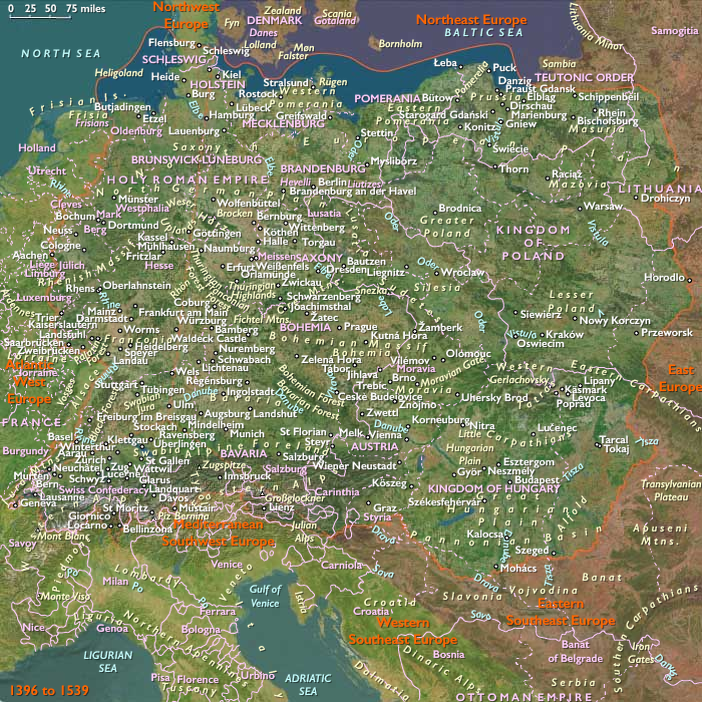
The independence and freedom of the Eidgenossen is a powerful and attractive role model for the common people in Swabia.
Many a baron in southern Swabia fears that his own subjects might revolt and seek adherence to the Swiss Confederacy.
These fears are not entirely without foundation: the Swiss had begun to form alliances north of the Rhine river, concluding a first treaty with Schaffhausen in 1454 and then also treaties with cities as far away as Rottweil in 1463 and Mulhouse in 1466.
The city of Constance and its bishop are caught in the middle between these two blocks: they hold possessions in Swabia, but the city also still exercises the high justice over the Thurgau, where the Swiss had assumed the low justice since the annexation in 1460.
The foundation of the Swabian League had prompted the Swiss city states of Zürich and Bern to propose accepting Constance into the Swiss Confederacy.
The negotiations had failed, though, due to the opposition of the founding cantons of the Confederacy and Uri in particular.
The split jurisdiction over the Thurgau has been the cause of many quarrels between the city and the Confederacy.
In 1495, one such disagreement is answered by a punitive expedition of soldiers of Uri and the city has to pay the sum of three thousand guilders to make them retreat and cease their plundering. (The Thurgau is a condominium of the Swiss Confederacy, and Uri is one of the cantons involved in its administration.)
Locations
People
Groups
- Constance, Bishopric of
- Swiss Confederacy, Old (Swiss Confederation)
- Uri, Swiss Canton of
- Bern, Swiss Canton of
- Zürich, Swiss Canton of
- Holy Roman Empire
- Swabian League
Topics
Subjects
Regions
Subregions

Years: 1495 - 1495
Locations
People
Groups
- Constance, Bishopric of
- Swiss Confederacy, Old (Swiss Confederation)
- Uri, Swiss Canton of
- Bern, Swiss Canton of
- Zürich, Swiss Canton of
- Holy Roman Empire
- Swabian League
Topics
Subjects
Regions
Subregions