Emperor Nero, unhappy with the growing Parthian …
Years: 57 - 57
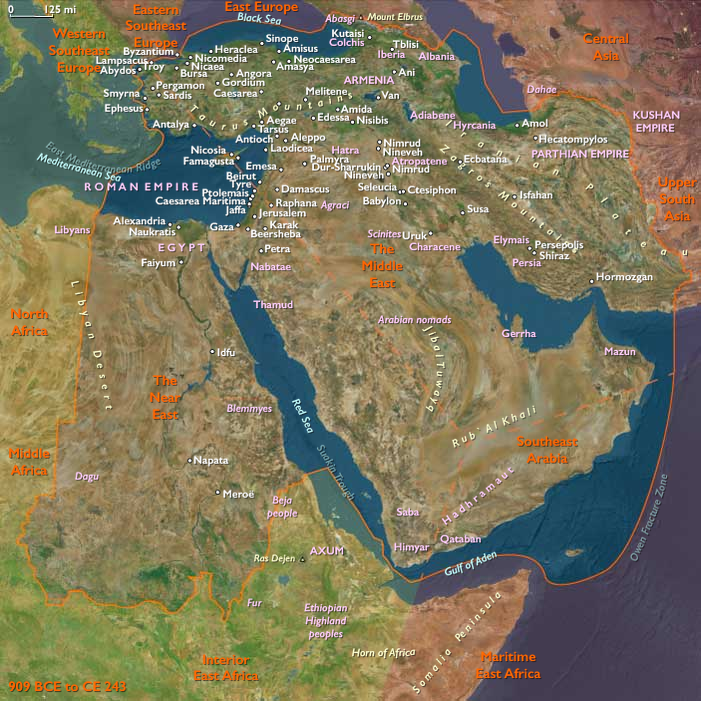
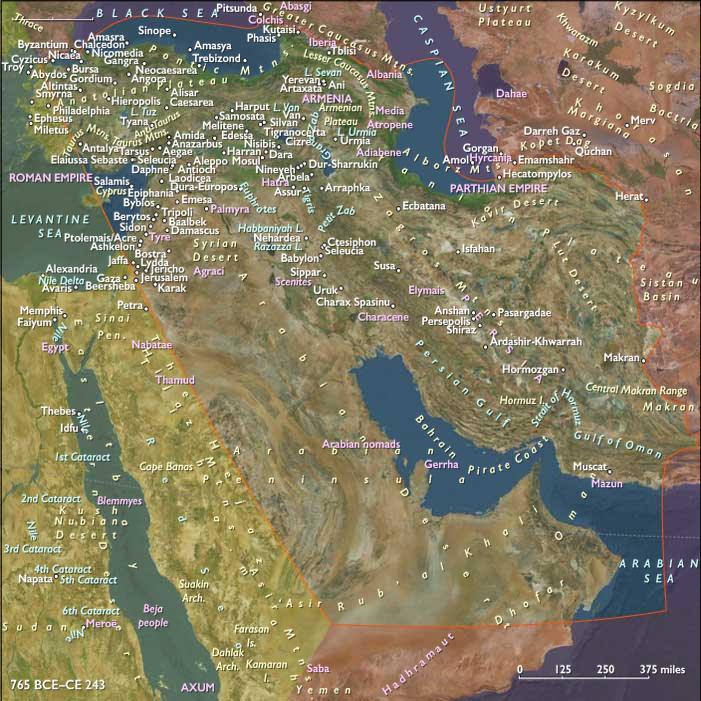
Emperor Nero, unhappy with the growing Parthian influence at the Roman’s doorstep in the East following Vologases’ installation of his brother, Tiridates, on the Armenian throne, directs Corbulo, his general in Asia Minor, to install another puppet king.
A Hasmonean named Aristobulus had already been given Lesser Armenia (Nicopolis and Satala) and Sohaemus of Emesa had in 54 received Armenia Sophene.
Locations
People
Groups
- Iranian peoples
- Armenian people
- Parthian Empire
- Armenia, Kingdom of Greater
- Roman Empire (Rome): Julio-Claudian dynasty
Topics
Commodoties
Subjects
Regions
Subregions
Related Events
Filter results
Showing 10 events out of 61713 total
Crown Prince Zhuang, as heir apparent to the Chinese imperial throne, is often requested by Emperor Guangwu to render opinions in important matters.
In 51, he had been involved in making a major decision in the Han dynasty's relationship with the Xiongnu.
By that point, Xiongnu had had a civil war and divided into two—with the Northern Xiongnu ruled by Chanyu Punu and South Xiongnu ruled by Chanyu Bi.
Han had become allied with the Southern Xiongnu, and in response, Chanyu Punu, also wanting peace with Han, requested a heqin marriage (literally "peace marriage").
During the Western Han dynasty between 200 and 140 BCE, there had been ten instances of such marriage alliances during between Han “princesses” (one actually was an Imperial princess) and Xiongnu chieftains.
In the closing decade of the second century BCE, Emperor Wu of Ha had arranged the marriage of two Han princesses to kings of Wusun; in 31 BCE, Emperor Yuan of Han had married Wang Zhaojun, a lady of the imperial harem, to Xiongnu chieftain Huhanye.
Prince Zhuang had suggested that Emperor Guangwu refuse the proposal, reasoning that the Northern Xiongnu had only made the proposal to alienate the Southern Xiongnu from Han.
Emperor Guangwu agrees.
At the death of Emperor Guangwu in 57, Crown Prince Zhuang ascends the throne as Emperor Ming.
Paul’s Epistle to the Philippians, written probably while he is imprisoned in Ephesos in 56—57 (or, as some scholars believe, while imprisoned in Rome in the early 60s), promotes a theology of self-emptying love as an antidote to partisanship and a response to adversity, and reveals much about the sharing of missionary work between Paul and the congregations he serves.
In the generally joyful Phillippians, a probable composite of three letters, Paul, in the first letter, thanks the Philippians, with whom he has good relations, for a gift they send him; in the second, he delivers a hopeful report of his legal situation and encourages them to Christian living; in a third, he attacks a Judaizing gnostic group attempting to mislead the Philippians.
Paul makes an eloquent appeal on behalf of a runaway slave, Onesimus, whom he has converted to Christianity, in his Epistle to Philemon, possibly written during his Ephesian imprisonment or during his Roman imprisonment five years later.
He displays in the letter the depth of his Christian humaneness by asking Philemon—a wealthy Christian of Colossae whom he has also converted—for Onesimus's quiet return to his former station (or, in another interpretation, for his complete freedom to become an evangelist).
Nero had begun taking on a more active role as an administrator in 55; he will serve as consul four times between 55 and 60.
During this period, some ancient historians speak fairly well of Nero and contrast it with his later rule.
Cartimandua has seized and holds hostage Venutius' brother and other relatives, Venutius makes war against her in 57, then wars against her Roman protectors.
Building alliances outside the Brigantes, he stages an invasion of the kingdom.
The Romans, having anticipated this, send some cohorts to defend their client queen.
The fighting is inconclusive until Caesius Nasica arrives with a legion, the IX Hispana, and defeats the rebels.
Thanks to this prompt military support from Roman forces, Cartimandua retains her throne.
Tacitus presents Cartimandua in a negative light in his moralizing narratives, the Annals and the Histories.
Although he refers to her loyalty to Rome, he invites the reader to judge her "treacherous" role in the capture of Caratacus, who had sought her protection; her "self-indulgence" (her sexual impropriety in rejecting her husband in favor of a common soldier); and her "cunning strategems" in taking Venutius' relatives hostage.
However, he also consistently names her as a queen (regina), the only one such known in early Roman Britain.
Boudica, the only other female British leader of the period, is not described in these terms.
Aulus Gallus has brought the Welsh borders under control but does not move further north or west, probably because Claudius is keen to avoid what he considered a difficult and drawn-out war for little material gain in the mountainous terrain of upland Britain.
When Nero became emperor in CE 54, he seems to have decided to continue the invasion and in 57 appoints Quintus Veranius as governor, a man experienced in dealing with the troublesome hill tribes of Asia Minor.
Emperor Ming quickly establishes himself as a diligent and capable administrator of the empire.
He takes a number of measures to try to stamp out corrupt officials, often putting them to death ion discovery of wrongdoing.
Historians praised him for was his fair treatment of his brothers by the deposed Empress Guo, treating them as if they were also born of his mother Empress Dowager Yin.
In 58, when his older brother, Prince Jiang of Donghai (the former crown prince) dies, he orders the princes and major officials to attend Prince Jiang's funeral—highly unusual honor—at Lucheng (in modern Jining, Shandong), the capital of Donghai.
Corbulo with his army enters Greater Armenia from Cappadocia in the spring of 58, and advances towards Artaxata, while Pharasmanes I of Iberia attacks from the north and Antiochus IV of Commagene attacks from the southwest.
Supported by his brother, Tiridates sends flying columns to raid the Romans far and wide.
Corbulo retaliates by using the same tactics and employing the Iberian tribes, who raid outlying regions of Armenia.
Tiridates I flees his capital, which Corbulo burns to the ground.
In the summer of this year, Corbulo advances towards Tigranakert through rough terrain and passing through the Taronitida (Taron), where several of his commanders die in an ambush by the Armenian resistance.
However, the city opens its gates, with the exception of one of the citadels, which is destroyed in the ensuing assault.
By this time, the majority of Armenians have abandoned resistance and accepted the Herodian prince favored by Rome.
Nero gives the crown to the last royal descendant of the Kings of Cappadocia, the grandson of Glaphyra (daughter of Archelaus of Cappadocia) and Alexander of Judea (the brother of Herod Archelaus and the son of Herod the Great), who assumes the Armenian name Tigranes (his uncle was Tigranes V).
Nero crowns Tigrans in Rome.
Little is known of his life before becoming king.
Raised in Rome, he had married a Phrygian noblewoman from central Anatolia called Opgalli, who may have been a Hellenic Jew.
His wife is only known through surviving numismatic evidence from his kingship.
Opgalli bore Tigranes at least two known children: a son Gaius Julius Alexander and a daughter Julia.
Tigranes and his children are the last royal descendants of the Kings of Cappadocia.
Nero is hailed vigorously in public for this initial victory, and Corbulo is rewarded with the governorship of Syria.
Border districts are bestowed to Roman allies that had assisted Corbulo, including Polemon, Parasmanes, Aristobolus and Antiochus IV of Commagene.
Nero had given to Tigranes a guard of one thousand legionary soldiers, three auxiliary cohorts and two wings of horses were allotted to him in order to defend and protect Armenia.
At the same time, his son Alexander marries Julia Iotapa, a Commagenean Princess and the daughter of King Antiochus IV of Commagene in Rome.
Nero crowns Alexander and Iotapa as Roman Client Monarchs of Cetis, a small region in Cilicia, which was previously ruled by Antiochus IV.

Vologases is infuriated by the fact that an alien now sits on the Armenian throne but hesitates to reinstate his brother as his power has been weakened by an attack of the Dahae and Sacae nomads, a rebellion of the Hyrcanians, and the usurpation of his son Vardanes II.
Vardanes II has rebelled against his father from about CE 55 to 58 and must have occupied Ecbatana, since he issues coins from the mint here, bearing the likeness of a young beardless king wearing a diadem with five pendants.
Nothing more about him is known.
Relations between Paul and the Corinthians have deteriorated into open conflict by the time he writes the second Letter to the Corinthians, which reveal Paul's zeal, strength, closeness to Christ, and feelings for his communities.
The early chapters largely reflect past conflict over the Corinthians' behavior, the rejection of Paul's apostolic authority by some, and subsequent reconciliation.
Next come distinct appeals for contributions to be given to the Jerusalem church, and finally Paul’s emotional defense of his life and ministry against adversaries claiming to have authority above Paul's.
Paul defends himself against rival missionaries who boast of their own attainments, arguing that God can accomplish his purposes through the weakest of human instruments.
Years: 57 - 57
Locations
People
Groups
- Iranian peoples
- Armenian people
- Parthian Empire
- Armenia, Kingdom of Greater
- Roman Empire (Rome): Julio-Claudian dynasty