Assyria, following the end of the reign …
Years: 1053BCE - 910BCE
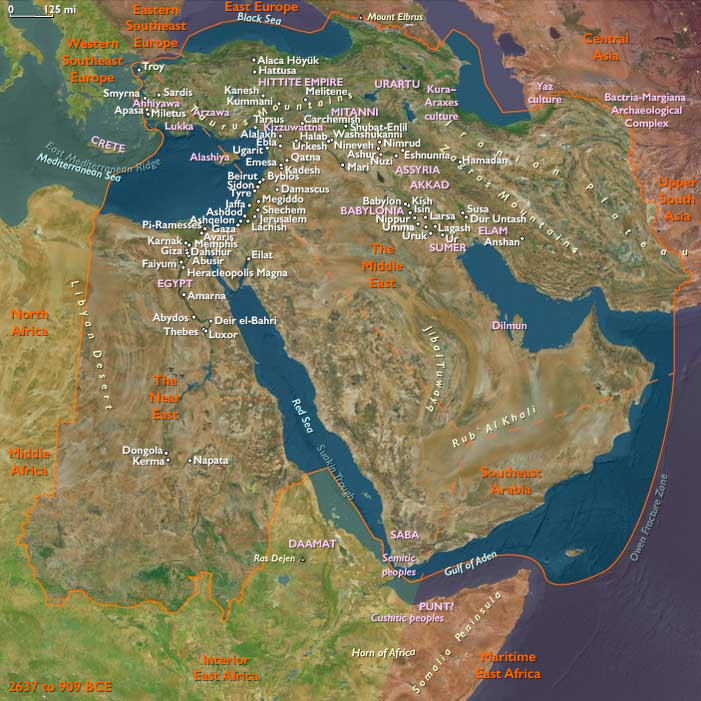
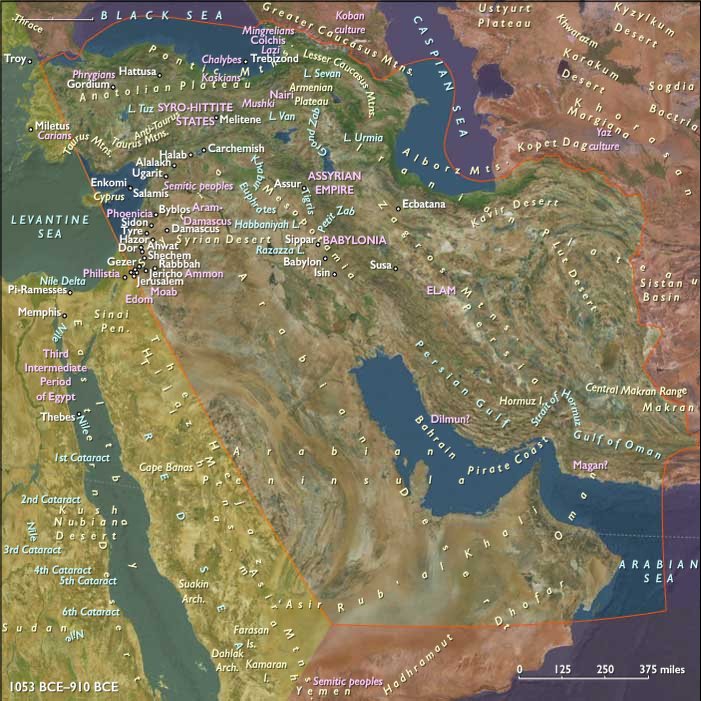
Assyria, following the end of the reign of Tiglath-Pileser I in 1076 BCE, has entered a comparative decline that is to last one hundred and fifty years.
Despite its apparent weakness, Assyria remains a solid, well-defended nation whose warriors are the best in the world.
With its stable monarchy and secure borders, Assyria is in a stronger position during this time than potential rivals such as Egypt, Babylonia, and Elam.
Kings such as Ashur-rabi II, Ashurnasirpal I, Tiglath-Pileser II, and Ashur-Dan II successfully defend Assyria's borders and uphold stability during this tumultuous time.
This long period of isolation ends with the accession in 911 BCE of Adad-nirari II.
Complete eponym lists exist from his reign through the middle of the reign of Ashurbanipal in the seventh century BCE; therefore, year one of his reign in 911 BCE is perhaps the first event in ancient Near Eastern history that can be dated to an exact year.
Moreover, the Assyrian King List is generally considered quite accurate for several centuries before Adad-nirari's reign, and scholars generally agree on a single set of dates back to Ashur-resh-ishi I in the late twelfth century BCE.
Locations
People
Groups
- Mesopotamia
- Aramaeans
- Assyria, (Middle) Kingdom of
- Syro-Hittite states
- Aram-Damascus (Syria), Kingdom of
- Babylon, Kingdom of
- Elam, (New) Kingdom of
- Egypt (Ancient), Third Intermediate Period of
- Syrian people
Topics
Subjects
Regions
Subregions
Related Events
Filter results
Showing 10 events out of 67026 total
World population in 1000 BCE is about fifty million.
People from Melanesia and Micronesia migrate toward the Polynesian triangle, a region of the Pacific Ocean with three island groups at its corners: Hawaii, Easter Island (Rapa Nui), and New Zealand.
It is often used as a simple way to define Polynesia.
At the center is Tahiti with Samoa to the west.
The Polynesian people, by ancestry, are considered to be a subset of the sea-migrating Austronesian people and the tracing of Polynesian languages places their prehistoric origins in the Malay Archipelago.
There are three theories regarding the spread of humans across the Pacific to Polynesia.
These are outlined well by Kayser et al. (2000) and are as follows:
• Express Train model: A recent (circa three thousand years ago) expansion out of Southeast Asia, predominantly Taiwan, via Melanesia but with little genetic admixture between those migrating and the existing native population, reaching western Polynesian islands around two thousand years ago.
The majority of current genetic, linguistic, and archaeological data supports this theory.
• Entangled Bank model: Supposes a long history of cultural and genetic interactions among southeast Asians, Melanesians, and already-established Polynesians.
• Slow Boat model: Similar to the express-train model but with a longer hiatus in Melanesia along with admixture, both genetically, culturally and linguistically with the local population.
This is supported by the Y-chromosome data of Kayser et al. (2000), which shows that all three haplotypes of Polynesian Y chromosomes can be traced back to Melanesia.
Speakers of Austronesian languages spread throughout the islands of Southeast Asia between circa 3000 and 1000 BCE.
These people, according to linguistic and archaeological evidence, originated from aborigines in Taiwan as tribes whose natives were thought to have arrived through South China at the beginning of the eighth millennium to the edges of western Micronesia and on into Melanesia.
The archaeological record shows well-defined traces of this expansion, which allow the path it took to be followed and dated with a degree of certainty.
It is thought that roughly thirty-five hundred years ago, the Lapita culture appeared in the Bismarck Archipelago, northwest Melanesia.
This culture is argued to have either been developed there or, more likely, to have spread from China/Taiwan.
The most eastern site for Lapita archaeological remains recovered so far through archaeology in Samoa is at Mulifanua on Upolu.
The Mulifanua site, where four thousand two hundred and eighty-eight pottery shards have been found and studied, has a true age of circa three thousand years BP, based on carbon-14 dating.
Within a mere three or four centuries between 1300 and 900 BCE, the Lapita culture spread six thousand kilometers further to the east from the Bismarck Archipelago, until it reached as far as Fiji, Tonga, and Samoa, which were populated around two thousand years ago.
In this region, the distinctive Polynesian culture will develop, sharing common traits in language, customs, and society.
The Proto Malays, who have a more diverse origin than their Negrito or Semang predecessors, are settled in Malaysia by 1000 BCE.
Although they show some connections with other inhabitants in Maritime Southeast Asia, some also have an ancestry in Indochina around the time of the Last Glacial Maximum, about twenty thousand years ago.
Anthropologists support the notion that the Proto-Malays originated from what is today Yunnan, China.
This was followed by an early-Holocene dispersal through the Malay Peninsula into the Malay Archipelago.
The Mon people of Thailand and southern Burma, one of the earliest distinct groups to occupy Burma, moving into the area as early as 1500 BCE or possibly earlier, apparently make large stone funerary monuments that are ornamented with figures. (These monuments may be connected with a megalithic culture extending westward beyond India and southern Arabia through Malaysia and Indonesia.)
Maritime East Asia (1053–910 BCE): Transition from Shang to Zhou and Cultural Flourishing
Between 1053 BCE and 910 BCE, Maritime East Asia—comprising lower Primorsky Krai, the Korean Peninsula, the Japanese Archipelago below northern Hokkaido, Taiwan, and southern, central, and northeastern China—experiences significant political transitions and remarkable cultural developments. This era sees the decline of the Shang Dynasty, the rise of the Zhou Dynasty, the origins of several important Chinese states, and archaeological discoveries challenging traditional narratives of Chinese civilization.
Mysterious Civilization at Sanxingdui
Archaeological findings at Sanxingdui, located in southern China’s kingdom of Shu, reveal a technologically advanced civilization distinct from the contemporary Shang capital at Anyang. Sanxingdui culture produces sophisticated bronze casting, including remarkable artifacts such as the world's oldest life-size standing human statue (260 centimeters high, weighing 180 kilograms) and an intricate bronze tree (396 centimeters high) featuring birds, flowers, and ornaments, possibly representing the mythological fusang tree.
Dozens of large bronze masks and heads, some originally adorned with gold foil, portray angular human features with exaggerated almond-shaped eyes, protruding pupils, and large ears. These discoveries, along with similar finds such as the Xingan tombs in Jiangxi, challenge the traditional narrative that Chinese civilization solely radiated from the central plains of the Yellow River. The Sanxingdui culture ultimately declines, potentially due to massive flooding or external invasion.
Artistic and Cultural Achievements of the Late Shang
The Shang Dynasty is renowned for producing artistic masterpieces in bronze, notably elaborate ritual vessels used in ceremonies dedicated to ancestor worship. These distinctive bronze objects continue into the Zhou period. Beginning in the 11th century BCE, artisans also manufacture large, barrel-shaped brass bells richly decorated on their surfaces.
Despite its artistic and ritual achievements, the Shang Dynasty faces internal unrest and declining political stability during the 12th century BCE, setting the stage for its eventual collapse.
Rise and Consolidation of the Zhou Dynasty
The Zhou, initially semi-nomadic people located west of the Shang realm, gradually emerge as a formidable power in the Yellow River valley. Under the leadership of King Wu, assisted by his brother, the Duke of Zhou, the Zhou decisively defeat the Shang at the Battle of Muye. King Wu legitimizes his rule by invoking the influential concept of the Mandate of Heaven, asserting divine justification for rulership contingent upon just governance.
Following their victory, the Zhou move their capital westward near modern Xi'an, on the Wei River, initiating the first of many historic population migrations from northern to southern China. This period, known as the Early or Western Zhou, features rapid consolidation under a centralized bureaucracy supported by vassal states managing peripheral areas. During this era, several notable states emerge that will play significant roles in later Chinese history, including Chen, Chu, Jin, Lu, Qi, and Yan, each originating as Zhou fiefdoms governed by hereditary nobles.
Cultural and Religious Transformations
The Zhou reorient Shang ancestor worship toward universal worship of Tian (Heaven), representing both the physical sky and a supreme divine entity, replacing Shang’s worship of the deity Di. Rituals of divination, bronze casting, and writing continue, blending Shang traditions with evolving Zhou customs.
Adhering to the code of conduct known as li, the Zhou promote detailed rules of etiquette, social hierarchy, and chivalric conduct, emphasizing civilization through adherence to ritual norms. Non-adherents, particularly groups beyond Zhou territories, are considered barbarians. To defend against these external threats, the Zhou begin constructing frontier walls along the northern boundary.
Sacred Geography and Settlement at Luoyang
The region of Luoyang, at the intersection of the Luo and Yi rivers, holds longstanding sacred significance as China's geographical center. Historically, multiple settlements have occupied this site:
-
In 2070 BCE, Xia Dynasty king Tai Kang establishes the capital Zhenxun.
-
Around 1600 BCE, King Tang of Shang builds a new capital called Western Bo.
-
In 1046 BCE, following the Shang defeat, the Duke of Zhou establishes Chengzhou, resettling captured Shang nobility and transferring the ceremonial Nine Tripod Cauldrons from the Zhou capital at Haojing to Chengzhou.
Legacy of the Age: Political and Cultural Transition
Thus, the age from 1053 to 910 BCE marks a critical transition from Shang to Zhou dominance, characterized by dynamic cultural evolution, political transformation, and significant archaeological discoveries. This period reshapes the historical narrative of Maritime East Asia, laying foundations for future social, cultural, and political developments.

Written records found at Anyang confirmed its existence but Western scholars are often hesitant to associate settlements contemporaneous with the Anyang settlement with the Shang dynasty.
For example, archaeological findings at Sanxingdui, a mysterious civilization in southern China, which was in the kingdom of Shu during the period of the Shang Dynasty, suggest a technologically advanced civilization culturally unlike Anyang.
The evidence is inconclusive in proving how far the Shang realm extended from Anyang.
The leading hypothesis is that Anyang, ruled by the same Shang in the official history, coexisted and traded with numerous other culturally diverse settlements in the area that is now referred to as China proper.
The Sanxingdui culture has a well developed bronze casting culture that permits the manufacture of the world's oldest life-size standing human statue (two hundred and sixty centimeters high, one hundred and eighty kilograms), and a bronze tree with birds, flowers, and ornaments (three hundred and ninety-six centimeters), which some have identified as renderings of the fusang tree of Chinese mythology.
Dozens of large bronze masks and heads (at least six with gold foil masks originally attached) represent angular human features, exaggerated almond-shaped eyes, some with protruding pupils, and large upper ears.
The discovery at Sanxingdui, as well as other discoveries such as the Xingan tombs in Jiangxi, challenges the traditional narrative of Chinese civilization spreading from the central plain of the Yellow River.
The Sanxingdui culture ends, possibly either as a result of natural disasters (evidence of massive flooding will be found in the early twenty-first century), or invasion by a different culture.
China’s Shang dynasty consists of thirty kings in fraternal succession.
The bronze vessels produced by Shang artisans in a variety of distinctive forms are artistic masterpieces.
The production and use of these ritual objects used for the offering of food (especially grains) and wine during the most sacred Shang ceremonies continues into the Zhou (Chou) dynasty.
Beginning in the eleventh century BCE, Chinese artisans manufacture large, barrel-shaped brass bells with ornate designs cast on their outer surfaces.
The Shang Dynasty declines in the twelfth century through internal unrest.
The Zhou dynasty adheres to a code of conduct called li, a collection of complex rules of social etiquette and personal deportment; a related chivalric code applies to royal relations, to nobles and conduct in battle.
Those who practice li are civilized; those who do not, such as those outside the Zhou domains, are barbarians.
Under King Wu, the Zhou Dynasty initiates construction of a series of northern frontier walls to keep the barbarians from the kingdom.
The Zhou Dynasty begins to emerge in the Yellow River valley, overrunning the territory of the ShangB by the end of the second millennium BCE.
The Zhou, a semi-nomadic people who live west of the Shang, appear to have begun their rule under a semi-feudal system, with the Zhou leader having been appointed "Western Protector" by the Shang.
The ruler of the Zhou, King Wu, with the assistance of his brother, the Duke of Zhou, as regent, manages to defeat the Shang at the Battle of Muye.
The king of Zhou at this time invokes the concept of the Mandate of Heaven to legitimize his rule, a concept that will be influential for almost every succeeding Chinese dynasty.
The Zhou initially move their capital west to an area near modern Xi'an, on the Wei River, a tributary of the Yellow River, but they are to preside over a series of expansions into the Yangtze River valley.
This is the first of many population migrations from north to south in Chinese history.
In the Chinese historical tradition, the Zhou defeated the Shang and oriented the Shang system of ancestor worship toward a universalized worship away from the worship of Di, the Supreme Being, and to that of Tian, which can either mean the physical sky or the presiding God of Heaven.
They legitimize their rule by invoking the Mandate of Heaven, the notion that the ruler (the "Son of Heaven") governed by divine right but that his dethronement would prove that he had lost the mandate.
Such things that proved the ruling family had lost the Mandate were natural disasters and rebellions.
The doctrine explains and justifies the demise of the Xia and Shang Dynasties and at the same time supports the legitimacy of present and future rulers.
After the Zhou conquest, the Shang practices of bronze casting, writing, and pyromancy—a kind of divination involving the application of heat or fire—continue.
China’s new dynasty (called by historians the Early, or Western, Zhou) is structured similarly to the Shang, operating as a centralized bureaucracy with vassals ruling the peripheral areas.
Consolidation of the Zhou Empire proceeds rapidly.
Years: 1053BCE - 910BCE
Locations
People
Groups
- Mesopotamia
- Aramaeans
- Assyria, (Middle) Kingdom of
- Syro-Hittite states
- Aram-Damascus (Syria), Kingdom of
- Babylon, Kingdom of
- Elam, (New) Kingdom of
- Egypt (Ancient), Third Intermediate Period of
- Syrian people