
The Zealots and revolutionaries like them had …
Years: 76 - 87
The Zealots and revolutionaries like them had been crushed by the Romans following the Jewish-Roman War of 66-73, and had little credibility (the last Zealots died at Masada in 73).
Similarly, the Sadducees, whose teachings were so closely connected to the Temple, had disappeared with the destruction of the Second Temple in 70 CE.
The Essenes too have disappeared, perhaps because their teachings so diverged from the concerns of the times, perhaps because they were sacked by the Romans at Qumran.
Of all the major Second Temple sects, only the Pharisees remain, poised with teachings directed to all Jews that could replace Temple worship.
Such teachings extended beyond ritual practices.
Following the destruction of the Temple, Rome governs Judea through a Procurator at Caesarea and a Jewish Patriarch and levies the Fiscus Judaicus.
Yohanan ben Zakkai, a leading Pharisee, has been appointed the first Patriarch (the Hebrew word, Nasi, also means prince, or president), and he has reestablished the Sanhedrin at Yavneh under Pharisee control.
Instead of giving tithes to the priests and sacrificing offerings at the (now-destroyed) Temple, the rabbis instruct Jews to give charity.
Moreover, they argue that all Jews should study in local synagogues, because Torah is "the inheritance of the congregation of Jacob" (Deut. 33: 4).
Galilee, especially the city of Tiberias, becomes the center of rabbinic learning after the fall of Jerusalem.
Locations
People
Groups
- Jews
- Pharisees
- Essenes
- Galilee, Roman province of
- Judea (Roman province)
- Roman Empire (Rome): Flavian dynasty
Topics
Subjects
Regions
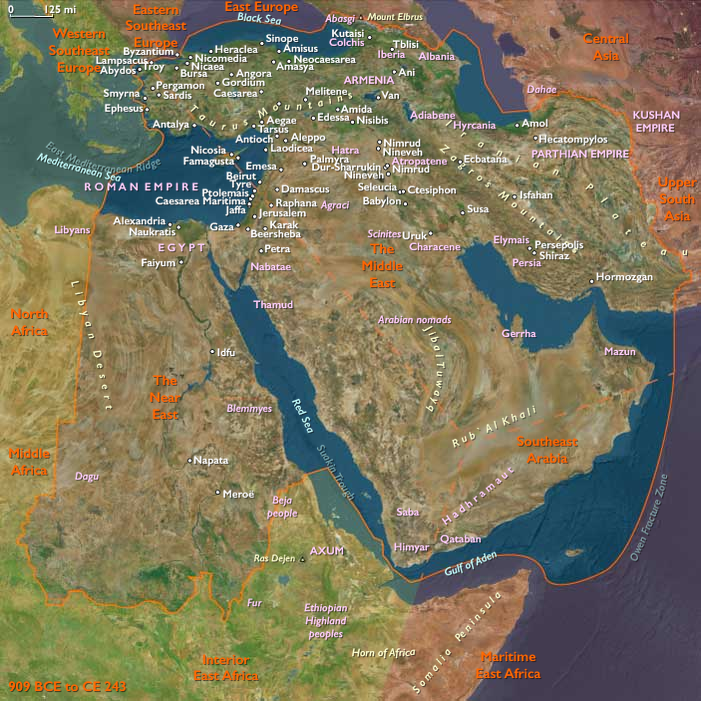
Subregions
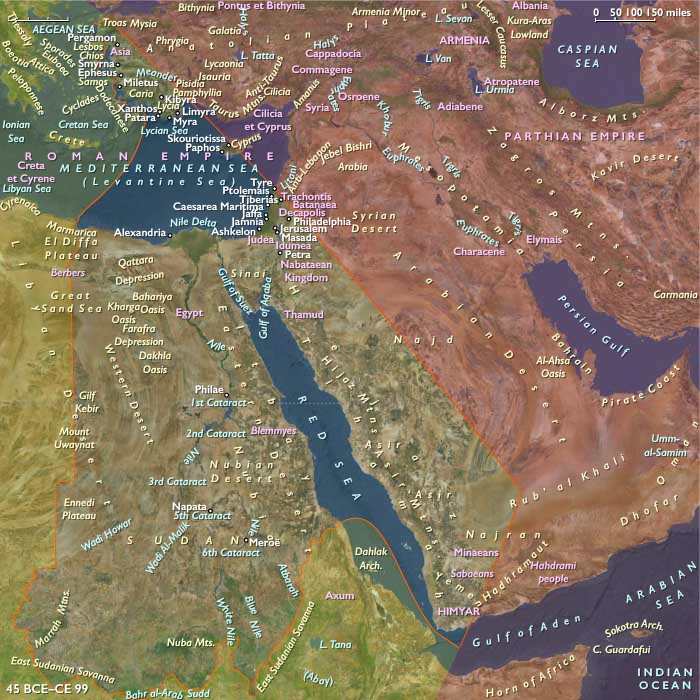
Related Events
Showing 10 events out of 61554 total
Years: 76 - 87
Locations
People
Groups
- Jews
- Pharisees
- Essenes
- Galilee, Roman province of
- Judea (Roman province)
- Roman Empire (Rome): Flavian dynasty
Topics
Subjects
Regions
Subregions