
The majority of Judahites live outside the …
Years: 573BCE - 562BCE
The majority of Judahites live outside the Holy Land following the destruction of the Temple in 586.
Lacking a state and scattered among the peoples of the Near East, the Judahites need to find alternative methods to preserve their special identity.
They turn to the laws and rituals of their faith, which become unifying elements holding the community together.
Thus, circumcision, sabbath observance, festivals, dietary laws and laws of cleanliness become especially important.
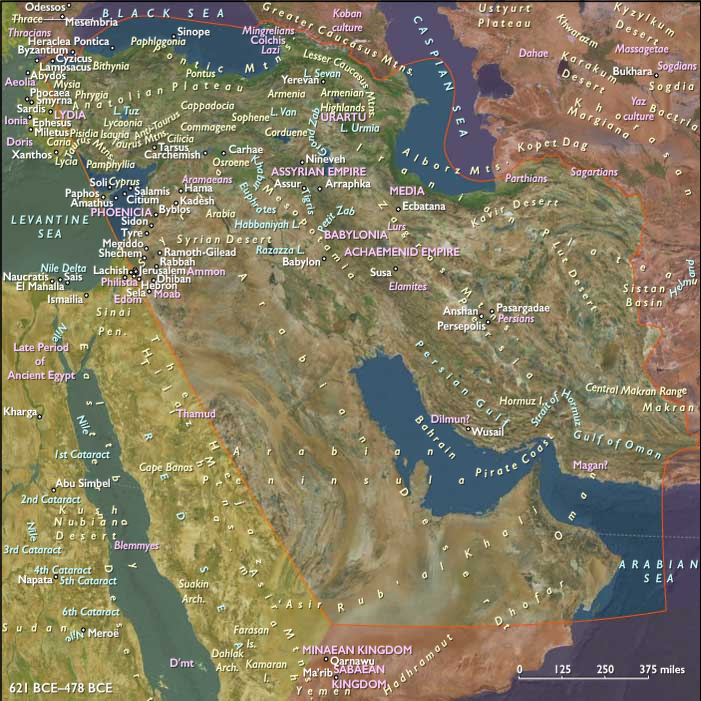
After the destruction of Jerusalem, Nebuchadnezzar had engaged in a thirteen year siege of Tyre (585–572 BCE), which ends in a compromise, with the Tyrians accepting Babylonian authority.
Following the pacification of Tyre, Nebuchadnezzar turns again to Egypt.
A clay tablet, now in the British Museum, states: "In the 37th year of Nebuchadnezzar, king of the country of Babylon, he went to Mitzraim (Egypt) to wage war.
Amasis, king of Egypt, collected [his army], and marched and spread abroad."
Having completed the subjugation of Phoenicia, and campaigned against Egypt, Nebuchadnezzar sets himself to rebuild and adorn the city of Babylon, and constructs canals, aqueducts, temples and reservoirs.
Outside Babylon, he is credited with the restoration of the Lake of Sippar, the opening of a port on the Persian Gulf, and the building of the famous Median wall between the Tigris and the Euphrates to protect the country against incursions from the North.
The inscription of the great temple of Marduk implies most probably that captives brought from various parts of Western Asia made up a large part of the labor force used in all his public works.
Events of the last years of Nebuchadnezzar are obscure.
The king figures prominently in the biblical Book of Daniel, which describes Nebuchadnezzar as eating grass and undergoing a physical transformation near the end of his life.
(Conversely, the Dead Sea Scrolls suggest that it was not Nebuchadnezzar, but the last Chaldean king, Nabonidus, who suffered from some such affliction.)
According to Babylonian tradition, towards the end of his life, Nebuchadnezzar prophesied the impending ruin of the Chaldean Empire (Berossus and Abydenus in Eusebius, Praeparatio Evangelica, 9.41).
Old, even senile, perhaps dethroned by his own son, Amel-Marduk, Nebuchadnezzar dies in 562 BCE in Babylon between the second and sixth months of the forty-third year of his reign.
Locations
People
Groups
- Mesopotamia
- Tyre, Kingdom of (Phoenicia)
- Egypt (Ancient), Late Period of
- Neo-Babylonian, or Chaldean, Empire
- Judahites
Topics
- Younger Subboreal Period
- Iron Age, Near and Middle East
- Iron Age Cold Epoch
- Classical antiquity
- Babylonian Captivity
Commodoties
Subjects
Regions
Subregions
Related Events
Showing 10 events out of 65873 total
Years: 573BCE - 562BCE
Locations
People
Groups
- Mesopotamia
- Tyre, Kingdom of (Phoenicia)
- Egypt (Ancient), Late Period of
- Neo-Babylonian, or Chaldean, Empire
- Judahites
Topics
- Younger Subboreal Period
- Iron Age, Near and Middle East
- Iron Age Cold Epoch
- Classical antiquity
- Babylonian Captivity
Commodoties
Subjects
Regions
Subregions