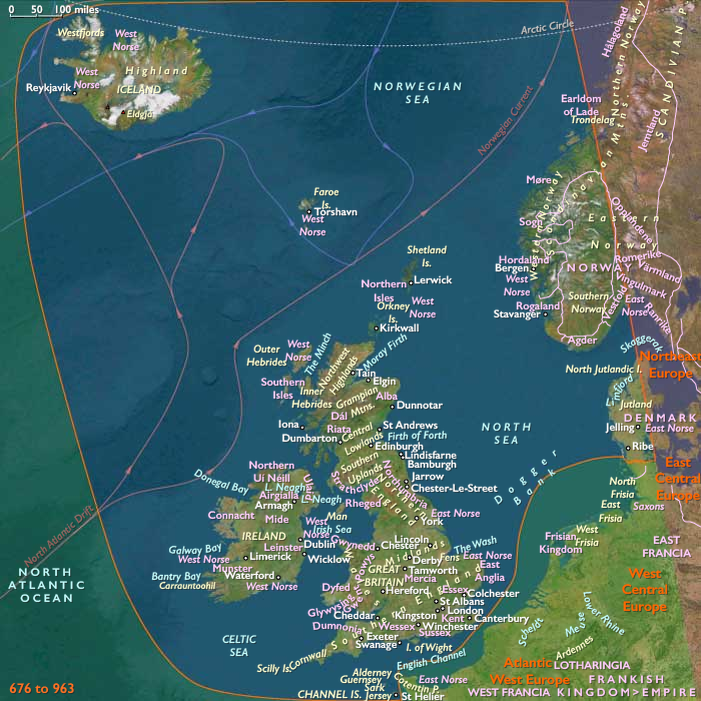
Edward, the brother of Æthelflæd, the Lady …
Years: 918 - 918
Edward, the brother of Æthelflæd, the Lady of the Mercians, incorporates English Mercia into Wessex following her death in 918.
Edward has by this time virtually extinguished Danish power in England.
Locations
People
Groups
- Saxons
- Angles
- Anglo-Saxons
- Wessex, English Kingdom of
- Mercia, Kingdom of
- Britain, Medieval
- Vikings
- Danes (Scandinavians)
- East Anglia, (Danish) Kingdom of
- York, Scandinavian (Norse)
Topics
Commodoties
Subjects
Regions
Subregions
Related Events
Filter results
Showing 10 events out of 53323 total
Gyeon Hwon, king and founder of Hubaekjek, had changed the state's name to Majin in 904, and eventually to Taebong in 911; he had also transferred the capital from Songak to Cheorwon in 905.
Taebong at its peak consists of territory in the present-day provinces North Hwanghae and South Hwanghae, Gyeonggi, Gangwon-do (South Korea)/Kangwon-do (North Korea), Pyongyang, North Chungcheong and southern part of South Jeolla.
In his later reign, Gung Ye had proclaimed himself a Buddha and become a tyrant who sentenced death to anyone opposing him, including his own wife Lady Gang.
As a result, in 918 four of his own generals—Hong Yu, Bae Hyeon-gyeong, Shin Sung-gyeom and Bok Ji-gyeom—overthrow Taebong and install Wang Geon as king, Soon thereafter, the Goryeo dynasty is proclaimed, from which the name Korea derives.
The Battle of Achelous, one of the most important battles in the long Byzantine–Bulgarian Wars, has foiled Constantinople’s designs on Bulgaria, secured the concession of the Imperial title to the Bulgarian rulers, and thereby firmly established Bulgaria's role as a key player in Europe.
Simeon has also demanded that his daughter be married Constantine VII, the son of empress Zoe Karbonopsina, but Zoe had refused and allied with Serbia and Hungary against him, which had postponed the decisive assault of Constantinople.
Simeon, deciding to secure his rear, had sent an army under Marmais and Theodore Sigritsa to destroy them.
His generals had captured the Serb prince but that had given the Empire precious time to recover.
Romanos Lekapenos, born in Lakape (Laqabin) between Melitene and Samosata (hence the name), was the son of an Armenian peasant with the remarkable name of Theophylact the Unbearable.
Theophylact, as a soldier, had rescued the Emperor Basil I from the enemy in battle at Tephrike and had been rewarded by a place in the Imperial Guard.
Although he did not receive any refined education (for which he will later be abused by his son-in-law Constantine VII), Romanos had advanced through the ranks of the army during the reign of Emperor Leo VI the Wise.
In 911, he was general of the naval theme of Samos and later served as admiral of the fleet (droungarios tou ploimou).
In this capacity, he was supposed to have participated in the operations against Bulgaria on the Danube in 917, but had been unable to carry out his mission.
In the aftermath of the disastrous imperial defeat at the Battle of Acheloos, Romanos had sailed to Constantinople, where he is gradually overcoming the discredited regency of Empress Zoe and her supporter Leo Phokas.
Zoe’s attempted alliance with Serbia and the Magyars has failed to produce any concrete results, and the Arabs, encouraged by the empire's weakness, renew their raids.
A humiliating treaty with the Arabs of Sicily, who are asked to help subdue revolts in Italy, does little to improve the position of Zoe and her supporters.
The Rashtrakutas retake Malwa from the Pratiharas during the years 915 to 918.
Toulouse had by the end of the ninth century become the capital of an independent county, the county of Toulouse, ruled by the dynasty founded by Frédelon, who in theory was under the sovereignty of the king of France, but in practice was totally independent.
The counts of Toulouse had had to fight to maintain their position at first.
They were mostly challenged by the dynasty of the counts of Auvergne, ruling over the northeastern part of the former Aquitaine, who claimed the county of Toulouse as their own, and even temporarily ousted the counts of Toulouse from the city of Toulouse.
However, in the midst of these Dark Ages, the counts of Toulouse had managed to preserve their own, and unlike many local dynasties that disappeared, have achieved survival.
Their county is just a small fraction of the former Aquitaine, the southeastern part of it, in fact.
However, at the death of Count William the Pious of Auvergne (Guillaume le Pieux) in 918, they had come into the possession of Gothia, which had been in the family of the counts of Auvergne for two generations.
Thus, they have more than doubled their territory, once again reuniting Toulouse with the Mediterranean coast from Narbonne to Nîmes.
The county of Toulouse takes its definitive shape, from Toulouse in the west to the Rhone River in the east, a unity that will survive until the French Revolution as the province of Languedoc.
Toulouse will never again be part of the Aquitaine polity, whose capital in later times will become Poitiers, then Bordeaux.
At first though, the memories of Aquitaine live strong in Toulouse.
A sign of William's independence of rule in Aquitaine is that he had a deniers minted in his own name at Brioude.
He is buried in the monastery of Saint-Julien there.
He had no sons of his own and is succeeded by a nephew, William the Younger, son of his sister Adelinda and Acfred I of Carcassonne.
Ordoño II’s Conquest of Arnedo and Calahorra (918 CE)
In 918 CE, King Ordoño II of León continues his military campaigns against Muslim-controlled territories, successfully capturing Arnedo and ...
...Calahorra from the Banu Qasi, a powerful Muladi (Muslim Iberian) dynasty in the Ebro Valley.
These victories further strengthen Christian control in the region, pushing the Muslim frontier southward and reinforcing Ordoño II’s role as a key figure in the Reconquista.
The Historia de Sancto Cuthberto states that Ealdred "was a friend of King Edward the Elder, as his father had been a favorite of King Alfred the Great".
Ealdred had been driven from his lands, whether all of Northumbria or merely the northern part which had once been Bernicia is debated, by Ragnall ua Ímair, either in or before 914, or alternatively as late as 918.
The Historia states that Ealdred sought refuge with Constantín mac Áeda, the king of Alba, and that the two fought Ragnall at the battle of Corbridge, dated to 918 by the Annals of Ulster and the Chronicle of the Kings of Alba.
The battle appears to have been indecisive and Ragnall remained the master of at least southern Northumbria, former Deira, or perhaps of all.
The Annals of Ulster informs us that the Norse army divided itself into four columns, in one of which may have been Ottir Iarla, a longtime ally of Ragnall.
The Scots destroy the first three but are ambushed by the last, commanded by Ragnall himself, which had remained hidden behind a hill.
The Scots manage to escape without disaster, however.
The Historia de Sancto Cuthberto adds that the English fought alongside the Norse, though it ignores the presence of the Scots.
All of the Danes south of the Humber by 918 have submitted to Edward.
The former Anglo-Saxon kingdom of East Anglia, since 886 a part of the Danelaw, now becomes an English earldom.
Rumors have begun to circulate that Leo Phokas, whose army lies encamped across the Bosporus from Constantinople, and his brother-in-law Constantine the Paphlagonian are planning to seize the throne from the young emperor Constantine VII.
Zoe herself (according to Steven Runciman) may have planned to marry the general and solidify her own position.
The Emperor's tutor, however, a certain Theodore, had turned to Romanos Lekapenos; although the admiral carries a great share of the blame for the failure of the Bulgarian campaign, Romanos remains a powerful factor as his fleet is intact and ready at hand.
The parakoimomenos Constantine tries to neutralize this threat by disbanding the fleet, but he is arrested by Lekapenos when he arrives to supervise the discharge of the crews.
With this stroke, Zoe loses all control of the situation, and at Theodore's urging, the young Emperor appoints the Patriarch Nicholas Mystikos as regent.
The Patriarch's first act is to dismiss Phokas from his post as Domestic and replace him with John Garidas.
Phokas tries to secure his position by forcing the Patriarch to appoint some of his relatives to command the Hetaireia, the imperial bodyguard.
The Patriarch at first agrees, but almost immediately dismisses them.
At this point, Phokas turns to Lekapenos and offers him a marriage alliance.
Lekapenos agrees and concludes a pact with him, allowing Phokas to return to his troops at Chrysopolis.
Pjokas apparently believes that Lekapenos, in view of his lowly origins, could never possibly put forward a credible claim for the imperial throne.
Events prove that he had severely miscalculated his new ally: on March 25, 919, Lekapenos manages to gain entrance to the imperial palace, occupies it and secures his appointment as magistros and commander of the Hetaireia.
A few weeks later, he marries his daughter Helena to the young Emperor and assumes the title of basileopator, becoming the virtual ruler of the Empire.
Phokas is now sent a letter, in the Emperor's name, in which he is bidden not to react to these events.
Inevitably, the outmaneuvered general rises in revolt, but fails to secure the loyalty of his troops: they begin to desert to the imperial camp, especially after a letter from the young Constantine VII, which acclaims Lekapenos as his protector and denounces Phokas's rebellion, reaches the rebel camp and is read aloud to them.
Eventually, Phokas is forced to flee, but is captured and blinded by the Emperor's agents in Bithynia.
Following the discovery of a plot by some of his friends a few months later, Phokas suffers a final humiliation, being paraded through the streets of Constantinople on a mule.
His fate hereafter is unknown.
Lekapenos engineers a coup to depose Zoe in August 919 and confines her to the monastery of St Euphemia-in-Petrium.

The Abbasid army had been defeated by Yusuf near Ardabil in 918, but the Sajid ruler is defeated in 919.
Yusuf is captured and brought back to Baghdad, where he will be imprisoned for the next three years.
Years: 918 - 918
Locations
People
Groups
- Saxons
- Angles
- Anglo-Saxons
- Wessex, English Kingdom of
- Mercia, Kingdom of
- Britain, Medieval
- Vikings
- Danes (Scandinavians)
- East Anglia, (Danish) Kingdom of
- York, Scandinavian (Norse)