Wallachia and ...
Years: 1419 - 1419
Wallachia and ...
Locations
Groups
Subjects
Regions
Subregions
Related Events
Filter results
Showing 10 events out of 42276 total
Le Loi, a wealthy Vietnamese landowner, had fomented an anti-Chinese resistance movement in 1416, organizing, with the help of the poet Nguyen Trai, a guerilla force in the Lam Son region.
Initially, the guerillas attacked outposts and supply lines without directly engaging the Chinese army of occupation, aiming to win a war of attrition.
Eventually drawn into three costly battles, Le Loi’s troops retreat to the Chi Linh Mountains near Lam Son, and obtain help in 1419 from the Laotians.
Ashikaga shogun Yoshimitsu, who has developed a passion for collecting Chinese paintings and art objects, indulges in elaborate ceremonial displays of his collection.
The painters of the Ashikaga mortuary temple, the Shokokuji in Kyoto, have come to form a virtual academy with a variety of functions, including the procuring of paintings for the shogun's collection.
Japanese priest-painter Josetsu, his pupil Shubun, and their associates formulate a national style based on Chinese styles of the Southern Song painting academy.
Josetsu, expert in the Southern Song styles of Ma Yuan and Liang K'ai, is a master of suibokuga, or Chinese-style ink painting.
A colophon to Josetsu's Catching a Catfish with a Gourd refers to its being in a "new style," presumably a reference to the incorporation of a Southern Song-type landscape setting into an illustration of a Zen allegory.
Shubun frequently executes formalized, Chinese-style mountain landscapes on narrow, vertical hanging scrolls to provide pictorial accompaniment to Chinese poetry inscribed on the scrolls by Zen priests.
His Studio of the Three Worthies—pine, bamboo, and plum, executed in 1418 exemplifies this style, as does 1419’s Koten En'i.
(Although approximately forty extant paintings that have been associated with Shubun, none of them can definitely be assigned to his hand.)
The Baltic Sea port of Rostock, a site by the Warnow River first settled by Wends in the twelfth century and superseded by three German towns that were united later in that century, has by the early fifteenth century become a powerful member of the Hanseatic League and the biggest city in the Duchy of Mecklenburg.
The University of Rostock, founded in 1419 by confirmation of Pope Martin V, is thus one of the oldest universities in continental Northern Europe.
Eric of Pomerania, King of the Nordic Kalmar Union, seizes the duchy of Schleswig in 1409 in a dispute over the Count of Holstein’s possession of it.
A desperate Holstein had opened its ports to the pirates known as the Victualling Brothers, who had eventually compelled Eric to withdraw from Schleswig.
Eric had continued to lose battles and territory to the Holsteiners and their pirate allies during 1416-18, but a series of bloody engagements in 1419 win him control of Fehmarn Island.
Sigismund of Luxembourg, King of Germany and Holy Roman Emperor-elect, assumes the Bohemian crown after the death on August 16, 1419, of his half-brother Wenceslas, ending decades of arguments and fights over the king’s choice of candidates for higher offices and church reform.
However, the Hussites, who hold the emperor partly responsible for Huss’s execution, will not allow him to take the Bohemian throne.
Zizka, like most Czechs, refuses to acknowledge Sigismund as king of Bohemia even though the latter offers him the viceroyalty of Bohemia.
Sigismund and Pope Martin V join forces to expunge the Hussite heresy and install the new king.
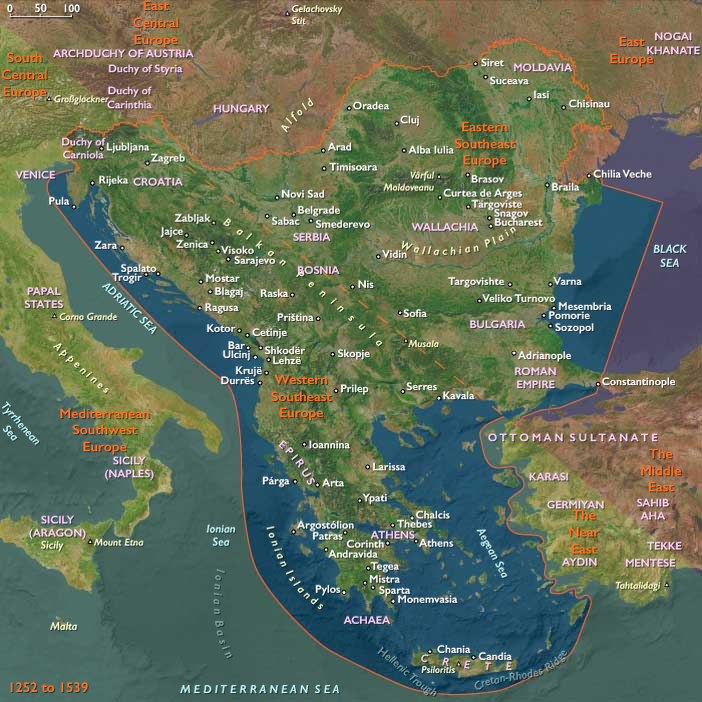
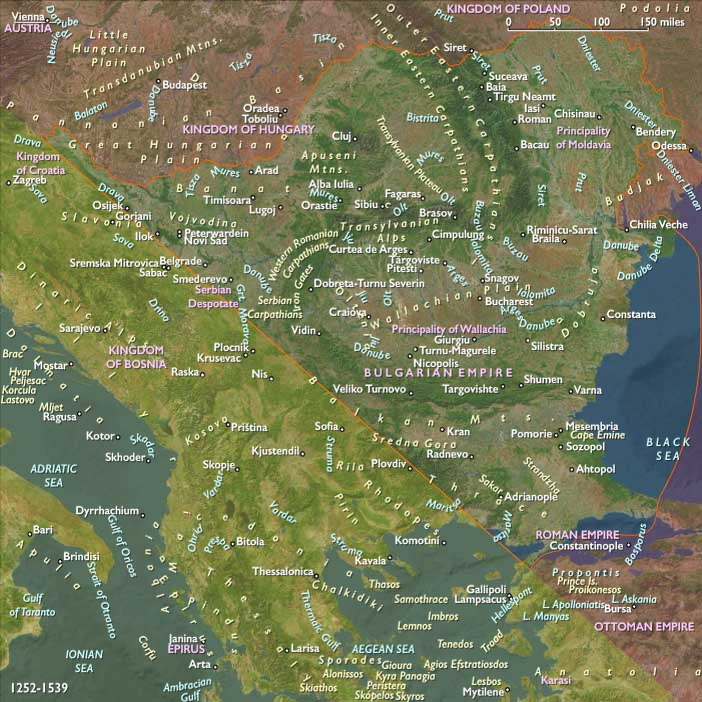
…Moldavia had begun to slide into decline after the death of Mircea in 1418.
Tvrtko II of Bosnia, despite Turkish support, had lost his throne in 1409 to his half-brother Stjepan Ostoja Kotromaniç, son of Tvrtko I, who rules for a second time amid power struggles with other Bosnian nobles, including Tvrtko II, who gains Hungarian support in 1418 after Ostoja’s death.
The Ottomans, beginning in the late fourteenth century, had started to expand their empire from Anatolia to the Balkans (Rumelia), and by the beginning of the fifteenth century ruled most of the Balkan Peninsula.
Ottoman supremacy in the west Balkan region had begun in 1385 with the Battle of Savra.
On the conquered part of Albania, which territory stretches between Mat River on the north and Çameria to the south, the Ottoman Empire has established the Sanjak of Albania and in 1419, Gjirokastër becomes the county town of the Sanjak of Albania.
Filippo Brunelleschi, the well-educated son of a lawyer, engages first in goldsmith work and sculpture but soon turns to architecture.
Sometime between 1417 and 1420, Brunelleschi, in his early forties, paints two panels demonstrating new schemes of perspective, techniques he may have discovered in his painstaking architectural studies of actual buildings. (These schemes establish the form of all subsequent perspective painting in the Renaissance.)
He receives a major commission in 1419 for the “Ospedale degli Innocenti” (Foundling Hospital).
Political infighting had brought Jacopo della Quercia into the design of a hexagonal basin with bronze panel for the Baptistery in Siena, after the cathedral in 1416 had asked Lorenzo Ghiberti (who had been his competitor for the bronze doors in Florence) to undertake the project.
He had only completed one bronze relief, The Annunciation to Zacharias, because he was working at the same time on the Fonte Gaia and the Trenta Chapel.
His lingering on this project brought him in legal difficulties with the authorities.
Since he had been rejected in the competition for the "Doors of Paradise" in Florence, he had been reluctant to work with bronze.
And when he worked on the tabernacle of the baptistery, he insisted on taking care only of the marble part.
Jacopo della Quercia had been asked in 1406 to build a new fountain in the Piazza del Campo in Siena, as it had been deemed necessary to replace the original fountain, which had featured a statue of the goddess Venus, blamed for an outbreak of the Black Plague.
The statue had been destroyed and buried outside the city walls to avert its "evil influence".
This prestigious commission shows that he was already being recognized as Siena's most prominent sculptor.
The rectangular fountain, built in white marble, is dedicated to the Virgin, adorned on the three sides by many statues and multiple spouts.
Because he also accepts other commissions at the same time, such as the baptismal font in the Sienese Baptistery, progress has been slow.
He had started in 1414 and the fountain is only finished in 1419.
He had carved the panels in the workshop for sculptors, next to the cathedral; this workshop will eventually be converted into the Cathedral Museum.
The fountain is called Fonte Gaia, because of the joy and the festivities when its is brought into operation.
It is now a center of attraction for the city’s many tourists.
When they were set up set up in 1419, Jacopo della Quercia's nude figures of Rhea Silvia and Acca Larenti are the first two female nudes, who are neither Eve nor a repentant saint, to stand in a public place since Antiquity.
The original statues will be replaced by copies in 1858 from Tito Sarrocchi, who will omit Jacopo della Quercia's two nude statues, which the nineteenth-century city fathers found too pagan or too nude; now much-damaged, they are are today on display in the loggia of the Palazzo Pubblico.