
King Juba II, following the annexation of …
Years: 33BCE - 22BCE
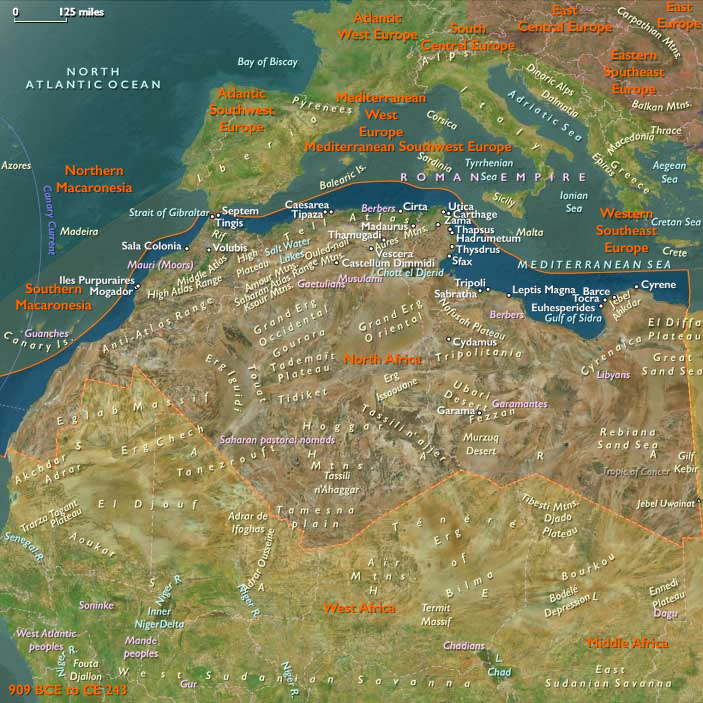
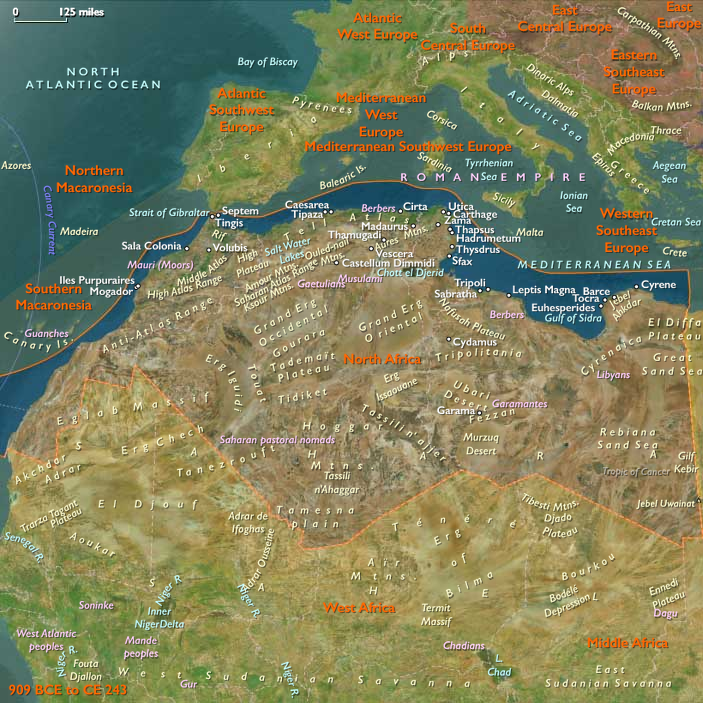
King Juba II, following the annexation of Numidia by Rome in 33 BCE, has rapidly developed Iol (at present Cherchell), founded as a small Carthaginian port on the coast of Algeria, sixty miles (ninety-six kilometers) west of Algiers.
Iol, prospering through its strategic location on Atlantic and Mediterranean trade routes, is renamed Caesarea after Augustus Caesar.
Juba embellishes the city with baths, a theater, and high-quality copies of classical Greek and Hellenistic sculptures.
Locations
People
Groups
Topics
Commodoties
Subjects
Regions
Subregions
Related Events
Filter results
Showing 10 events out of 62253 total
The Rise of Augustus and the Birth of the Roman Empire (27 BCE)
After nearly a century of internal conflict, Octavian successfully ended the Roman civil wars, restoring peace and stability to a state that had been plagued by power struggles, assassinations, and civil unrest.
In 27 BCE, the Senate formally granted Octavian the title of Augustus, marking his transformation into the most powerful figure in the Roman world. This moment signified:
- The end of the Roman Republic and the transition to the autocratic Roman Empire.
- The concentration of power under a single ruler, while maintaining a facade of Republican institutions.
Augustus and the Foundations of the Roman Empire
- As Augustus Caesar, he carefully reshaped Rome’s political system, ensuring his dominance while preserving Senate authority in name only.
- His rule stabilized the empire, bringing an end to the chaotic struggles of the late Republic.
- He enacted economic, legal, and military reforms, securing Rome’s dominance over its vast territories.
The Pax Romana: The Longest Period of Stability in European History
The conclusion of Rome’s final civil war ushered in the Pax Romana ("Roman Peace"), an era of:
- Relative peace and stability across the empire, lasting for over 200 years (27 BCE – 180 CE).
- Expansion and prosperity, as Rome strengthened infrastructure, trade, and governance.
- Cultural flourishing, with advancements in literature, architecture, and engineering.
Significance of Augustus’ Rule
- His reign laid the political and institutional foundations of the Roman Empire, shaping the governance of Europe for centuries.
- He became the model for future emperors, setting a precedent for imperial rule.
- The Pax Romana, which he initiated, provided stability and unity to a vast, diverse empire stretching from Britain to the Middle East.
Augustus' ascension in 27 BCE was a turning point in world history, marking the end of the Republic and the beginning of an empire that would last for nearly 500 years in the West and over 1,400 years in the East.
The Middle East: 33–22 BCE
Parthian Civil War and Roman Diplomacy
In 32 BCE, the Parthian Empire descends into civil war as Tiridates rebels against the rule of Phraates IV, who had previously alienated the nobility through harsh persecutions. Tiridates initially seizes power with considerable support from the Parthian elite, driving Phraates from the throne. However, Phraates soon returns with the backing of Scythian allies, regaining control and forcing Tiridates to flee.
Seeking refuge, Tiridates travels to Roman-held Syria, appealing to the Roman ruler Augustus for assistance. Augustus, unwilling to directly intervene against Parthia at this juncture, allows Tiridates safe haven but withholds active support. Undeterred, Tiridates launches another invasion into Parthian territory around 26 BCE, briefly minting coins under the royal title "Arsaces Philoromaios"—emphasizing his pro-Roman stance with symbolic imagery of Tyche, the goddess of fortune, offering him victory.
Despite this symbolic proclamation of legitimacy, Tiridates is swiftly expelled once more by Phraates. In an attempt to strengthen his political position, Tiridates captures one of Phraates' sons and delivers him to Augustus in Spain, intending to leverage the prince as a bargaining chip. Augustus returns the boy to his father, a gesture of diplomatic goodwill aimed at preserving peace. However, Augustus pointedly refuses to surrender Tiridates himself, further complicating Roman-Parthian relations.
Thus, this era underscores the intricate balance of power in the Middle East, with Rome cautiously navigating internal Parthian conflicts to extend its diplomatic influence without committing to direct military confrontation.
Civil war breaks out in Parthia around 32 BCE, when a certain Tiridates rebels against Phraates IV, probably with the support of the nobility that Phraates had previously persecuted.
Tiridates is expelled when Phraates returns with the help of the Scythians.
He flees to Syria, where Augustus allows him to stay, but refuses to support him.
During the next few years Tiridates invades Parthia again; some coins dated from March and May, 26 BCE, with the name of a king "Arsaces Philoromaios," belong to him; on the reverse they show the king seated on the throne, with Tyche stretching out a palm branch towards him.
He is soon expelled again, and brings a son of Phraates into Spain to Augustus.
Augustus gives the boy back to his father, but declines to surrender "the fugitive slave Tiridates."
Near East (33–22 BCE): Rome Conquers Egypt and Ends the Hellenistic Era
The Roman Republic, increasingly dominated by Octavian, confronts Mark Antony following Antony's betrayal and his alliance with the Egyptian queen Cleopatra VII. In 32 BCE, the Roman Senate formally declares war against Cleopatra, characterizing Antony as a traitor for siding with Egypt against Rome. The decisive confrontation occurs at the Battle of Actium in 31 BCE, where Octavian, aided by his general and close ally Marcus Agrippa, achieves a conclusive naval victory.
Following their defeat at Actium, Antony and Cleopatra retreat to Alexandria. Octavian besieges the city, which falls in 30 BCE. Faced with inevitable capture, both Antony and Cleopatra choose suicide, Antony by sword and Cleopatra reportedly by the bite of an asp. With their deaths, the centuries-old Ptolemaic Kingdom concludes, marking the end of the Hellenistic Age.
Egypt is annexed by Rome in 30 BCE, becoming a Roman province governed directly by Octavian’s appointed prefects. The wealth and resources of Egypt, particularly grain, significantly bolster Rome’s imperial strength, reinforcing Octavian's political dominance in Rome. The Roman Republic is poised for its transition into the Roman Empire, with Octavian—soon to be named Augustus—as its first emperor.
Legacy of the Era
The era from 33 to 22 BCE witnesses Rome’s consolidation of power over Egypt and the broader Near East, bringing an end to the Hellenistic kingdoms. This period definitively transforms the geopolitical landscape of the eastern Mediterranean, firmly embedding Roman administrative structures and cultural influence in a region historically shaped by diverse local traditions and Hellenistic governance.
Mark Antony, the lover and ally of the Egyptian queen Cleopatra, betrays the Roman government and joins the war on Cleopatra’s side after the Roman Senate declares war on her.
Cleopatra and Antony, after the decisive victory for Octavian and his friend and general Agrippa at the Battle of Actium, withdraw to Alexandria, where Octavian besieges the city until both Antony and Cleopatra die by suicide.
Rome annexes Egypt.
Mediterranean Southwest Europe (33–22 BCE): The Rise of Augustus and Rome's Imperial Transformation
The era 33–22 BCE witnesses the dramatic ascendancy of Octavian—soon to be Augustus—and Rome's definitive transformation from Republic to Empire. This period is marked by decisive military victories, the consolidation of authority under Octavian, and significant political reforms that establish imperial governance.
Final Conflict: Octavian versus Antony and Cleopatra
Tensions within the Second Triumvirate reach a breaking point by 33 BCE, resulting in open conflict between Octavian and Mark Antony. Antony's alliance and romantic involvement with Cleopatra VII of Egypt provide Octavian with a potent propaganda tool, framing the struggle as Rome versus foreign influence.
The conflict culminates in the decisive naval Battle of Actium in 31 BCE, off the western coast of Greece. Octavian's fleet, commanded by Marcus Vipsanius Agrippa, decisively defeats Antony and Cleopatra, who subsequently flee to Egypt. Octavian pursues and, upon his arrival in Egypt in 30 BCE, Antony and Cleopatra both commit suicide—Antony by sword, Cleopatra famously by an asp bite.
Annexation of Egypt and End of the Hellenistic Era
Egypt becomes a Roman province following the deaths of Antony and Cleopatra, bringing the prosperous and culturally rich Hellenistic kingdom under Roman control. The annexation of Egypt in 30 BCE not only enriches Rome but also marks the symbolic end of the Hellenistic Age, definitively transitioning power in the Mediterranean fully to Rome.
Octavian’s Consolidation of Power and the Principate
Returning to Rome, Octavian carefully consolidates his power, presenting himself not as a monarch but as the restorer of republican traditions and protector of Roman values. In 27 BCE, he ostensibly returns authority to the Senate but retains crucial powers, including command over the provinces and legions. The Senate awards him the title Augustus, meaning "revered one," formalizing his supreme status.
Augustus establishes the Principate, a governance model blending republican elements with autocratic authority. This subtle but definitive shift inaugurates the Roman Empire, preserving republican institutions in form while concentrating actual authority in the emperor.
Reforms and Establishment of Imperial Stability
Augustus embarks on extensive administrative, social, and military reforms designed to stabilize and strengthen Rome. He reorganizes provincial governance, ensuring greater efficiency and reduced corruption. Augustus also institutes moral legislation aimed at reinforcing traditional Roman family values and societal structure.
Notably, Augustus reorganizes the Roman military, creating a standing professional army directly loyal to him, fundamentally transforming Rome’s military and political landscapes. He also establishes the Praetorian Guard, an elite force tasked with protecting the emperor, highlighting his centralization of power.
Cultural and Architectural Renaissance
Under Augustus, Rome experiences a significant cultural revival, often referred to as the Augustan Age. He sponsors an extensive building program that transforms Rome, famously claiming, "I found Rome a city of bricks and left it a city of marble." Public buildings, forums, temples, and monuments such as the Ara Pacis Augustae (Altar of Augustan Peace) reinforce his image as a restorer of peace, prosperity, and Roman virtues.
Augustus also patronizes poets and intellectuals, including Virgil, Horace, and Ovid, whose works celebrate and legitimize his rule, profoundly influencing Roman culture and identity.
Legacy of the Era
The era 33–22 BCE permanently reshapes Rome, marking the transition from republic to empire. Augustus’ calculated consolidation of power, comprehensive reforms, cultural patronage, and symbolic governance set a precedent for subsequent emperors, defining imperial Rome's character for centuries to follow.
With the civil wars finally over, Octavian restores stability to Rome, ending nearly a century of internal conflict.
In 27 BCE, the Senate bestows upon him the title Augustus, marking his rise as the most powerful figure in the Roman world. As Augustus Caesar, he establishes himself as Rome’s first emperor, transforming the oligarchic-democratic Republic into an autocratic empire.
This final victory of the Roman Republic ushers in the Pax Romana—the longest era of peace and stability in Europe’s recorded history.
North Africa (33–22 BCE)
Roman Provincial Development, Juba II and Mauretanian Flourishing, Cyrenaic Continuity, Berber Integration, and Saharan Networks
Roman Governance and Continued Provincial Integration
Between 33 and 22 BCE, Rome further consolidates and enhances administrative control over Africa Proconsularis, continuing significant investments in infrastructure, agriculture, and urbanization. Strategic cities like Utica sustain their prominence as administrative and commercial hubs, fostering regional prosperity through expanded trade networks and efficient governance.
Numidia: Ongoing Integration and Stability
Having been fully integrated as a Roman province since 46 BCE, Numidia continues to flourish under structured Roman administration. Agricultural productivity and regional trade efficiency improve steadily, bolstered by Roman infrastructural projects and administrative reforms. Numidian society, while closely integrated within Roman provincial frameworks, retains distinctive local customs and traditions, contributing to regional stability.
Mauretania: Juba II’s Flourishing Client-Kingdom
In 33 BCE, Rome transitions Mauretania from direct provincial governance to a client-kingdom, placing it under the rule of King Juba II. Juba II, an educated and culturally refined ruler, rapidly develops Iol—a small Carthaginian port located in present-day Cherchell, Algeria—renaming it Caesarea in honor of Augustus Caesar. Under Juba's leadership, Caesarea thrives due to its strategic position on Atlantic and Mediterranean trade routes.
Juba II significantly embellishes Caesarea, constructing baths, a theater, and filling the city with high-quality replicas of classical Greek and Hellenistic sculptures. Mauretania thus becomes a prosperous, culturally vibrant client-kingdom, effectively sharing responsibilities in regional security and defense, thereby substantially contributing to the stability of Roman North Africa.
Cyrenaica: Sustained Economic and Cultural Prosperity
Cyrenaica maintains its economic prosperity and cultural prominence under continued stable governance. The Greek Pentapolis—Cyrene, Barce (Al Marj), Euhesperides (Benghazi), Teuchira (Tukrah), and Apollonia (Susah)—remains prosperous through extensive trade in grain, wine, wool, livestock, and particularly the valued medicinal herb Silphium.
Cyrene preserves its reputation as an intellectual and cultural center, attracting scholars, philosophers, and medical experts. Its educational institutions, medical schools, and significant architectural heritage sustain its importance within the broader Mediterranean cultural networks.
Berber Communities: Cultural Resilience and Economic Integration
Berber communities remain deeply involved in regional economic networks, integrated within Roman and Mediterranean trade systems. Coastal economic centers, particularly Oea (Tripoli), continue vibrant trade, indirectly benefiting inland Berber tribes.
Inland Berber communities sustain traditional governance and cultural practices, supported by prosperous coastal commerce. This ongoing interplay ensures regional cohesion, fostering sustained Berber resilience and economic continuity.
Garamantes and Saharan Networks
The Garamantes persist in their crucial role as facilitators of trans-Saharan trade, enhancing regional prosperity through extensive commercial connections with Roman and coastal markets. Their innovative agricultural practices sustain significant Saharan settlements, reinforcing trade routes and cultural exchanges across vast desert expanses.
Musulami, Gaetulians, Mauri (Moors), and Saharan Pastoral Nomads
The Musulami, inhabiting frontier areas between Numidia and the Sahara, continue active participation in agriculture and pastoral activities, regularly interacting commercially and culturally with Roman and Numidian communities.
The semi-nomadic Gaetulians sustain their significant pastoral and trading roles, their movements facilitating cultural exchanges and enhancing economic linkages between coastal and inland territories.
The Mauri (Moors), dominant in western regions adjoining Mauretania, actively engage in regional diplomacy and economic activities, maintaining stability and prosperity in their territories.
Saharan pastoral nomads remain crucial in connecting various ecological and economic zones. Their transhumant practices support trade, cultural exchanges, and knowledge dissemination, further enriching North Africa’s interconnected societies.
Cultural Syncretism and Richness
Cultural interactions among Berber, Roman, Greek, Garamantian, Musulami, Gaetulian, Mauri, and Saharan pastoral communities continue to enrich local traditions in crafts, art, and artisanal practices. Religious syncretism remains vibrant, harmonizing indigenous beliefs with Roman, Greek, Phoenician, and Saharan religious customs, enhancing the region's diverse cultural fabric.
Stable Foundations and Regional Flourishing
By 22 BCE, North Africa enjoys continued prosperity and stability, underpinned by Roman administrative strength, Numidian integration, Juba II's flourishing Mauretania, sustained Cyrenaic prosperity, resilient Berber communities, dynamic Saharan trade networks, and the strategic contributions of indigenous groups. Collectively, these factors secure North Africa's lasting importance within the Mediterranean geopolitical landscape.
Mauretania, on the other hand, is transferred from Roman provincial status to that of a client-kingdom, for such dependent monarchies, as in the later republic, bear a considerable part of the burden of imperial defense.
Atlantic Southwest Europe (33–22 BCE): The Cantabrian Wars and the Final Roman Conquest
Between 33 and 22 BCE, Atlantic Southwest Europe—covering northern and central Portugal, Galicia, Asturias, Cantabria, and northern Spain south of the Franco-Spanish border (43.05548° N, 1.22924° W)—experienced a decisive turning point characterized by the outbreak and conclusion of the Cantabrian Wars (29–19 BCE). Rome committed extensive military resources to subdue the resilient northern tribes—especially the Gallaeci, Astures, and Cantabri—completing their conquest and formally integrating the entire region into the Roman Empire. Economic and social integration accelerated, further entrenching slavery within regional economies, while distinct local identities persisted despite intensified Roman influence.
Political and Military Developments
Outbreak and Escalation of the Cantabrian Wars
-
Between 29 and 22 BCE, Roman military forces under Emperor Augustus decisively targeted the fiercely independent tribes of the northern regions—particularly the Cantabri, Astures, and Gallaeci—launching comprehensive and sustained campaigns.
-
Roman military operations featured extensive troop deployments, siege warfare, and the construction of permanent fortifications, aiming to eliminate tribal resistance definitively.
Roman Provincial Expansion and Military Consolidation
-
As a result of these sustained military efforts, Rome successfully subdued resistant tribes and established stable administrative structures. This conquest allowed the consolidation of a unified provincial system, solidifying Roman rule across the entirety of Atlantic Southwest Europe.
-
The establishment of military garrisons and fortified towns facilitated the administrative control, cultural integration, and long-term stability of the region under Roman governance.
Diplomatic Neutrality of the Vascones
-
The Vascones continued to employ careful diplomatic neutrality, successfully preserving territorial integrity and cultural autonomy by navigating between resistant northern tribes and advancing Roman forces, ultimately securing favorable regional status within the Roman provincial structure.
Economic and Technological Developments
Intensified Economic Integration within the Roman Empire
-
Economic integration reached new heights, with increased exports of metals (silver, copper, tin), salt, agricultural produce, timber, livestock products, textiles, and especially slaves. Imports included Mediterranean luxury goods, fine ceramics, advanced iron implements, wine, and olive oil.
-
Tribal elites and newly formed provincial classes significantly benefited economically, reinforcing regional social hierarchies and deepening dependency on Roman economic networks.
Continued Reliance on Slave Labor
-
Slavery remained an essential component of regional economic structures, extensively employed in mining operations, agricultural estates, domestic service, artisanal production, and urban settings. The thriving slave trade became thoroughly embedded in the regional economic and social fabric.
Technological Advancements and Metallurgical Sophistication
-
Metallurgical technology, notably ironworking, continued its significant advancements, further enhancing agricultural productivity, artisanal craftsmanship, and military capabilities. Skilled artisans across the region, especially in Lusitania and among the Gallaeci and Celtici, produced finely crafted weapons, armor, tools, and decorative items, integrating Roman influences with local traditions.
Cultural and Religious Developments
Cultural Integration and Continued Resilience
-
Material culture increasingly exhibited a hybridization of indigenous Iberian, Celtic, and strong Roman influences. Artistic expressions—particularly evident in sophisticated metalwork, pottery, ceremonial artifacts, decorative jewelry, and household items—showcased the continuing vitality and resilience of regional identities.
-
Despite intensified Roman political dominance, local tribal identities—especially among the Gallaeci, Astures, Cantabri, and Vascones—persisted robustly, demonstrating enduring cultural resilience.
Ritual Adaptations and Cultural Continuity
-
Ritual and religious practices persisted and adapted, blending indigenous Iberian, Celtic, and Roman religious traditions. Major ritual sites, sanctuaries, and ceremonial landscapes continued to reinforce communal cohesion, cultural continuity, and tribal identities.
-
Ancestral rites, warrior ceremonies, and communal religious festivals actively sustained social solidarity and regional identity throughout the transition toward full Roman rule.
Notable Tribal Groups and Settlements
-
Lusitanians: Further integrated into Roman provincial administration, maintaining economic stability and cultural traditions within a stable provincial environment.
-
Vettones and Vaccaei: Successfully maintained local autonomy, territorial integrity, and economic prosperity within Roman governance structures through strategic diplomacy.
-
Gallaeci, Astures, Cantabri: Ultimately subdued by Roman forces after intense and prolonged resistance, their territories became fully incorporated into the Roman provincial system by the end of the era.
-
Vascones: Effectively navigated diplomatic neutrality, preserving territorial integrity, autonomy, and cultural distinctiveness within the Roman provincial framework.
Long-Term Significance and Legacy
Between 33 and 22 BCE, Atlantic Southwest Europe:
-
Witnessed the culmination of Roman military efforts with the decisive and historically critical Cantabrian Wars, achieving full Roman integration of the previously independent northern regions.
-
Deepened regional economic integration and established long-lasting economic structures heavily reliant on slavery and Roman Mediterranean trade.
-
Preserved strong regional cultural identities, shaping long-term processes of assimilation, cultural adaptation, and resilience within the Roman Empire.
This pivotal period marked the final transition from resilient tribal autonomy to comprehensive Roman provincial governance, laying essential foundations for the region’s subsequent historical trajectory under full Roman imperial rule.
Years: 33BCE - 22BCE
Locations
People
Groups
Topics
Commodoties
Subjects
Regions
Subregions