
Zeno's seven-year-old son reigns as Leo II …
Years: 474 - 474
January
Zeno's seven-year-old son reigns as Leo II following Leo’s death from dysentery early in 474.
Locations
People
Groups
- Italy, Praetorian prefecture of
- East, or Oriens, Praetorian prefecture of
- Roman Empire, Western (Ravenna)
- Roman Empire, Eastern: Leonid dynasty
Topics
Subjects
Regions
Subregions
Related Events
Filter results
Showing 10 events out of 58527 total
Zeno, as co-Emperor with his young son, continues the official position of Constantinople to deny any recognition of Glycerius, whom the court continues to view as a usurper.
Regardless, Glycerius tries to reconcile with the Eastern court or, at least, to avoid conflicts with it.
For example, he does not choose a second consul in order to allow Leo II to be consul alone for the year 474.
The Italian ports had reopened in spring 474 and Julius Nepos had crossed the Adriatic Sea to depose Glycerius, who probably left Ravenna for Rome to resist the invader; he has a silver coin minted in Rome, claiming himself as Emperor together with Leo II and Zeno, and not recognizing Julius Nepos.
Nepos, however, disembarks at Portus in July 474 and deposes Glycerius, who offers no resistance; neither do the Senate nor the Gallo-Roman aristocracy, and Nepos accepts the imperial purple.
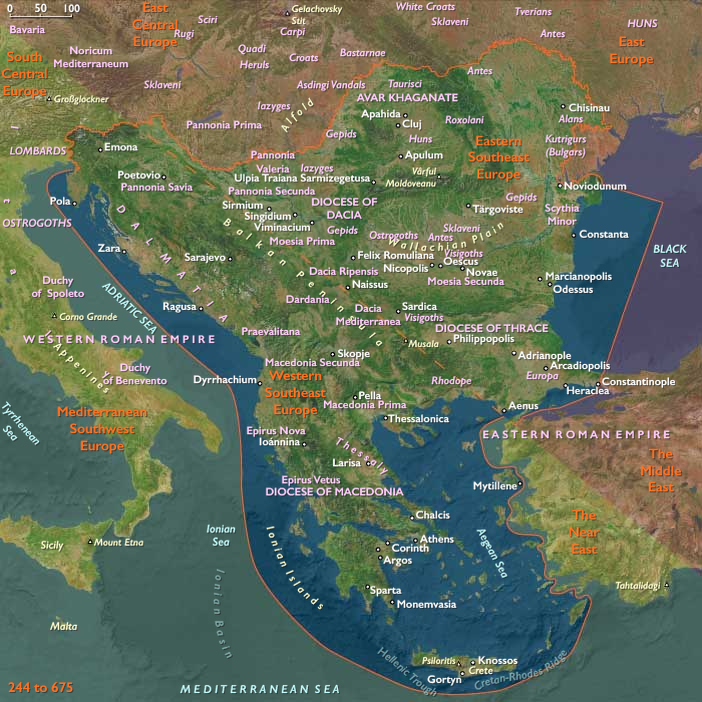
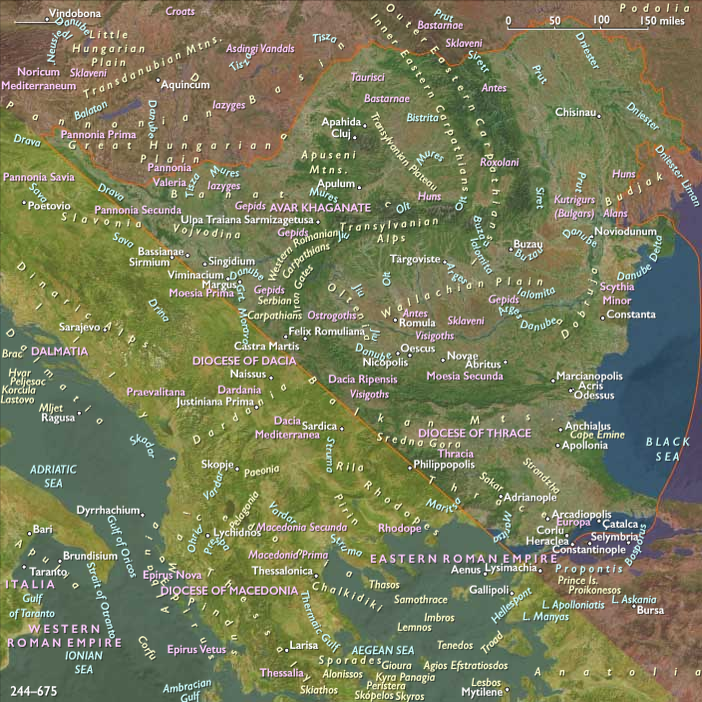
Glycerius is sent to Dalmatia as Bishop of Salona.
Glycerius' deposition is thus without any bloodshed, and historians have investigated the possible reasons why the Western Emperor, who had Gundobad and his army at his command, did not try to resist.
One possible reason is that Glycerius' elevation, not recognized by Eastern court, received the support of neither the Roman Senate nor the Gallic-Roman aristocracy; resisting Nepos without the support of the Senate would have been a bad choice for Gundobad.
It is possible that Gundobad, who was absent from Italy when Glycerius was deposed, had gone to Gaul to gather some more troops or to receive the legacy of his late father Gundioc as King of the Burgundians, thus effectively leaving Glycerius alone.
The child emperor Leo II dies before the end of the year, after having appointed his father co-emperor of the East.
Zeno makes what is to prove a lasting peace with the Vandals in Africa.
The new regime is not particularly popular, as the people of Constantinople are antipathetic to Zeno’s barbarian origins.
Furthermore, the strong Germanic portion of the military, led by Theodoric Strabo, dislikes the Isaurian officers that Leo I had brought in to reduce his dependency on the Ostrogoths.
Finally, Zeno alienates his fellow Isaurian general Illus, his most trusted adviser, who plots a coup d'etat with Leo I's brother-in-law Basiliscus and Verina.
Zeno’s embassy to conclude a peace with king Genseric succeeds in an agreement with the Vandals to secure the commercial routes in the Mediterranean.
Gongju becomes the capital of Baekje, and is threatened by Goguryeo, which conquers the Han River valley.
Euric, one of the more learned of the great Visigothic kings, is the first German to formally codify his people's laws, which had been entrusted to the memory of designated specialists who had learned each article by heart.
The Visigoths' comprehensive “Codex Euricianus,” promulgated around 475, the first collection of Germanic law, displays the considerable influence of Roman law.
The code of law that Euric has had Roman jurists compile for his use is memorable in that it acknowledges the rights of his Roman as well as his Gothic subjects.
(The palimpsest manuscript of the code is preserved in Paris.)
The Visigoths have thrived under Euric, whose kingdom (usually called the kingdom of Toulouse, sometimes the kingdom of Aquitaine) in the western part of the Roman Empire includes what is now southwestern France (south of the Loire and west of the Rhône) and most of Spain.
Over the decades, the Visigoths have gradually expanded their holdings at the expense of the weak Roman government.
Previous Visigothic kings had officially ruled only as legates of the Roman Emperor but Euric is the first to declare his complete independence from the puppet emperors.
In 475, he forces the Western Emperor Julius Nepos to recognize Euric as an independent ruler west of the Rhône Rive in exchange for the return of the Provence region of Gaul.
The Roman citizens of Hispania now pledge their allegiance to Euric, recognizing him as their king.
The Fall of Clermont-Ferrand to the Visigoths (471–475 CE)
The city of Augusto Nemetum (modern Clermont-Ferrand) had long been an important Roman administrative and religious center, becoming the seat of a bishopric in the early fifth century under Bishop Namatius (Saint Namace). He is credited with building a cathedral, later described by Gregory of Tours, marking the city's growing role as a Christian stronghold in late Roman Gaul.
Visigothic Expansion and Repeated Sieges
Between 471 and 475 CE, Clermont-Ferrand becomes a frequent target of Visigothic expansion, as King Euricseeks to consolidate his kingdom by absorbing Auvergne, one of the last major Roman-held territories in Gaul.
- The city is repeatedly besieged by the Visigoths, facing continuous assaults.
- It is defended by Sidonius Apollinaris, a former Roman aristocrat, poet, and bishop of Clermont, and by the patrician Ecdicius, a Roman noble with a small but determined force.
- Despite their efforts, the Western Roman Empire is too weak to provide meaningful reinforcements, leaving the defenders increasingly isolated.
The Roman Cession of Clermont to the Visigoths (475 CE)
By 475 CE, the Western Roman Emperor Julius Nepos, recognizing his empire's declining military strength, formally cedes Auvergne, including Clermont-Ferrand, to the Visigoths in a last-ditch diplomatic effort to preserve what remains of Roman control in Provence and Italy.
- The city's fall to the Visigoths marks the effective end of Roman rule in central Gaul.
- The Visigoths integrate Auvergne into their expanding kingdom, further strengthening their dominance over southern Gaul and Hispania.
The Fate of Sidonius Apollinaris
- As a prominent defender of Clermont, Sidonius Apollinaris is briefly imprisoned by King Euric, due to his active role in the resistance.
- However, he is later restored to his bishopric, allowed to continue governing his diocese until his death.
- His writings provide valuable firsthand accounts of the last days of Roman Gaul, including a surviving letter to Riothamus, where he requests assistance against rebellious Bretons.
The Decline of Roman Influence in Gaul
- The loss of Auvergne to the Visigoths accelerates the collapse of Roman authority in Gaul, leaving only Syagrius' Domain of Soissons as the last significant remnant of Roman rule.
- The Franks, still consolidating their power to the north, will soon become the only major force capable of opposing the Visigoths.
The fall of Clermont-Ferrand is one of the final milestones in the transformation of Roman Gaul into a land ruled by barbarian successor states, signaling the emergence of the early medieval world.
The continental invaders of Britain have established the Jutish kingdom of Kent by 475.
A popular revolt against the emperor starts within the capital in 475.
The uprising receives military support by Theodoric Strabo, Illus and Armatus and succeeds in taking control of Constantinople.
Verina persuades her son-in-law to leave the city.
Zeno flees to his native lands, bringing with him some of the Isaurians living in Constantinople, and the imperial treasury.
Basiliscus is now acclaimed as Augustus on January 9, 475, at the Hebdomon palace, by the palace ministers and the Senate.
The mob of Constantinople takes its revenge, killing almost all of the Isaurians left in the city.
Basilicius supports the Monophysites, who gain control of the key sees of Alexandria, Antioch, and Jerusalem.
However Basiliscus soon manages to estrange himself from most of his key collaborators.
Nepos, a year after ascending the Western throne, is obliged to recognize the independence of the Visigothic kingdom centered near present Toulouse, France.
Orestes, born an aristocrat of Pannonia Savia, is probably at least partly of Germanic descent.
He was the son of Tatulus, a pagan, and son-in-law to Romulus, who had served as comes in the Western Roman Empire.
After Pannonia was ceded to Attila the Hun, Orestes had joined Attila's court, reaching high position as a secretary (notarius) in 449 and 452.
In 449 Orestes had been sent by Attila twice to Constantinople as envoy to Emperor Theodosius II.
In 475, Orestes had been appointed magister militum and patricius by Julius Nepos.
This proves to be a mistake on the part of Nepos.
By August 28, 475, Orestes, at the head of the foederati, manages to take control of the government in Ravenna, which has served as the capital of the Western Roman Empire since 402.
Julius Nepos flees without a fight to Dalmatia, where he will continue to reign until his assassination in 480.
Years: 474 - 474
January
Locations
People
Groups
- Italy, Praetorian prefecture of
- East, or Oriens, Praetorian prefecture of
- Roman Empire, Western (Ravenna)
- Roman Empire, Eastern: Leonid dynasty
