
The British and Colonials had fallen into …
Years: 1879 - 1879
July
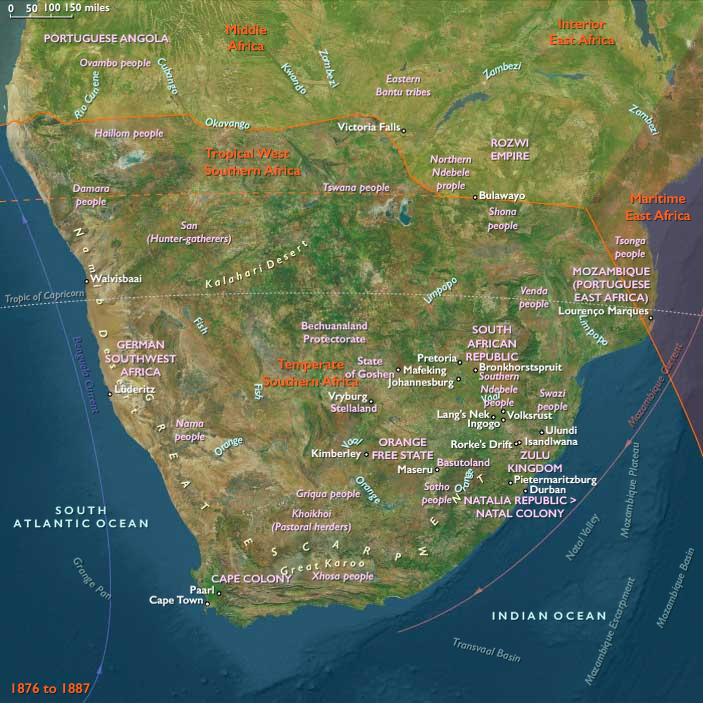
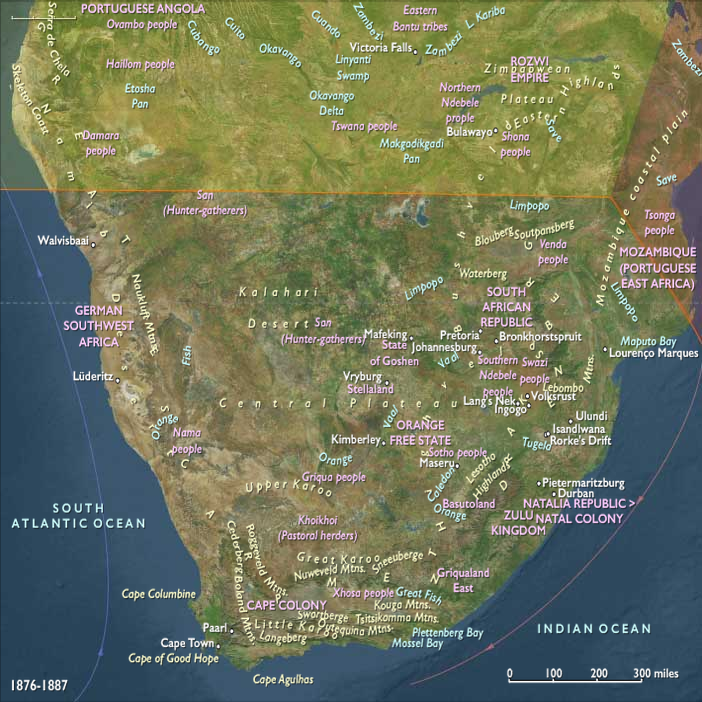
The British and Colonials had fallen into complete panic over the possibility of a counter invasion of Natal by the Zulus following the battles of Isandlwana and Rorke's Drift.
All the towns of Natal have 'laagered' up and fortified and provisions and stores laid in.
Bartle Frere has stoked the fear of invasion despite the fact that, aside from Rorke's Drift, the Zulus have made no attempt to cross the border.
Immediately following the battle, Zulu Prince Ndanbuko had urged them to advance and take the war into the colony but they were restrained by a commander, kaNthati, reminding them of Cetshwayo's prohibiting the crossing the border.
Unknown to the inhabitants of Natal, Cetshwayo, still hoping to avoid a total war, had prohibited any crossing of the border in retaliation and was incensed over the violation of the border by the attack on Rorke's Drift.
The British government's reasoning for a new invasion is threefold.
The first is jingoistic to a degree and national honor demands that the enemy, victors in one battle, should lose the war.
The second concerns the domestic political implications at the next parliamentary elections. (However, despite the new invasion, the British Prime Minister Disraeli and his party will lose the 1880 election.)
Finally, there are considerations affecting the Empire: unless the British are seen to win a clear-cut victory against the Zulus, it will send a signal that the British Empire is vulnerable and that the defeat of a British field army could alter policy.
If the Zulu victory at Isandlwana encourages resistance elsewhere in the Empire, then committing the resources necessary to defeat the Zulus will, in the long term, prove cheaper than fighting wars that the Zulu success inspire against British Imperialism elsewhere.
After Isandlwana, the British field army is heavily reinforced and again invades Zululand.
Sir Garnet Wolseley is sent to take command and relieve Chelmsford, as well as Bartle Frere.
Chelmsford, however, avoids handing over command to Wolseley and manages to defeat the Zulus in a number of engagements, the last of which is the Battle of Ulundi, followed by capture of King Cetshwayo.
The British encourage the subkings of the Zulus to rule their subkingdoms without acknowledging a central Zulu power.
By the time King Cetshwayo is allowed to return home in 1883 there will no longer be an independent Zulu kingdom.
The measure of respect that the British had gained for their opponents as a result of Isandlwana can be seen in that in none of the other engagements of the Zulu War had the British attempted to fight again in their typical linear formation, known famously as the Thin Red Line in an open-field battle with the main Zulu impi.
In the battles that followed, the British, when facing the Zulu, had entrenched themselves or formed very close-order formations, such as the square.
Locations
People
- Benjamin Disraeli
- Cetshwayo kaMpande
- Frederic Thesiger, 2nd Baron Chelmsford
- Garnet Wolseley, 1st Viscount Wolseley
- Henry Bartle Frere
Groups
- Sotho (Basotho or Basuto) people
- Zulu people
- Boers
- Afrikaners
- Britain (United Kingdom of Great Britain and Ireland)
- Cape Colony, British
- Zululand
- Zulu, Kingdom of the
- Matabele Kingdom
- South African Republic (the Transvaal)
- Orange Free State, Republic of the (Boer Republic)
- Transvaal, Republic of the
- South African Republic (the Transvaal) (restored)
- Bechuanaland Protectorate (British)
Topics
Subjects
Regions
Subregions
Related Events
Showing 10 events out of 11580 total
Years: 1879 - 1879
July
Locations
People
- Benjamin Disraeli
- Cetshwayo kaMpande
- Frederic Thesiger, 2nd Baron Chelmsford
- Garnet Wolseley, 1st Viscount Wolseley
- Henry Bartle Frere
Groups
- Sotho (Basotho or Basuto) people
- Zulu people
- Boers
- Afrikaners
- Britain (United Kingdom of Great Britain and Ireland)
- Cape Colony, British
- Zululand
- Zulu, Kingdom of the
- Matabele Kingdom
- South African Republic (the Transvaal)
- Orange Free State, Republic of the (Boer Republic)
- Transvaal, Republic of the
- South African Republic (the Transvaal) (restored)
- Bechuanaland Protectorate (British)
Topics
Subjects
Regions
Subregions