
The majority of the Gallic tribes congratulate …
Years: 58BCE - 58BCE
The majority of the Gallic tribes congratulate Caesar following his victory over the Helvetii, and seek to meet with him in a general assembly.
Diviciacus, the head of the Aeduan government and spokesmen for the Gallic delegation, expresses concern over Ariovistus’ conquests and the hostages he has taken.
Diviciacus demands that Caesar defeat Ariovistus and remove the threat of a Germanic invasion otherwise they would have to seek refuge in a new land.
Not only does Caesar have a responsibility to protect the long-standing allegiance of the Aedui, but this proposition presents an opportunity to expand Rome’s borders, strengthen the loyalty within Caesar’s army and establish him as the commander of Rome’s troops abroad.
As the Senate had declared Ariovistus a “king and friend of the Roman people” in 59 BCE, Caesar cannot declare war on the Suebi tribe.
Caesar, saying that he cannot ignore the pain the Aedui have suffered, delivers an ultimatum to Ariovistus demanding that no German cross the Rhine, the return of Aedui hostages and the protection of the Aedui and other friends of Rome.
Although Ariovistus assures Caesar that the Aedui hostages will be safe as long as they continue their yearly tribute, he takes the position that he and the Romans are both conquerors and that Rome has no jurisdiction over his actions.
With the attack of the Harudes on the Aedui and the report that a hundred clans of Suebi are trying to cross the Rhine into Gaul, Caesar has the justification he needs to wage war against Ariovistus in 58 BCE.
Learning that Ariovistus intends to seize Vesontio, the largest town of the Sequani, Caesar commences marching his troops toward Vesontio.
Some of Caesar’s officers hold their posts for political reasons only and have no war experience.
As a result, they suffer from poor morale which threatens Caesar’s campaign.
Caesar challenges the officers and their legions, saying that the only legion he can trust is the Tenth.
With their pride on the line, the other legions follow the Tenth’s lead, determined not to be outdone.
Consequently, Caesar arrives in Vesontio before Ariovistus.
They meet and rout the Germanic army in the land between the city and river, effecting a massacre as the Germans try to escape over the river.
Most of Ariovistus’ hundred and twenty thousand men are killed.
Some, including Ariovistus himself, manage to cross the river in boats or by swimming.
The rest are cut down by Roman cavalry, including both of Ariovistus's wives and one of his daughters; another daughter is taken prisoner.
Ariovistus and what remains of his troops escape and cross the Rhine, never to engage Rome in battle again.
Both Caesar's emissaries are rescued unharmed, to relate their harrowing adventures as the Germans debated (in their presence) whether they should be burned then or later.
Caesar said that encountering Procillus and freeing him from his chains gave him as much pleasure as the victory, which offers some insight into the emotional climate of Caesar's forces; the officers were a sort of family.
The fate of the twenty-four thousand Harudes is not known.
The Suebi encamped near the Rhine return home.
Caesar is victorious.
Locations
People
Groups
- Dacians, or Getae, or Geto-Dacians
- Gauls
- Roman Republic
- Aedui (Gaulish tribe)
- Helvetii
- Dacia, Kingdom of
- Suebi (Germanic tribe)
Topics
Commodoties
Subjects
Regions
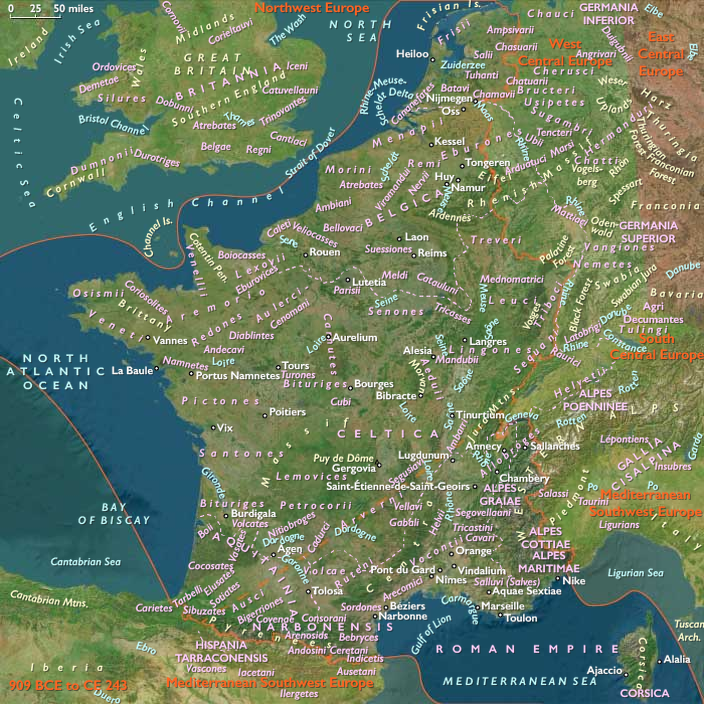
Subregions

Related Events
Showing 1 events out of 1 total
Years: 58BCE - 58BCE
Locations
People
Groups
- Dacians, or Getae, or Geto-Dacians
- Gauls
- Roman Republic
- Aedui (Gaulish tribe)
- Helvetii
- Dacia, Kingdom of
- Suebi (Germanic tribe)
Topics
Commodoties
Subjects
Regions
Subregions