Hiero, pressed by the Roman forces following …
Years: 262BCE - 262BCE
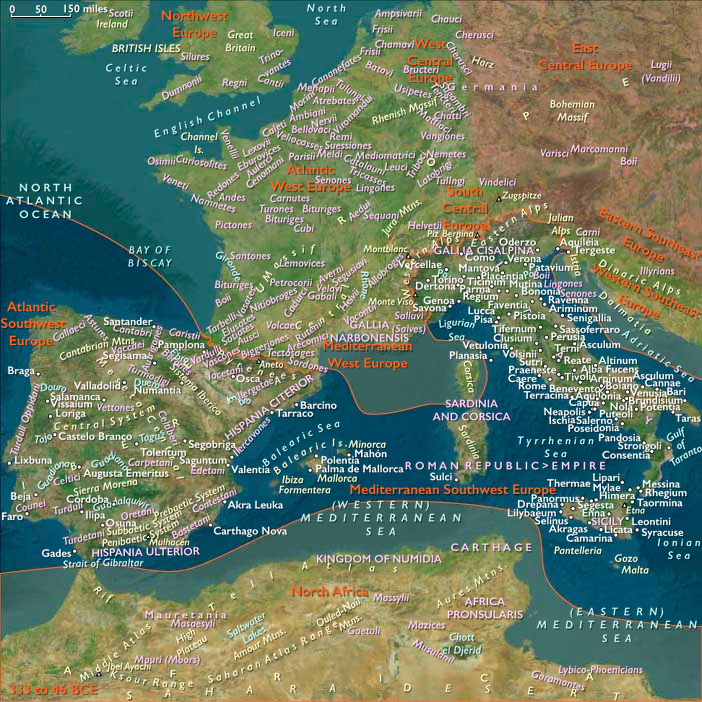
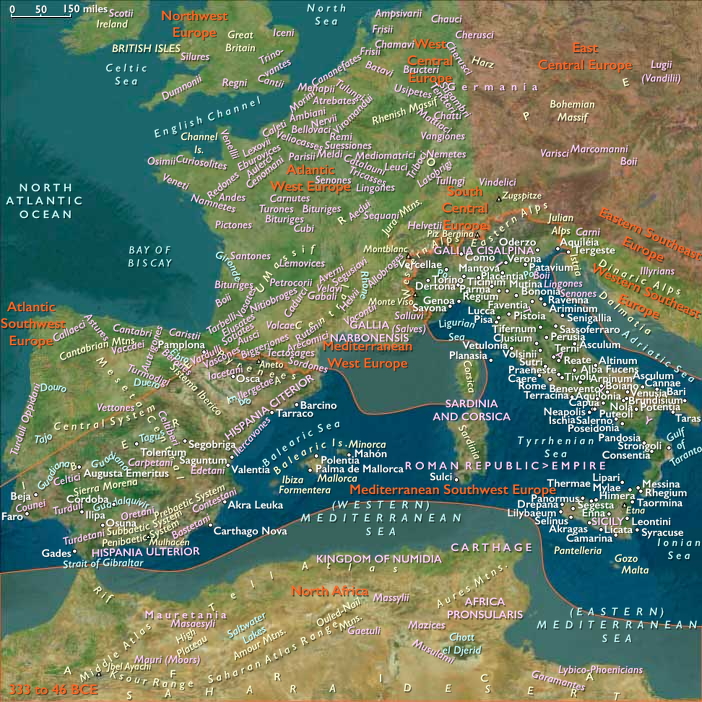
Hiero, pressed by the Roman forces following a Roman attack on Syracuse in 263 BCE, is compelled to conclude a treaty with Rome that restricts his kingdom to southeast Sicily and the eastern coast as far as Tauromenium (Taormina).
In switching his allegiance, he lends the non-seafaring Romans technical support to construct a large navy to challenge Carthaginian control of the seas around Sicily.
Locations
People
Groups
Topics
Commodoties
Subjects
Regions
Subregions
Related Events
Filter results
Showing 10 events out of 63932 total
Eumenes of Pergamon had in 263 BCE succeeded his uncle Philetaerus (reportedly a eunuch), who had abandoned the Seleucids in favor of a tie with Egypt, and defeats the Seleucid army near Sardis (the old capital of Lydia) in 262 BCE, thereby establishing Pergamon as an independent city-state.
Pergamon has great resources in silver, agriculture, and stockbreeding, but only now comes to marked prominence.
The Syrio-Egyptian War of 274-270 BCE had not affected the basic position of the rival kingdoms, but the Chremonidean War has resulted in the weakening of Ptolemaic influence in the Aegean and brought about near disaster to Ptolemy's allies Sparta and …
…Athens.
Their alliance in tatters, the besieged Athenians in 263-262 capitulate to Gonatus; the Chremonidean War will end in 261 with a peace.
The political power of Athens is finally broken, but the city will survive as a cultural center.
Gonatus' appointees replace Athenian officials, and Athens becomes no more than a Macedonian provincial city.
Maurya emperor Asoka is said to have sent missionaries to the East to present Burma (Myanmar) and …
…Thailand.
Chinese builders construct the Dujiangyan Irrigation System on the Min River.
During the Warring States period (406–221 BCE), people who live along the banks of the Min River are plagued by annual flooding.
Qin governor Li Bing investigates the problem and discovers that the river is swelled by fast flowing spring melt-water from the local mountains that bursts the banks when it reaches the slow moving and heavily silted stretch below.
One solution would have been to build a dam, but Li Bing has also been charged with keeping the waterway open for military vessels to supply troops on the frontier, so instead he proposes to construct an artificial levee to redirect a portion of the river's flow and then to cut a channel through Mount Yulei to discharge the excess water upon the dry Chengdu Plain beyond.
Li Bing receives one hundred thousand taels of silver for the project from King Zhao of Qin and sets to work with a team said to number tens of thousands.
The levee is constructed from long sausage-shaped baskets of woven bamboo filled with stones, known as Zhulong, and held in place by wooden tripods known as Macha.
The massive construction, which takes four years to complete, is finished in 256 BCE.
Cutting the channel proves to be a far greater problem as the tools available to Li Bing at the time, prior to the invention of gunpowder, are unable to penetrate the hard rock of the mountain so he uses a combination of fire and water to heat and cool the rocks until they crack and can be removed.
After eight years of work, a twenty meter (sixty-six foot) wide channel has been gouged through the mountain.
After the system is finished, no more floods occur.
The irrigation makes Sichuan the most productive agricultural place in China.
On the east side of Dujiangyan, people build a shrine in remembrance of Li Bing.
Li Bing’s construction is also credited with giving the people of the region a laid-back attitude to life.
By eliminating disaster and insuring a regular and bountiful harvest, it has left them with plenty of free time.
Still in use today to irrigate over 5,300 square kilometers (500,000 acres/202,000 hectares) of land in the region, the Dujiangyan, along with the Zhengguo Canal in Shaanxi Province and the Lingqu Canal in Guangxi Province, are known as “The three great hydraulic engineering projects of the Qin Dynasty”.
The armies of the emerging western Wei valley frontier state of Qin (Ch'in), long an effective opponent of the invaders from central Asia, adopt the nomad tactic of using mounted cavalry troops rather than the traditional Chinese chariots.
With the consequent increase in mobility, the Qin capture the Zhou imperial capital of Luoyang in 256.
Philo of Byzantium, who flourishes around 250 BCE, writes a textbook on mechanics (one of the earliest such known).
He is apparently supported by a wealthy patron, Ariston (to whom each extant section of his great book, three chapters of which survive in fragments, is dedicated).
Philo discusses in a probable nine chapters the lever, the construction of seaports and fortresses, catapults, pneumatics, automatic theaters, and military tactics. (Little else is known of Philo, although both Hero and Vitruvius mention him in their writings.)
Philo is supposedly the author of a work entitled Peri ton hepta theamaton (“Concerning the Seven Wonders of the World”).
In his listing of the monuments, the Pharos of Alexandria replaces the Walls of Babylon.
According to recent research, a section of Philo's Pneumatics which so far has been regarded as a later Arabic interpolation, includes the first description of a water mill in history, placing the invention of the water mill in the mid-third century BCE by the Greeks.
Philo's works also contain the oldest known application of a chain drive in a repeating crossbow.
Two flat-linked chains are connected to a windlass, which by winding back and forth will automatically fire the machine's arrows until its magazine is empty.
Philon also is the first to describe a gimbal: an eight-sided ink pot with an opening on each side could be turned so that any face is on top, dip in a pen and ink it-yet the ink never runs out through the holes of the side.
This is done by the suspension of the inkwell at the center, which is mounted on a series of concentric metal rings that remain stationary no matter which way the pot turns itself.
In his Pneumatics (chapter 31) Philon describes an escapement mechanism, the earliest known, as part of a washstand.
A counterweighted spoon, supplied by a water tank, tips over in a basin when full releasing a pumice in the process.
Once the spoon has emptied, it is pulled up again by the counterweight, closing the door on the pumice by the tightening string.
Philo’s comment that "its construction is similar to that of clocks" indicates that such escapements mechanism were already integrated in ancient water clocks.
In mathematics, Philo tackles the challenge of doubling the cube, necessitated by the following problem: given a catapult, construct a second catapult that is capable of firing a projectile twice as heavy as the projectile of the first catapult.
His solution is to find the point of intersection of a rectangular hyperbola and a circle, a solution that is similar to Heron's solution several centuries later.

The Middle East: 261–250 BCE
The Rise of the Parthians and Shifts in Regional Power
Parthian Expansion and Greek Retreat
By 250 BCE, the Greeks have lost all territories east of Syria to the emerging Persian dynasty known as the Parthians. With these victories, the Parthians assert control over the Persian Gulf, significantly reshaping regional trade dynamics and geopolitical boundaries. They establish their authority firmly enough to extend their influence to Oman, thereby clearly demarcating the Greek world centered around the Mediterranean from the Persian-dominated East.
Trade Routes and Persian Gulf Dominance
The Parthian Empire’s control of the Persian Gulf route stands in sharp contrast to the Greek and, later, Roman reliance on the Red Sea route. To ensure the loyalty and stability of merchant traffic along these vital routes, Parthian rulers station military garrisons as far south as Oman. Persian colonization in the region establishes enduring infrastructures such as the falaj irrigation system, which will sustain agricultural productivity and support local civilizations in Oman for the next two millennia.
Armenian Dynastic Shifts
In 260 BCE, Arsames I consolidates his rule over Commagene, Sophene, and Armenia, following the suspiciously simultaneous deaths of his grandfather, Orontes III (king of Armenia), and his father, Sames (king of Commagene). Although historical records lack details of these deaths, their timing suggests possible external interference, likely involving the Seleucid Empire, which continuously aims to undermine independent Armenian dynasties.
In 254 BCE, Ziaelas of Bithynia, who had found sanctuary at the court of Arsames, returns home upon the death of Nicomedes I to claim the throne of Bithynia, further highlighting the period’s ongoing dynastic intrigues and shifts in regional allegiances.
The Greeks have lost all territory east of Syria to the Parthians, a Persian dynasty in the East, by about 250 BCE.
The Parthians bring the Gulf under Persian control and extend their influence as far as Oman.
The Parthian conquests demarcate the distinction between the Greek world of the Mediterranean Sea and the Persian Empire in the East.
The Greeks, and the Romans after them, depend on the Red Sea route, whereas the Parthians depend on the Persian Gulf route.
Because they need to keep the merchants who ply those routes under their control, the Parthians establish garrisons as far south as Oman.
Persian colonization before the first century CE establishes the falaj irrigation system, which will sustain Omani agriculture and civilization for the next two millennia.