A tsunami following a great earthquake in …
Years: 365 - 365
July
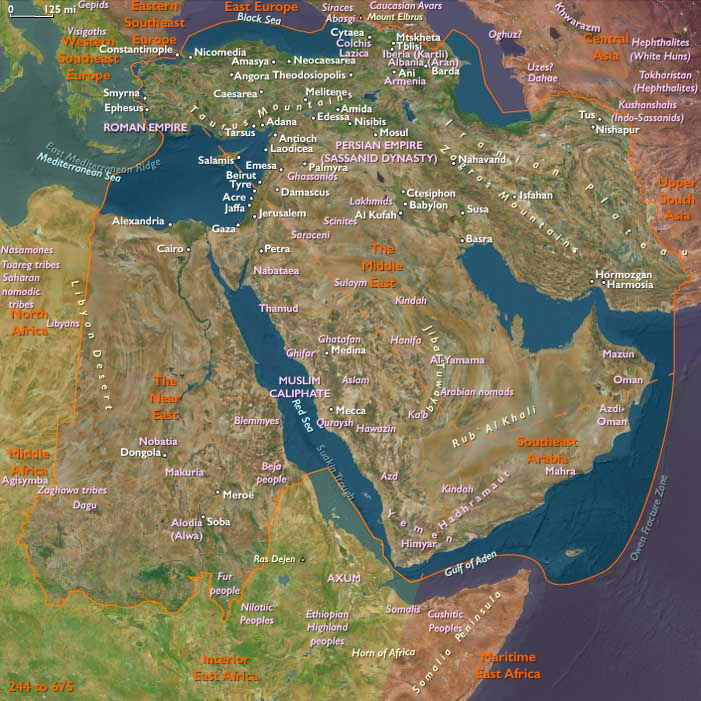
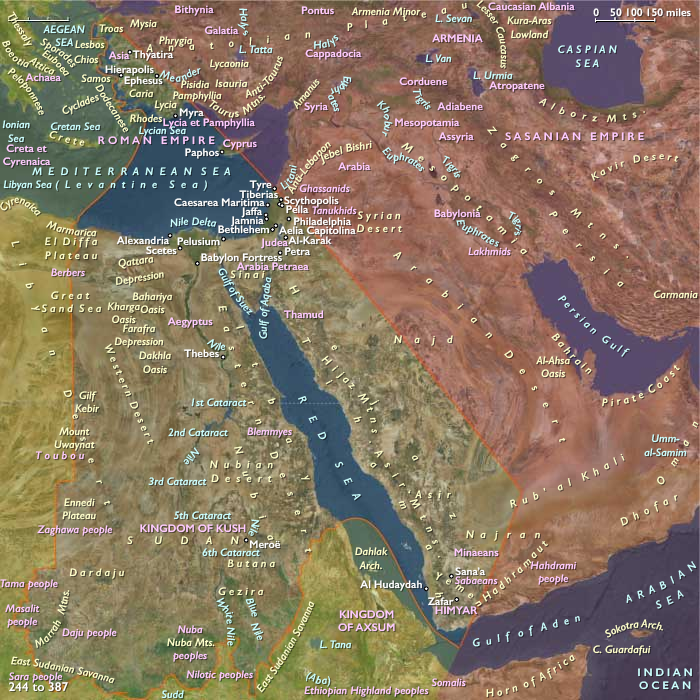
A tsunami following a great earthquake in the Eastern Mediterranean region on July 21, 365, devastates Crete and coastal Egypt, leveling the Pharos of Alexandria, and affecting Italy, Greece and Palestine.
Locations
Groups
- Greece, Roman
- Egypt (Roman province)
- Syria Palæstina, Roman province of (Judea, Samaria, and Idumea)
- Crete (Roman province)
- East, Diocese of the
- Roman Empire: Valentinian dynasty (Rome)
Subjects
Regions
Subregions
Related Events
Filter results
Showing 10 events out of 59675 total
The pagan Procopius, the sole surviving relative of the emperor Julian, had taken part in Julian's campaign against the Persian Empire in 363.
Entrusted with leading thirty thousand men towards Armenia, he had joined King Arsaces and later returned to Julian’s camp.
At the time of Julian's death, there had been rumors that he had intended Procopius to be his successor, but when Jovian was elected emperor by the Roman army, Procopius had gone into hiding to preserve his life.
Though Jovian made accommodations to appease this potential claimant, Procopius fell increasingly under suspicion in the first year of Valens' reign.
The ancient historians differ on the exact details of Procopius's life in hiding, but agree that he returned to public knowledge at Chalcedon before the house of the senator Strategius.
suffering from starvation and ignorant of current affairs.
By this time, Jovian was dead, and Valentinian I had shared the purple with his brother.
The incapable and suspicious Valens has inherited the eastern portion of an empire that had recently retreated from most of its holdings in Mesopotamia and Armenia because of the treaty that his predecessor had made with the Sassanid Empire.
His first priority after the winter of 365 is to move east in hopes of shoring up the situation.
By the autumn of 365, he has reached Cappadocian Caesarea when he learns that Procopius, by bribing two legions passing by Constantinople, had on September 28 proclaimed himself emperor in the imperial city.
Though his early reception in the city seems to have been lukewarm, Procopius wins favor quickly by using propaganda to his advantage: he seals off the city to outside reports and begins spreading rumors that Valentinian had died; he begins minting coinage flaunting his connections to the Constantinian dynasty; and he further exploits dynastic claims by using the widow and daughter of Constantius II to act as showpieces for his regime.
This program meets with some success, particularly among soldiers loyal to the Constantinians and eastern intellectuals who have already begun to feel persecuted by the Valentinians.

Valentinian I’s Response to the Alemanni Invasion (365 CE): The Defense of Gaul
In 365 CE, the Alemanni, having once again crossed the frozen Rhine in large numbers, launched a major incursion into Roman Gaul. On January 2, 365, they defeated Valentinian I’s generals, delivering a serious blow to Roman forces in the region.
Despite this setback, Emperor Valentinian I (r. 364–375 CE) demonstrated tireless energy and strategic focus, initiating a massive effort to fortify and defend the empire’s northern borders.
1. Fortifying the Rhine Frontier
- Valentinian personally took charge of military operations, recognizing the urgent threat posed by the Alemanni.
- He ordered new defensive fortifications along the Rhine, reinforcing existing garrisons and constructing new military bases.
- His strategy emphasized securing key crossings to prevent further barbarian incursions into Gaul.
2. Establishing Command in Lutetia (Paris) by October 365 CE
-
By October 365 CE, Valentinian set up his imperial residence in Lutetia (modern Paris), making it the center of his military operations.
-
From Lutetia, he coordinated:
- Defensive strategies against further Alemanni invasions.
- Counteroffensives to reclaim lost territory.
- The reorganization of Roman forces in Gaul, ensuring better preparedness for future conflicts.
-
Lutetia’s strategic location made it an ideal command center, providing access to both northern and eastern frontiers.
3. Significance of Valentinian’s Defense Efforts
- Valentinian’s leadership stabilized the Rhine frontier, preventing the Alemanni from gaining a permanent foothold in Gaul.
- His military reforms strengthened the Roman border defenses, setting the stage for future Roman counterattacks.
- His personal involvement in military affairs enhanced his reputation as a capable and resolute emperor.
4. Conclusion: A Strong Emperor Against the Barbarian Threat
- Despite the initial defeat of Roman forces in early 365, Valentinian acted swiftly and effectively to secure Gaul.
- His presence in Lutetia as a wartime headquarters marked an important moment in the city’s history, reinforcing its role as a key Roman stronghold.
- His campaigns against the Alemanni would continue in the following years, leading to a decisive Roman victory in 368 CE, securing the Rhine frontier for a time.
Through determination and strategic foresight, Valentinian proved to be one of the last great defenders of the Western Roman Empire, successfully holding back the barbarian tide for another generation.
Valens, left with the task of dealing with Procopius, considers abdication and perhaps even suicide, but soon steadies his resolve to fight.
His efforts to forestall the usurper are hampered by the fact that most of his troops had already crossed the Cilician gates into Syria when he learned of the revolt.
Even so, Valens sends two legions to march on Procopius, who easily persuades them to desert to him.
Valens himself is nearly captured in a scramble near Chalcedon.
Troubles are exacerbated by the refusal of Valentinian to do any more than protect his own territory from encroachment.
The failure of imperial resistance in 365 allows Procopius to gain control of the dioceses of Thrace and Asiana by year's end.
Geunchogo, the second son of Biryu, the eleventh king of Baekje, had become king in 346 upon the death of the twelfth king, Gye.
His reign seems to have marked the permanent ascendancy of the descendants of the fifth king Chogo (reflected in Geunchogo's name) over those of the eighth king, Goi, and ended the alternating kingship of the two lines.
Having set set out to solidify the royal power within the Baekje state upon ascending the throne, he has reduced the power of the aristocracy and set up a system of local government with regional heads appointed by the court.
He has married a wife from the Jin clan, setting a precedent for his successors, and he has moved the capital to Hansan, today's southeast Seoul.
The first Korean envoy to Japan, an emissary of the government of Baekje, reportedly arrives in 366.
In this year, Geunchogo allies with Silla, which borders Baekje on the east, maintaining a rough balance of power among the Three Kingdoms.
Construction of the Buddhist cave shrines known today as the Mogao Caves, or Mogao Grottoes, also known as the Caves of the Thousand Buddhas and Dunhuang Caves, begins in 366 as a places to store scriptures and art.
According to local legend, a Buddhist monk, Lè Zūn, had a vision of "golden rays of light shining down on one thousand Buddhas" and inspired the excavation of the caves he had envisioned.
The number of temples will eventually grow to more than a thousand.
When completed, the caves will form a system of four hundred and ninety two temples, twenty-five kilometers (fifteen and a half miles) southeast of the center of Dunhuang, an oasis strategically located at a religious and cultural crossroads on the Silk Road, in Gansu province, China.
The caves contain some of the finest examples of Buddhist art spanning a period of one thousand years.
Valens has finally assembled enough troops to deal effectively with the usurper Procopius in the spring of 366.
Marching out from Ancyra through Pessinus, Valens proceeds into Phrygia, where he defeats Procopius's general Gomoarius at the Battle of Thyatira.
The defeat of Gomoarius decreases the hopes of Procopius, so that, when Valens reaches Procopius and his troops at Nacoleia, the troops of the usurper desert their commander, and Procopius is on May 27 executed by the army, most of which have remained faithful to Valens, and his head sent to Valentinian in Trier for inspection.
Jovian had surrendered Rome's much disputed claim to control over Armenia in 363, and Shapur II, being eager to make good on this new opportunity, had begun enticing Armenian lords over to his camp, eventually forcing the defection of the Arsacid Armenian king, Arshak II, whom he had quickly arrested and incarcerated.
Shapur had then sent an invasion force to seize Caucasian Iberia and a second to besiege Arshak's son, Pap, in the fortress of Artogerassa, probably in 367.
By the following spring, Pap has engineered his escape from the fortress and flight to Valens, whom he seems to have met at Marcianople, Valens’s winter quarters, while campaigning against the Goths.
A Danube flood in spring 368 prevents Valens from crossing; instead the emperor occupies his troops with the construction of fortifications.
Valens next wages war on the Thervings, now settled agriculturists in Dacia, who had aided Procopius and are threatening to invade Thrace.
The Tervingi, at this time under the leadership of Athanaric, had apparently remained peaceful since their defeat under Constantine in 332.
The Emperor, furious at their support of the late would-be usurper, crosses the Danube in May 367 and devastates the Gothic territories in modern Romania.
The Thervings flee into the Carpathian Mountains, and elude Valens' advance, forcing him to return later in the summer.
Julian had recalled Aëtius of Antioch from exile, bestowed upon him an estate in Lesbos, and retained him for a time at his court in Constantinople.
Having been consecrated as a bishop, Aëtius had used his office in the interests of Arianism by creating other bishops of that party.
At the accession of Valens in 364, Aëtius had retired to his estate at Lesbos, but soon returned to Constantinople, where he dies in 367.
Eunomius of Cyzicus, deposed from his bishopric by Constantius for his extreme Arianist views, had resided in Constantinople during the reigns of Julian and Jovian, in close intercourse with his mentor Aëtius, consolidating an heretical party and consecrating schismatical bishops.
He had then gone to live at Chalcedon, whence in 367 he is banished to Mauretania for harboring the rebel Procopius.
He is recalled, however, before he reaches his destination.
Years: 365 - 365
July
Locations
Groups
- Greece, Roman
- Egypt (Roman province)
- Syria Palæstina, Roman province of (Judea, Samaria, and Idumea)
- Crete (Roman province)
- East, Diocese of the
- Roman Empire: Valentinian dynasty (Rome)