
Desiderio da Settignano adopts Donatello's technique of …
Years: 1454 - 1454
Desiderio da Settignano adopts Donatello's technique of rilievo schiacciato ("flattened relief") and employs it with the greatest delicacy.
Born around 1430 in the stone cutting center of Settignano near Florence, and possibly a pupil of Donatello, Desiderio’s tomb of the humanist Carlo Marsuppini, completed after 1453 for the church of Santa Croce, is made to complement the tomb opposite it done by Bernardo Rosselino, but Desiderio's is lighter and more graceful. (Other works attributed to Desiderio, on the basis of their stylistic relation to these two major monuments, include a frieze of putti heads for Santa Croce’s Pazzi Chapel, a relief of “Saint John,” and a “Madonna and Child,” all believed to have been completed before the completion of the Marsuppini tomb.)
Italian sculptor-architect Mino da Fiesole, at about twenty-four, had created a bust of Piero de' Medici in 1453, inspired by antique Roman models.
This is the earliest-known dated Renaissance portrait bust.
Mino’s other important busts of the era, notable for their realism and vigor, include those of Niccolo Strozzi, executed in 1454, and Astorgio Manfredi, in 1455.
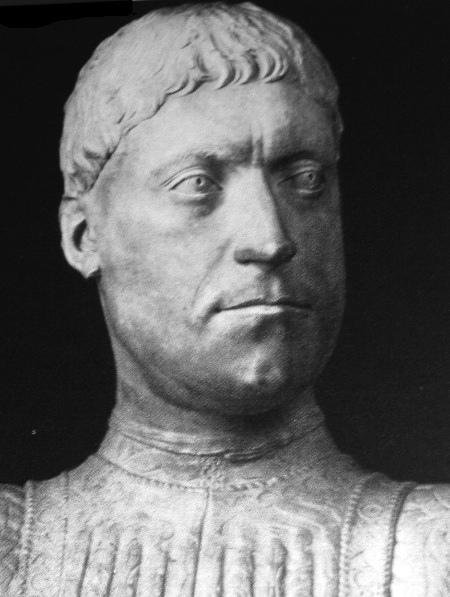
Mino da Fiesole: Piero de Medici, son of Cosimo, father of Lorenzo the Magnificent (scanned from "Lorenzo the Magnificent" Hugh Ross Williams)
Locations
People
Groups
Topics
Subjects
Regions
Subregions
Related Events
Showing 2 events out of 2 total
Years: 1454 - 1454
Mino da Fiesole: Piero de Medici, son of Cosimo, father of Lorenzo the Magnificent (scanned from "Lorenzo the Magnificent" Hugh Ross Williams)
Locations
People
Groups
Topics
Subjects
Regions
Subregions