
The Solutrean Tool Industry (c. 18,000–15,000 BCE) …
Years: 16461BCE - 14734BCE
The Solutrean Tool Industry (c. 18,000–15,000 BCE)
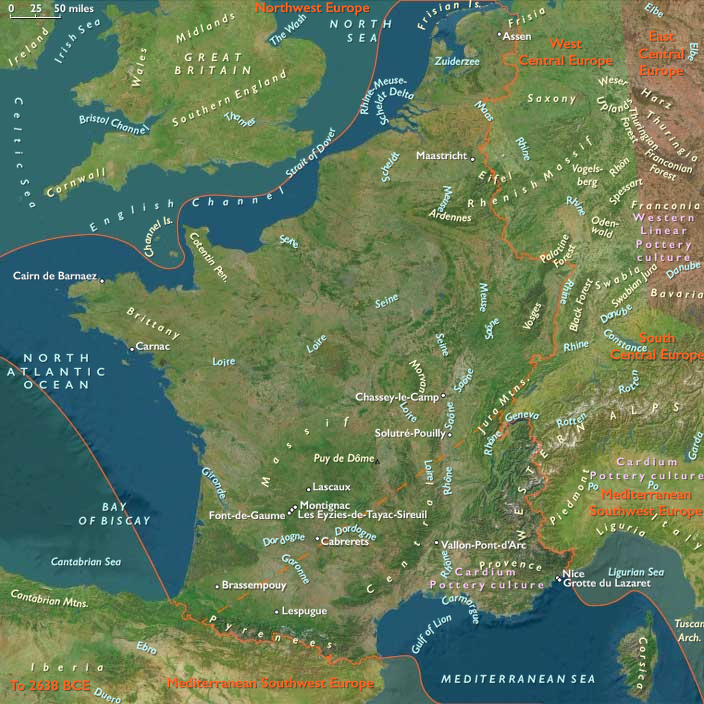
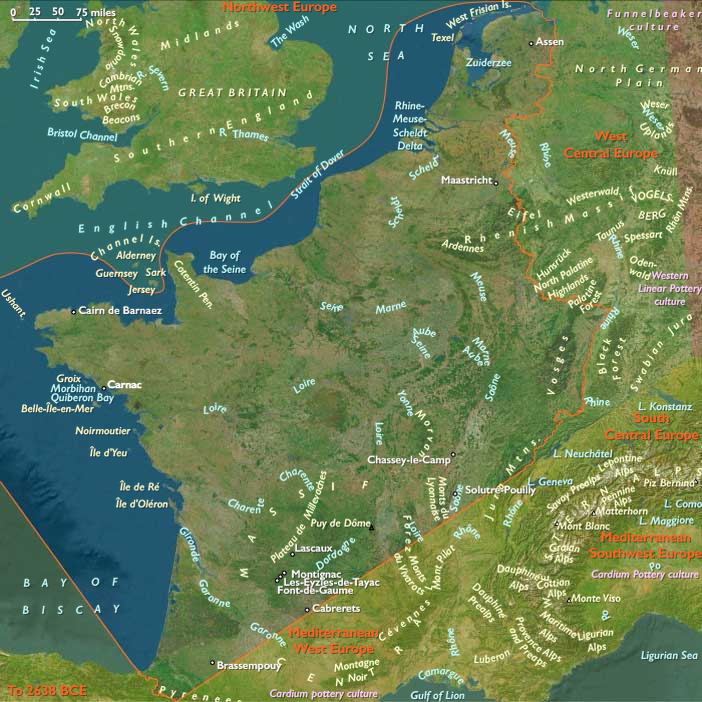
The Solutrean tool industry, named after the site of Solutré, near Mâcon, France, was a brief but technologically spectacular phase of the Upper Paleolithic. Geographically restricted to central and western France and northeastern Spain, it emerged around 18,000 BCE in southwestern France before disappearing by 15,000 BCE.
Characteristics of Solutrean Tool Collections
- Side scrapers – The most abundant tool type, used for processing hides, wood, and bone.
- Borers and gravers – Frequently used for engraving and working organic materials such as bone and antler.
- Burins – Less common but still present, used for carving and shaping.
The Solutrean Laurel Leaf: A Masterpiece of Stoneworking
- The Solutrean laurel leaf, a lanceolate point of varying length, is the hallmark of Solutrean craftsmanship.
- The earliest examples were unifacially worked, meaning flaked on only one side.
- Later versions show bifacial retouching, making them thinner, more symmetrical, and highly refined.
- These points were likely used as projectile tips or ceremonial objects, showcasing the exquisite flint-knapping skills of Solutrean artisans.
Significance of the Solutrean Industry
- Solutrean artisans developed advanced pressure flaking techniques, allowing for thin, delicate, and finely retouched tools—a skill level unmatched in earlier tool industries.
- The geographic and chronological isolation of the Solutrean industry suggests it may have been an adaptive response to cold-climate conditions during the Last Glacial Maximum.
- The disappearance of the Solutrean tradition around 15,000 BCE coincided with the transition to the Magdalenian culture, which emphasized bone and antler tools over highly flaked stone points.
Despite its brief duration, the Solutrean tool industry represents a peak of Paleolithic stone craftsmanship, demonstrating a level of precision and artistry that remains one of the greatest achievements of Ice Age technology.
Locations
Groups
Topics
Subjects
Regions
Subregions
Related Events
Showing 10 events out of 69434 total
Years: 16461BCE - 14734BCE
Locations
Groups
Topics
Subjects
Regions
Subregions