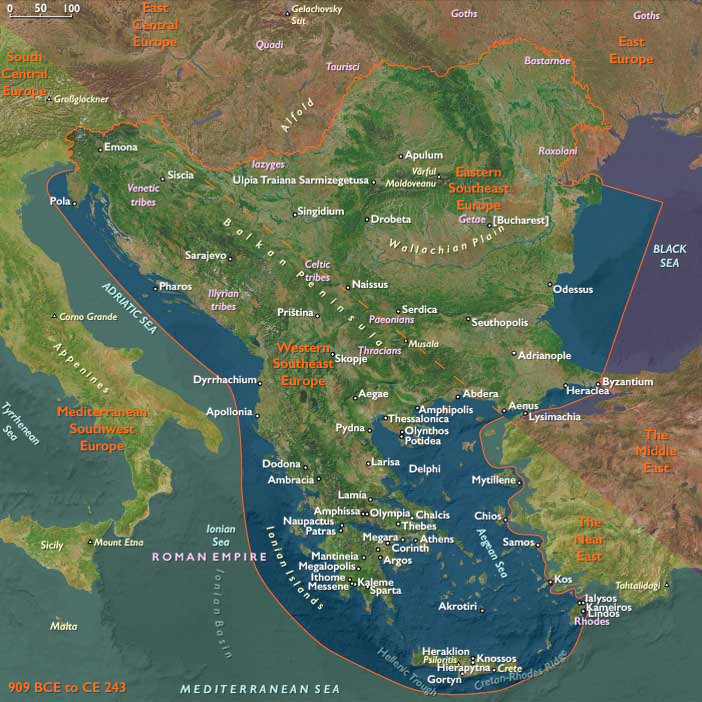
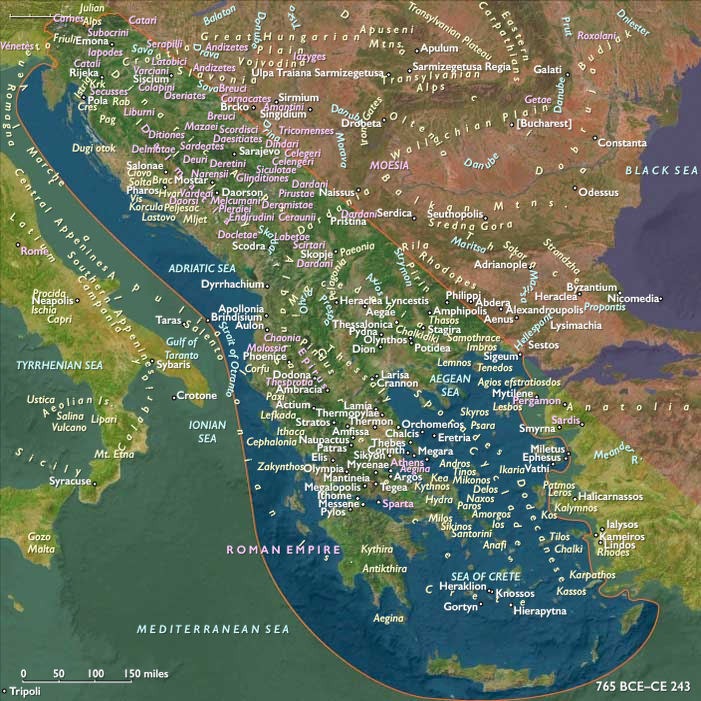
Flaminius now accuses Nabis of tyranny, …
Years: 196BCE - 196BCE
Flaminius now accuses Nabis of tyranny, …
Locations
People
Groups
- Argos, City-State of
- Sparta, Kingdom of
- Aetolian League
- Greece, Hellenistic
- Macedon, Antigonid Kingdom of
- Achaean League, Second
- Seleucid Empire
Topics
Commodoties
Subjects
Regions
Subregions
Related Events
Filter results
Showing 10 events out of 28 total
Mediterranean West Europe (820 – 963 CE): Carolingian Lotharingia, Early Provence, and Rhone–Mediterranean Trade
Geographic and Environmental Context
Mediterranean West Europe includes southern France (from the Rhône valley to the Pyrenees, including Languedoc, Provence, and Roussillon), Monaco, Corsica, Lyon, and the southern Jura.
-
Anchors: the Rhône Valley (Lyon–Avignon–Arles–Marseille), the southern Jura gateways to Burgundy and Helvetia, the Provençal littoral (Nice, Toulon, Avignon, Marseille), the Languedoc plain (Narbonne, Carcassonne, Montpellier), the Roussillon/Catalan marches (Perpignan, Pyrenean passes to Aragon/Andorra), Corsica in the Tyrrhenian, and Monaco as a fortified seigneurial port.
Climate and Environmental Shifts
-
The early Medieval Warm Period improved cereal yields and vineyard productivity.
-
The Rhône valley and Languedoc plain supported olives, vines, and wheat; Jura uplands supported cattle and dairying.
Societies and Political Developments
-
After the Treaty of Verdun (843), much of the Rhône–Provence–Languedoc fell into Middle Francia (Lothair’s realm), later fragmenting into Burgundian and Provençal polities.
-
County of Provence consolidated around Arles and Marseille.
-
Septimania/Languedoc: local counts balanced between Frankish kings and Umayyad/Andalusian influence from across the Pyrenees.
-
Corsica: contested between local lords and Saracen raids.
-
Lyon emerged as an ecclesiastical center and a nodal point in Carolingian administration.
Economy and Trade
-
Rhone trade: wine, salt, and grain moved downstream to Arles and Marseille; luxury goods and silks from Italy passed upriver toward Lyon.
-
Agriculture: wheat, olives, and vines in Provence/Languedoc; cattle and cheese in Jura.
-
Corsica provided timber and pasturage.
Belief and Symbolism
-
Christianity anchored in monastic reform (Cluniac currents rising in the Jura).
-
Episcopal sees (Lyon, Arles, Narbonne) supervised cultural continuity.
Long-Term Significance
By 963, Mediterranean West Europe was a frontier zone of Carolingian heirs, with Rhône–Provençal commerce, Languedoc counts, and Corsican raiding setting the stage for 11th-century growth.
West Europe (820 – 963 CE): Carolingian Fragmentation, Monastic Renewal, and the Birth of Normandy
Geographic and Environmental Context
West Europe in this age stretched from the Rhône and Languedoc plains to the Loire and Seine valleys, the Channel coasts, and the Low Countries, forming the western heartlands of the former Carolingian Empire.
Two major subregions framed its geography:
-
Mediterranean West Europe—the Rhône valley, Provence, Languedoc, and Roussillon, connecting Burgundy and the Frankish interior to the western Mediterranean and Pyrenees.
-
Atlantic West Europe—northern France and the Low Countries, dominated by the Seine, Loire, and Scheldt basins opening to the Channel and North Sea.
From the Alpine passes and Jura uplands to the Breton headlands, river systems underpinned trade and defense, while the onset of the Medieval Warm Period after c. 950 lengthened growing seasons and expanded viticulture and grain production.
Societies and Political Developments
Mediterranean West Europe: Provençal Polities and the Rhone Corridor
-
After the Treaty of Verdun (843), the Rhône–Provence–Languedoc belt entered Middle Francia (Lothair’s realm), later fragmenting into Burgundian and Provençal spheres.
-
The County of Provence centered on Arles and Marseille; Septimania (Languedoc) balanced between Frankish and Andalusian influence across the Pyrenees.
-
Corsica remained semi-autonomous but suffered frequent Saracen raids; Monaco and coastal towns fortified themselves under local lords.
-
Lyon served as an ecclesiastical and Carolingian administrative hub, mediating Burgundy’s ties to the Mediterranean.
-
Regional counts in Narbonne, Carcassonne, and Montpellier asserted practical independence, forming the political seedbed of later Occitan culture.
Atlantic West Europe: Carolingian Successors and Viking Frontiers
-
Carolingian fragmentation (843–888) divided the western realm into West Francia, Burgundy, and Lotharingia.
-
Paris emerged as a fortified bastion against Viking fleets, who exploited navigable rivers—Seine, Loire, Scheldt—to plunder Rouen, Nantes, Tours, and Ghent.
-
The Treaty of Saint-Clair-sur-Epte (911) created the Duchy of Normandy under the Viking leader Rollo, securing coastal settlement and Christian conversion.
-
Flanders developed as a fortified marcher county, mediating between West Francia and Lotharingia, while Brittany alternated between independence and Frankish pressure.
-
In the Loire basin, regional counts (Anjou, Blois, Poitiers) consolidated territories that would later define the Capetian and Angevin worlds.
Economy and Trade
-
Agriculture:
-
Provence & Languedoc: olives, vines, wheat, and cattle; terraces and irrigation along the Rhône.
-
Northern France & Flanders: cereals, flax, and wool; viticulture on the Loire and Seine; cattle and dairying in Flanders and the Jura.
-
-
Rhone–Mediterranean trade: wine, salt, and grain moved downriver to Arles and Marseille; silks and spices from Italy moved upriver to Lyon and Burgundy.
-
Atlantic markets: Channel fisheries, salt pans, and wool processing in Flanders; Scheldt trade linked to the Rhine–Meuse.
-
Ports and routes:
-
Marseille, Narbonne, Arles connected inland Gaul to the Mediterranean.
-
Rouen, Nantes, and Bruges became northern entrepôts for textiles, salt, and grain.
-
-
Monetization: Carolingian deniers remained the standard; regional mints in Lyon, Tours, and Rouen circulated silver coins that tied seigneurial economies to long-distance trade.
Subsistence and Technology
-
Cereal expansion: heavy plow adoption on the loess soils of the Seine–Loire basins.
-
Viticulture: Rhone, Burgundy, and Loire slopes terraced for wine; barrels and presses standardized storage.
-
Maritime and river transport: flat-bottomed boats and clinker-built vessels navigated river–sea transitions.
-
Defensive architecture: wooden motte-and-bailey prototypes appeared by the 10th century; stone keeps in Provence and Narbonne guarded trade routes.
-
Monastic estates integrated mills, vineyards, and waterworks, providing food security and technical innovation.
Movement and Interaction Corridors
-
Rhône corridor: Burgundy ⇄ Provence ⇄ Mediterranean ports.
-
Loire & Seine rivers: arteries of Carolingian and Viking-era commerce; connected Paris and Tours to the Atlantic.
-
Via Domitia: Roman road linking Nîmes, Narbonne, and the Pyrenees.
-
Scheldt–Rhine–Meuse delta: network joining Flanders to the Rhineland and North Sea markets.
-
Pyrenean passes: opened communication between Roussillon and Aragon/Andorra, precursors to Catalan integration.
Belief and Symbolism
-
Christianity and reform:
-
Episcopal sees (Lyon, Arles, Narbonne, Reims, Tours) maintained Carolingian ecclesiastical continuity.
-
Cluny Abbey (founded 910) in Burgundy initiated the monastic reform movement that revitalized European spirituality and discipline.
-
-
Monastic patronage: monasteries in the Rhône–Saône–Loire triangle (Cluny, Tournus, Vézelay) and in Tourssafeguarded manuscripts and relics during Viking disruptions.
-
Relic cults and pilgrimage: shrines at Tours (St. Martin), Chartres, and Reims drew pilgrims and royal patronage.
-
Syncretism: Christian and regional traditions fused—Roman saints in Languedoc, local miracle cults in Burgundy, and re-sanctified pagan sites in Brittany and the Jura.
Adaptation and Resilience
-
Political decentralization created flexible local governance: counts and bishops stabilized territories when kingship faltered.
-
Riverine redundancy: when overland travel was unsafe, goods moved by river; when Vikings disrupted the Seine, the Loire or Rhône systems took up traffic.
-
Maritime continuity: even during raids, coastal trade adapted through fortified ports and protected monastic harbors.
-
Monastic organization and Cluniac discipline reasserted stability, literacy, and agrarian innovation.
-
Agrarian diversification—grains, vines, livestock—buffered communities from climate and warfare shocks.
Long-Term Significance
By 963 CE, West Europe had reorganized itself around river valleys, fortified counties, and monastic centers:
-
The Rhone–Provence corridor revived Mediterranean exchange under Burgundian and Provençal counts.
-
The Seine–Loire heartland endured Viking assault and birthed Normandy, a hybrid duchy bridging Norse vigor and Frankish order.
-
Flanders and Burgundy prospered as border economies balancing Latin and Germanic realms.
-
The Cluniac reform radiated spiritual renewal from Burgundy across Europe.
These patterns—local lordship, monastic reform, fortified commerce, and riverine unity—defined the political and cultural rebirth that would propel West Europe into the high medieval age.
The Magyars devastate Burgundy in 937, overcoming French defenders led by Burgundy’s King Rudolph, who dies in this year, and is succeeded by his son Conrad.
Hugh makes peace in 933 with Rudolph of Upper Burgundy by giving him the Kingdom of Lower Burgundy, and the two the Transjurane and Cisjurane sections of Burgundy are combined into a single Kingdom of Burgundy (later called Arles).
Rudolph, in turn, relinquishes all his rights to Italy.
Hugh replaces Boso of Tuscany with his own son Hubert in 936.
He grants Octavion in the Viennois to Hugh Taillefer and patches up his relations with Charles-Constantine in a final effort to save influence in Provence.
Hugh of Italy has maintained friendly relations with Constantinople and, in 942, Hugh even comes to terms with Alberic, who marries one of Hugh's daughters.
Romanos concludes a treaty with Prince Igor of Kiev in 944.
This crisis having passed, Kourkouas is free to return to the eastern frontier.
It has sometimes been suggested that a marriage alliance might bring together the Eastern and Western parts of the empire and so provide for a united defense against the common enemy in Sicily—the Arabs.
In 944, Constantine's five-year-old son is married to a daughter of Hugh of Provence, the Carolingian claimant to Italy.
Constantine also keeps up diplomatic contact with Otto I, the Saxon king of Germany.
Romanos' later reign has been marked by the old emperor's heightened interest in divine judgment and his increasing sense of guilt for his role in the usurpation of the throne from Constantine VII.
On the death of Christopher, by far his most competent son, in 931, Romanos had not advanced his younger sons in precedence over Constantine VII.
Fearing that Romanos will allow Constantine VII to succeed him instead of them, his younger sons Stephen and Constantine, impatient to succeed to power, arrest their father in December 944, carry him off to the Prince's Islands and compel him to become a monk.
The Lekapenos brothers threaten the position of Constantine VII, and the people of Constantinople, fearing only that the Porphyrogenitus emperor might be included in the purge accompanying the seizure of power, riot until Constantine appears at a window of the palace.
This show of loyalty emboldens him to banish Romanus' sons on January 27, 945.
Stephen and Constantine are likewise stripped of their imperial rank and sent into exile to their father.
Having never exercised executive authority, Constantine remains primarily devoted to his scholarly pursuits and relegates his authority to bureaucrats and generals, as well as to his energetic wife Helena Lekapene, the daughter of Emperor Romanos I and his wife Theodora.
Romanos II is a son of Emperor Constantine VII and Helena Lekapene.
Named after his maternal grandfather, Romanos had been married, as a child, to Bertha, the illegitimate daughter of Hugh of Arles, King of Italy, who changes her name to Eudokia after her marriage.
Constantine crowns his son Romanos co-emperor on April 6, 945.
John Kourkouas, although considered by some of his contemporaries "a second Trajan or Belisarius," is dismissed after the fall of the Lekapenoi in 945.
Nevertheless, his campaigns in the East have paved the way for the even more dramatic reconquests in the middle and the second half of the tenth century.
Constantine, now thirty-nine, will rule alone from this point forward.
He appoints to the highest army commands four members of the Phokas family, which had been in disgrace under the Lekapenoi, but takes no further reprisals, except for an incidental remark, in De ceremoniis, that Romanus Lecapenus was neither an aristocrat nor a cultured man.
That he does not depart from the admiral's basic policy-at home, maintaining a delicate balance among civil and military officers, landed aristocrats, and peasant soldiers; abroad, friendship with the Rus, peace with the Bulgarians, a limited commitment in Italy, and a resolute offensive against the Muslims—may be ascribed to statesmanship as well as to timidity.
The policy continues to be effective.
The Chersonese Greeks had alert the emperor about the approaching Kievans, who fled in 944/945.
This time, Constantinople hastens to buy peace and concludes a treaty with Kievan Rus'.
Its text is quoted in full in the Primary Chronicle.
The Emperor had sent gifts and offered tribute in lieu of war, and the Rus’ had accepted.
Envoys are sent between the Rus’, Constantinople, and the Bulgarians in 945, and a peace treaty is completed.
The agreement again focused on trade, but this time with terms less favorable to the Rus’, including stringent regulations on the conduct of Rus’ merchants in Cherson and Constantinople and specific punishments for violations of the law.
Constantinople may have been motivated to enter the treaty out of concern of a prolonged alliance of the Rus', Pechenegs, and Bulgarians against them, though the more favorable terms further suggest a shift in power.

Within the Kingdom of Italy, Hugh has intensified his existing habit of giving any available offices or lands to relations, including his numerous legitimate and illegitimate progeny, and a small circle of old and trusted friends.
The effect this has had on Italian nobles, who see this as threatening themselves, eventually results in rebellion.
In 941, Hugh had expelled Berengar of Ivrea from Italy and abolished the March of Ivrea.
In 945, Berengar returns from exile in Germany and defeats Hugh in battle.
By a diet Berengar holds at Milan, Hugh is deposed, though he manages to come to terms by which he nominally keeps the crown and the title rex (king) but returns to Provence, leaving his son Lothair as nominal king, but with all real power in Berengar's hands.
Hugh had retired to Provence, but continued to carry the royal title until his death in 947.
Lothair II, although he holds the title of rex Italiae, will never succeeded in exercising power here.
He had been betrothed in 931 and had been married, on December 12, 947, to the fifteen-year-old Adelaide, the spirited and intelligent daughter of Rudolph II of Burgundy and Bertha of Swabia.
Their marriage is part of a political settlement designed to conclude a peace between her father and his.
In 933, Hugh of Arles had given up his kingdom (Provence) to his inveterate enemy Rudolph II, who merged the two kingdoms into a new Kingdom of Arles, but died in 937.
The couple have a daughter, Emma, born as early as 948, who will be married in 966 to the Carolingian Lothair of France.
Lothair's power in Italy is nominal.
From the time of the successful uprising of the nobles in 945, when Hugh had been forced into exile, Berengar of Ivrea has kept all real power and patronage in his hands.
Lothair's brief "reign" comes to an end with his death on November 22, 950, presumably poisoned by Berengar II, leaving Adelaide widowed before her twentieth birthday.
Berengar II crowns himself king with his son Adalbert of Italy as his co-ruler and heir apparent.
Failing to receive widespread support for his right to the crown, Berengar II attempts to legitimize his reign and tries to force Adelaide, the respective daughter, daughter-in-law and widow of the last three Italian kings, into marriage with Adalbert.
Adelaide fiercely refuses and is imprisoned by Berengar II at Garda Lake.
Years: 196BCE - 196BCE
Locations
People
Groups
- Argos, City-State of
- Sparta, Kingdom of
- Aetolian League
- Greece, Hellenistic
- Macedon, Antigonid Kingdom of
- Achaean League, Second
- Seleucid Empire