Flamininus has made allies of most of …
Years: 197BCE - 197BCE
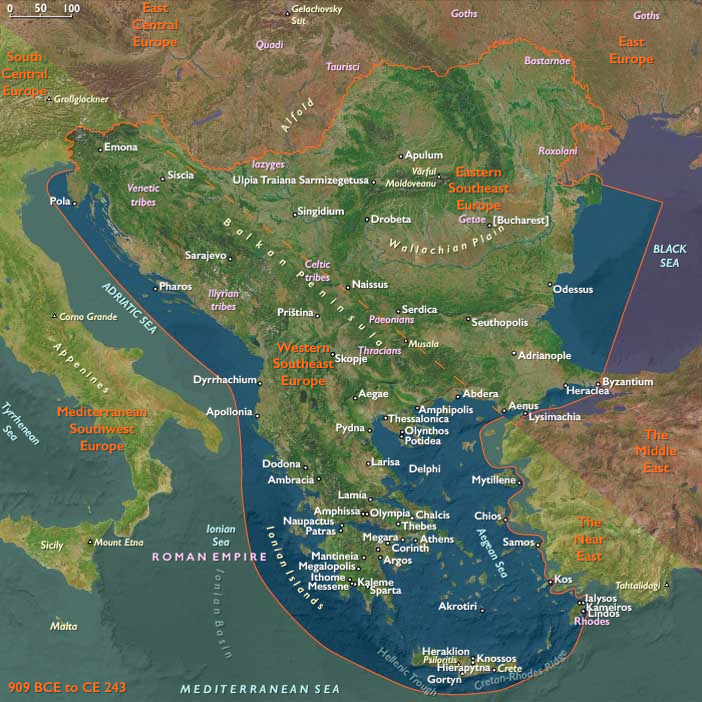
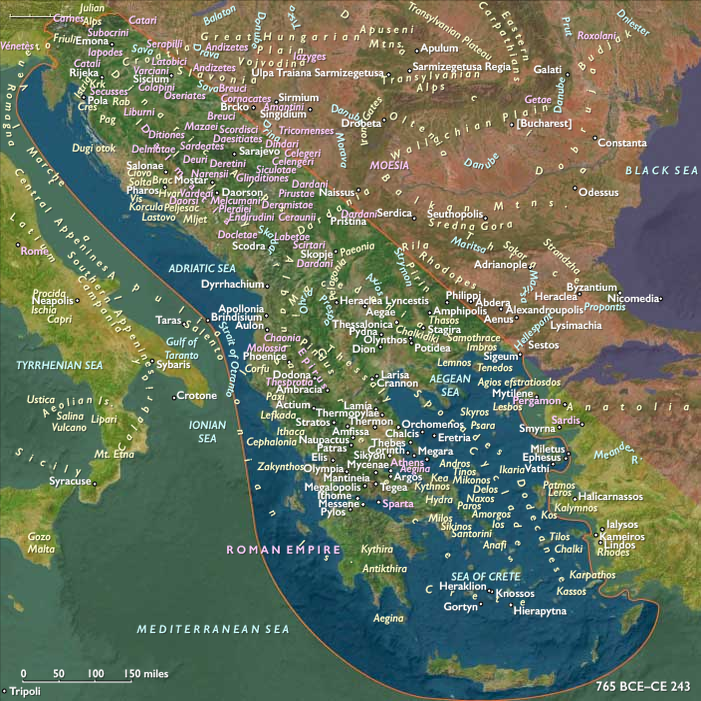
Flamininus has made allies of most of Greece by spring 197 BCE.
When the Aetolian cavalry prevails against the isolated Philip's forces at Cynoscephalae in Thessaly, the single decisive battle of the war, in which the Macedonian phalanx of heavy infantry had shown that it was hard to beat if it kept its ranks but vulnerable if it did not, …
Locations
People
Groups
- Roman Republic
- Aetolian League
- Greece, Hellenistic
- Macedon, Antigonid Kingdom of
- Achaean League, Second
Topics
Commodoties
Subjects
Regions
Subregions
Related Events
Filter results
Showing 10 events out of 16 total
Maximian’s Naval Defense Against the Franks and Saxons (Late 3rd Century CE)
By the late 3rd century CE, the Franks and Saxons had intensified their maritime raids, pillaging the coasts of Spain and Gaul. In response, Emperor Maximian (co-ruler with Diocletian) assembled a naval force to counter these threats and secure the Roman Channel and North Sea regions.
The Fleet at Gesoriacum and the Appointment of Carausius
- The Roman fleet was based at Gesoriacum (modern Boulogne, France), a key naval and commercial hub on the Channel.
- Command of this newly assembled fleet was given to Mausaeus Carausius, a skilled naval officer and former pilot, originally from Menapia (modern Belgium).
- Carausius had previously won distinction fighting the Bagaudae, a group of peasant rebels and brigands who had destabilized parts of Gaul and Hispania.
Carausius’ Mission and Rise to Power
- His primary objective was to intercept and destroy Frisian, Frankish, and Saxon raiders before they could reach the Roman coasts.
- However, he was accused of corruption, as he allegedly allowed the pirates to raid first before attacking them and seizing their loot.
- Facing execution by Maximian, Carausius declared himself Emperor of Britain and Northern Gaul in 286 CE, breaking away from Roman central authority and forming his own rebel state known as the Britannic Empire.
Impact of Maximian’s Naval Campaign
- While the Franks and Saxons were a major threat, Rome’s internal power struggles undermined its ability to effectively police the Channel.
- Carausius' seizure of power in Britain and northern Gaul forced Maximian and Diocletian to focus on civil war rather than frontier defense.
- The Franks and Saxons continued raiding, exploiting Rome’s weakening grip over its northern provinces.
Conclusion: The Prelude to Further Roman Decline in the West
Maximian’s naval efforts were a necessary response to the growing barbarian threat, but the rise of Carausius as a breakaway ruler demonstrated the empire’s internal instability. These events foreshadowed later Germanic incursions and the eventual breakdown of Roman control in the West.
Carausius’ Rebellion and the Creation of the Britannic Empire (286 CE)
After being entrusted by Emperor Maximian with the command of the Roman fleet at Gesoriacum (Boulogne) to combat Saxon and Frankish pirates, Mausaeus Carausius was soon accused of corruption. His alleged crime was:
- Allowing pirates to raid Roman territories first, then attacking them afterward and seizing their stolen cargoes for himself rather than returning them to the imperial treasury.
Maximian’s Response and Carausius’ Escape to Britain
- Furious at this betrayal, Maximian ordered the execution of Carausius.
- Before he could be arrested, Carausius fled with his loyal troops to Britain in 286 CE.
- Once in Britain, he declared himself ruler, taking the imperial title of Augustus, effectively seceding from the Roman Empire and forming an independent state, later known as the Britannic Empire.
The Britannic Empire: A Breakaway Roman State
- Carausius established a power base in Britain, securing support from British legions, local elites, and even some northern Gallic territories.
- He minted his own coins, emphasizing his legitimacy with the phrase "Restorer of Britain" (Restitutor Britanniae).
- His control over naval forces allowed him to dominate the English Channel, making any Roman attempt to retake Britain difficult.
Significance of Carausius’ Revolt
- His rebellion exposed the weaknesses of Roman control over Britain and the northern provinces.
- The Franks and Saxons continued their raids, taking advantage of Rome’s internal instability.
- His rule set a precedent for future breakaway states in the Western Roman Empire, showing that provincial military leaders could defy central authority and establish their own rule.
Though Carausius would eventually be assassinated by his own finance minister, Allectus, in 293 CE, his secession from Rome marked a major turning point in the empire’s struggle to maintain control over its far-flung provinces.
Constantius Chlorus' Campaign Against Carausius and the Rise of Allectus (293 CE)
In 293 CE, Constantius Chlorus, newly appointed Caesar of the West under Emperor Diocletian’s Tetrarchy, was tasked with reclaiming Britain and northern Gaul from the usurper Marcus Aurelius Carausius. Carausius, a Menapian naval officer, had seized power in 286 CE, declaring himself Augustus and establishing an independent Britannic Empire.
1. The Fall of Gesoriacum (Bononia) and the Defeat of the Franks
- Constantius launched a campaign to isolate Carausius by attacking his mainland holdings.
- He successfully recaptured Gesoriacum (modern Boulogne, France), the key Roman naval base on the English Channel.
- To ensure a secure rear before invading Britain, he also defeated Carausius’ Frankish allies in Batavia, further cutting off continental support for the breakaway state.
2. The Assassination of Carausius and the Rise of Allectus
- The loss of Gaul and its ports weakened Carausius' position, reducing his ability to control trade and reinforce Britain.
- Sensing his vulnerability, his finance minister, Allectus, assassinated him in 293 CE and seized power.
- Allectus ruled Britain independently for three years, but his reign was not marked by open conflict with Rome, leading to a temporary period of peace.
3. Rome’s Next Move: Preparing for the Final Invasion
- Though the recapture of Bononia was a major victory, the Britannic Empire still controlled Britain and its defenses.
- Constantius could not immediately launch an invasion, as he needed time to build a new fleet and prepare a coordinated offensive.
- Over the next three years (293–296 CE), the Romans rebuilt their naval capabilities, setting the stage for the final reconquest of Britain in 296 CE.
4. Significance of the Conflict
- The fall of Gesoriacum marked the beginning of the end for the Britannic Empire, as it isolated Allectus’ regime from the continent.
- The assassination of Carausius demonstrated internal instability within the breakaway government.
- Although Allectus ruled peacefully for a time, he was ultimately unable to stop the Roman reconquest, which would come in 296 CE under Constantius Chlorus.
Conclusion: The Beginning of the End for the Britannic Empire
While Constantius’ victories on the continent weakened the secessionist state, the Britannic Empire under Allectus endured for three more years. However, Rome’s preparations for invasion were underway, ensuring that Britain would soon return to imperial control.
Constantine Joins His Father Constantius in the West (305–306 CE)
In 305 CE, following the abdication of Diocletian and Maximian, Constantius Chlorus was elevated to Augustus of the West, while Galerius became the senior emperor (Augustus) of the East. As part of the Tetrarchic system, Constantius now ruled Gaul, Britannia, and Hispania, while Galerius controlled the Balkans and the Eastern provinces.
Recognizing the political and military significance of his son, Constantius requested that Constantine be sent to join him at Gesoriacum (modern Boulogne, France). This move would prove to be pivotal in Constantine’s rise to power.
1. Constantine’s Status Under Galerius
- Constantine had been serving under Galerius in the Eastern court, gaining military and administrative experience.
- As the son of an emperor, he was a potential rival to Galerius and his faction.
- Constantine was aware that remaining too long in the East might jeopardize his future, as Galerius favored his own allies over Constantine.
2. Constantine’s Escape and Journey to the West
- Galerius was reluctant to send Constantine to Constantius, fearing that he might become a threat.
- According to historical accounts, Constantine escaped the Eastern court, possibly by secretly fleeing at night.
- He allegedly disabled or took the horses along his escape route to prevent pursuit by Galerius’ men.
- He traveled across the empire to Gaul, where he joined his father at Gesoriacum.
3. Constantine Joins His Father in Britain
- Shortly after his arrival, Constantius launched a campaign in Britain, aimed at securing Roman control over the northern frontier.
- Constantine accompanied his father on military campaigns against the Picts, further developing his leadership and battlefield experience.
4. The Death of Constantius and Constantine’s Proclamation (306 CE)
- In July 306 CE, Constantius fell ill and died at Eboracum (modern York, England).
- His troops immediately proclaimed Constantine as Augustus, despite the Tetrarchic system, which did not allow for dynastic succession.
- This move challenged the authority of Galerius, setting the stage for a new power struggle in the empire.
5. Conclusion: A Key Turning Point in Constantine’s Rise
- Constantine’s journey to the West was a defining moment that allowed him to escape Galerius’ control and establish himself as a legitimate claimant to the throne.
- His proclamation as emperor in 306 CE triggered a series of civil wars, culminating in his ultimate victory and unification of the Roman Empire in 324 CE.
- This event set the course for Constantine’s eventual conversion to Christianity and the founding of Constantinople, shaping the future of the Roman world.
By securing his place at his father’s side, Constantine positioned himself for greatness, paving the way for his eventual ascendancy as the sole ruler of Rome.
Constantine's Marriage to Fausta and the Repudiation of Minervina
As Constantine rose to power, he strategically aligned himself with the Tetrarchic ruling elite, particularly by marrying Fausta, the daughter of former Emperor Maximian, in 307 CE. To solidify this union, he repudiated his first wife, Minervina, the mother of his eldest son, Crispus.
1. The Political Significance of Constantine’s Marriage to Fausta
- Fausta was the daughter of Maximian, the former Western Augustus, and sister of Maxentius, who had seized power in Rome in 306 CE.
- By marrying Fausta, Constantine:
- Forged an alliance with Maximian, strengthening his political legitimacy.
- Secured ties with the Tetrarchic system, giving him greater standing among the ruling elite.
- Positioned himself as a rightful contender for supreme power in the Western Roman Empire.
2. The Repudiation of Minervina
- Constantine had previously been married to Minervina, but little is known about her.
- She bore him a son, Crispus, who would later become one of Constantine’s most successful military commanders.
- It is unclear whether Minervina was a concubine or a legitimate wife, but her status was likely politically inconvenient after Constantine sought to marry into the imperial family.
- Following his marriage to Fausta, Constantine formally repudiated Minervina, though Crispus remained recognized as his legitimate son.
3. The Legacy of These Marriages
- Crispus rose to prominence as a skilled military leader, playing a key role in Constantine’s campaigns.
- Fausta, now empress, became a powerful figure at court, but her later involvement in court intrigues would lead to her execution in 326 CE.
- Constantine’s political marriages shaped his dynastic ambitions, reinforcing his status as a ruler who balanced military strength with strategic alliances.
This marriage alliance with Fausta strengthened Constantine’s path to ultimate power, helping him navigate the complex rivalries of the Tetrarchy, leading to his eventual domination of the Roman world.
The Marriage of Edward II and Isabella of France (1308) and Growing Noble Resentment
On January 25, 1308, King Edward II of England married Isabella of France, daughter of King Philip IV of France, in Boulogne. This union was intended to strengthen Anglo-French relations following the Treaty of Paris (1303), which had restored Gascony to England and sought to prevent further conflict between the two kingdoms.
Piers Gaveston as Regent and Noble Suspicion
- Before departing for France to wed Isabella, Edward II appointed his close friend and confidant, Piers Gaveston, as regent.
- Gaveston, a Gascon knight, had risen to extraordinary prominence under Edward, enjoying lavish royal favor and influence.
- This deeply alienated the English magnates, who saw Gaveston as an unworthy foreigner and a dangerous influence on the king.
- The marriage to Isabella did little to ease their suspicions, as Edward’s favoritism toward Gaveston continued unabated.
Tensions Between Edward II, Isabella, and the Barons
- Upon her arrival in England, Isabella found herself sidelined, as Edward showered attention on Gaveston, reportedly ignoring his new queen at their own coronation feast.
- The English barons, already hostile to Gaveston, grew even more determined to curtail his influence, leading to an ongoing power struggle.
- In 1308, Edward was forced to banish Gaveston under pressure from his magnates, though he would recall him soon after, further inflaming tensions.
The Road to Conflict
- The Isabella-Edward marriage alliance failed to stabilize English politics, as noble resentment toward the king’s favoritism toward Gaveston deepened.
- The crisis would escalate into baronial opposition, leading to the execution of Gaveston in 1312 and the eventual collapse of Edward II’s rule in 1327, when Isabella played a leading role in his deposition.
Edward II’s marriage to Isabella of France in 1308 was intended as a diplomatic success, but it failed to resolve internal tensions, as his continued favoritism toward Gaveston alienated his nobility, setting the stage for one of the most turbulent reigns in English history.
Henry VII’s Campaign and the Siege of Boulogne (1490–1492)
By 1490, King Henry VII of England saw his diplomatic efforts to protect English interests in Brittany frustrated by the shifting political landscape, especially France’s assertive move to annex the duchy and Spain’s secret diplomatic rapprochement with the French crown. Faced with diminishing options and the failure of diplomatic channels, Henry turned to military force in an attempt to pressure France into concessions, launching an invasion of northern France.
Background: Diplomatic Frustration and Breton Crisis
Henry VII’s primary objective was to prevent French domination of Brittany, maintaining it as an independent buffer against French expansion across the Channel. However, his strategy had unraveled following the Treaty of Laval (1491), in which the Breton duchess, Anne, succumbed to French pressure and married King Charles VIII, thus bringing Brittany directly under French control. Henry’s diplomatic isolation was compounded when Ferdinand II of Aragon, previously an ally against France, entered into secret negotiations with Charles VIII.
English Military Intervention: Siege of Boulogne (1491–1492)
In response to this diplomatic setback, Henry mobilized a substantial English expeditionary force in late 1490, personally sailing across the Channel to invade French territory. By 1491, Henry had laid siege to Boulogne, a fortified and strategically significant port city, intending to apply military pressure on Charles VIII and secure a stronger bargaining position.
The siege was part of a larger, calculated strategy: Henry hoped that direct military pressure would force Charles VIII into concessions, thereby reasserting English influence on the continent. However, the siege was plagued by logistical challenges, insufficient supplies, and limited support from Henry’s continental allies, especially after Spain’s diplomatic realignment.
Diplomatic Resolution: Treaty of Étaples (1492)
The English siege of Boulogne, despite demonstrating England’s willingness to employ military force, did not yield immediate strategic gains. Ultimately, facing domestic pressures, military expenses, and the impending winter, Henry negotiated a settlement. The resulting Treaty of Étaples (November 1492) ended hostilities, with Charles VIII agreeing to pay a substantial financial compensation—known as the "French pension"—in exchange for Henry’s withdrawal from France.
While the treaty did not restore Brittany’s independence, it provided Henry VII with financial security and diplomatic recognition, satisfying immediate political and fiscal objectives. This compromise underscored the pragmatic nature of Henry’s foreign policy.
Long-Term Historical Significance
The Siege of Boulogne (1491–1492) and subsequent Treaty of Étaples highlighted both the limitations and adaptability of English diplomacy under Henry VII. Although Henry failed to preserve Brittany’s independence, his actions secured a financially advantageous peace, which supported his broader goal of stabilizing the Tudor regime and consolidating royal authority domestically.
Furthermore, the episode clarified the shifting nature of European alliances, with Spain’s secret diplomacy marking a new era of competitive statecraft. It also foreshadowed England’s future continental engagements, which oscillated between ambitious intervention and cautious diplomacy over the ensuing centuries.
In essence, Henry VII’s campaign at Boulogne represented a critical moment in late medieval geopolitics in Atlantic West Europe, illustrating the challenges of balancing military ambition, diplomatic reality, and economic prudence at a pivotal moment in the early history of Tudor England.

Henry had meanwhile ordered Suffolk to attack Boulogne, crossing on July 14 to Calais and moving to join him.
The Siege of Boulogne begins on July 19—despite the protests of the Emperor, who insists that Henry should advance towards Paris.
Henry, meanwhile, is personally directing the besiegers at Boulogne; the town falls in early September, and a breach is made into the castle on September 11.
The defenders finally surrender a few days later.
Charles, short on funds and needing to deal with increasing religious unrest in Germany, asks Henry to continue his invasion or to allow him to make a separate peace.
By the time Henry has received the Emperor's letter, however, Charles has already concluded a treaty with Francis—...
Henry himself returns to England at the end of September 1544, ordering Norfolk and Suffolk to defend Boulogne.
Years: 197BCE - 197BCE
Locations
People
Groups
- Roman Republic
- Aetolian League
- Greece, Hellenistic
- Macedon, Antigonid Kingdom of
- Achaean League, Second