
Fire destroys much of Dresden, the seat …
Years: 1491 - 1491
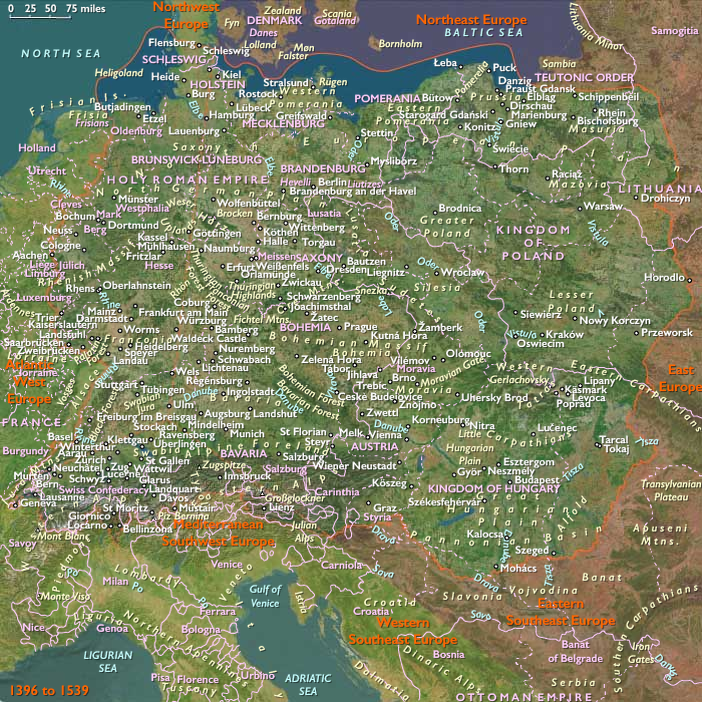
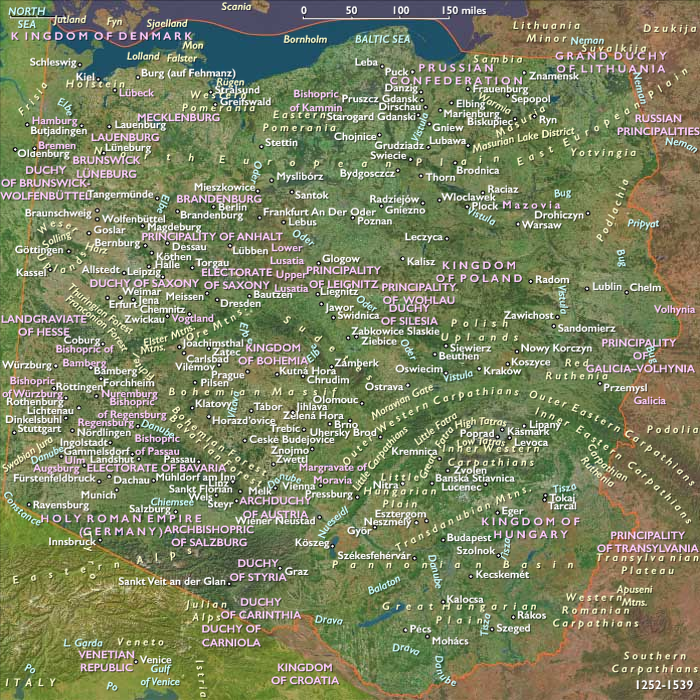
Fire destroys much of Dresden, the seat of the dukes of Saxony, in 1491.
Locations
Groups
Subjects
Regions
Subregions
Related Events
Filter results
Showing 10 events out of 40423 total
The struggle against the adherents of Skhariya the Jew is led by hegumen Joseph Volotsky and his followers (Josephinians) and Archbishop Gennady of Novgorod.
Gennady is from the Gonzov boyar clan of Moscow and was, prior to his archiepiscopate, hegumen of the Chudov Monastery in the Moscow Kremlin.
His immediate predecessor in Novgorod, Sergei, had served less than a year and had been recalled and confined to the Chudov Monastery apparently due to mental illness.
Gennady had been named Archbishop of Novgorod in Moscow and placed in office on December 12, 1484, the first Novgorodian prelate not chosen by lots since 1359.
He had arrived in Novgorod in January 1485 with the task (as had been Sergei's) of bringing the newly conquered Novgorodian church (the city had been brought under direct Muscovite control only in 1478 and the last locally elected archbishop, Feofil, had been removed only in 1480) more in line with Muscovite ecclesiastical practices.
He faces opposition from the local clergy by his commemoration of several Muscovite saints, but deals with this opposition by including several local saints in his commemoration.
Gennady's main difficulty during his archepiscopate, however, is rooting out the Judaizer heresy from Novgorod and also Moscow, where it had spread when several Novgorodian clergymen were transferred to the capital.
He is said to have borrowed methods from the Spanish Inquisition, admiring how the King of Spain had dealt with heterodoxy in his kingdom, and he burns several heretics with the support of the grand prince and metropolitan.
After uncovering adherents in Novgorod around 1487, Gennady had written a series of letters to other churchmen over several years calling on them to convene sobors ("church councils") with the aim "not to debate them, but to burn them."
Such councils have been held in 1488 and 1490.
The councils have outlawed religious and non-religious books and initiated their burning, sentenced a number of people to death, sent adherents into exile, and excommunicated them.
In 1491, Skhariya the Jew is executed in Novgorod by the order of Ivan III.
More adherents are executed with Gennady's approval, including archimandrite Kassian of the Iuriev Monastery (who had allowed a number of adherents to hide there), Nekras Rukavov (they first tear out his tongue, then burn him at the stake), a Pskovian monk, Zakhar, and others.
The Novgorodian Fourth Chronicle notes that Gennady also helped pay for one third of the reconstruction of the current Detinets or Kremlin walls between 1484 and 1490.
Albrecht Dürer was born on May 21, 1471, the third child and second son of his parents, who will eventuallyy have between fourteen and eighteen children.
His father, Albrecht Dürer the Elder, is a successful goldsmith, originally Ajtósi, who in 1455 had moved to Nuremberg from Ajtós, near Gyula in Hungary.
The German name "Dürer" is a translation from the Hungarian, "Ajtósi" Initially, it was "Türer," meaning doormaker, which is "ajtós" in Hungarian (from "ajtó", meaning door).
A door is featured in the coat-of-arms the family acquired.
Albrecht Dürer the Younger later changed "Türer", his father's diction of the family's surname, to "Dürer", to adapt to the local Nuremberg dialect.
Albrecht Dürer the Elder had married Barbara Holper, the daughter of his master, when he himself became a master in 1467 Dürer's godfather is Anton Koberger, who left goldsmithing to become a printer and publisher in the year of Dürer's birth and had quickly become the most successful publisher in Germany, eventually owning twenty-four printing-presses and having many offices in Germany and abroad.
Koberger's most famous publication is the Nuremberg Chronicle, published in 1493 in German and Latin editions.
It contains an unprecedented 1,809 woodcut illustrations (albeit with many repeated uses of the same block) by the Wolgemut workshop.
Dürer may well have worked on some of these, as the work on the project began while he was with Wolgemut.
Because Dürer left autobiographical writings and became very famous by his mid-twenties, his life is well documented by several sources.
After a few years of school, Dürer started to learn the basics of goldsmithing and drawing from his father.
Though his father wanted him to continue his training as a goldsmith, he showed such a precocious talent in drawing that he started as an apprentice to the leading artist in Nuremberg, Michael Wolgemut at the age of fifteen in 1486.
Wolgemut has a large workshop producing a variety of works of art, in particular woodcuts for books.
His paintings reflect the influence of the Flemish realist school, especially the works of Rogier van der Weyden.
Wolgemut's workshop in Nuremberg famously illustrates, in 1491, the Schatzbehalter der wahren Reichthumer des Heils (Treasurechest), by Stephan Fridolin, printed and published by Germany's largest publisher, the Nuremberger Anton Koberger, who is also Dürer's godfather.
Dürer is already gone by this time: having completed his term of apprenticeship earlier in the year, he has followed the common German custom of taking Wanderjahre—in effect gap years —in which the apprentice learns skills from artists in other areas.
Struggles for succession after the death of Corvinus in 1490, will leave the Middle Danube front relatively quiet for the remainder of Bayezid's reign.
The Ottoman Empire’s intermittent war with the Mamluks has been inconclusive, and peace negotiations in 1491 gain the Mamluks territorial concessions and suspend fighting.
Bayezid's disinclination to commit major forces to the endeavor lead to dissension and criticism on the part of his more militant followers.
To counter this, ...
...Bayezid tries to use Hungarian internal dissension to take Belgrade, but without success.
Verrocchio, while finishing the “Doubting of Thomas” group in Florence, had been summoned to Venice in around 1483 to create an equestrian monument to the condottiere Bartolommeo Colleoni; a work of great dramatic power.
Unfinished at Verrocchio’s death on October 7, 1488, the Venetian sculptor Alessandro Leopardi is charged with the task of completing the work.
Leopardi, who was born (and will die) in Venice, is first heard of in 1482 and is said to have worked at the mint.
He was once reputed to have designed the sepulchral monument of doge Andrea Vendramin, now in the church of San Giovanni e Paolo, but this is generally now thought to have been the work of Tullio Lombardo, though Leopardi may have contributed some figures.
He had in 1479 submitted a model for the competition initiated by the Signoria in Venice to find a sculptor for an equestrian monument to Bartolomeo Colleoni.
Three sculptors had submitted models, including Verrocchio, to whom the contract had been awarded.
Leopardi had been exiled for five years on a charge of fraud in 1487, and is recalled in 1490 by the senate to finish Verrocchio's impressive statue of Colleoni, which the Venetians had commissioned him to make in accordance with the provisions of Colleoni's will.
Verocchio, having made the clay model in Venice, had died in 1488, before it had been cast in bronze.
He asked in his will that his pupil, Lorenzo di Credi, should be engaged to arrange for it to be cast, but after much delay the Venetians in 1490 had selected Leopardi to cast it and he also made the pedestal on which it stands.
His name (in Latin) is inscribed on the horse's girth: "ALEXANDER . LEOPARDUS . V . P . OPUS", so that early authorities thought that the work was entirely his.
When Colleoni bequeathed the money for his statue, he stipulated that it should be erected in the Piazza San Marco, but the Venetian state cannot allow this and compromises by having it installed near the Scuola San Marco outside the church of SS Giovanni è Paolo, where it stands today.
The emir, although refusing to recognize the sovereignty of King Ferdinand V and Queen Isabella I of Castile and Aragon, agrees to a truce, which he breaks when he answers a call by his subjects to lead them in defense of their homes.
A siege of Granada begins in April 1491.
The besiegers construct a western command post, Santa Fe, that effectively severs Granada’s connection with the outside world.
The situation for the defenders grows progressively dire, as their forces for interfering with the siege dwindle and advisers scheme against each other.
Bribery of important officials is rampant, and at least one of the chief advisers to Boabdil seems to have been working for Castile the entire time.
Superior Christian forces repulse Moorish sorties, eventually driving the defenders to the point of starvation.
After the Battle of Granada, a provisional surrender, the Treaty of Granada, is signed on November 25, 1491, which grants two months to the city.
The reason for the long delay is not so much intransigence on either side, but rather the inability of the Granadan government to coordinate among itself in the midst of the disorder and tumult that grip the city.
After the terms, which prove rather generous to the Muslims, are negotiated, the city capitulates on January 2, 1492.
The besieging Christians sneak troops into the Alhambra that day in case resistance materializes, which it does not.
Granada's resistance has come to its end.
The estimated Jewish population in Italy in 1491, numbering eighty thousand of a total twelve million, represents a one hundred percent increase in one hundred years.
Martin Schongauer and the Art of Engraving (ca. 1480–1490)
The German artist Martin Schongauer (c. 1448–1491) significantly transformed the medium of printmaking, elevating engraving to an artistic form on par with painting. His remarkable innovation lay in the refined use of black-and-white linear engraving techniques, expertly simulating textures, tonal variations, and subtle coloristic effects typically associated only with painted works. Schongauer's technical precision and mastery of descriptive outlines imparted to his prints a painterly depth and narrative richness previously unseen in European graphic art.
Technical Mastery and Early Innovations
Schongauer’s most influential technical advancement was his adept control over the descriptive outline, through which he could vividly represent complex textures, forms, and lighting effects. His engravings thus achieved a distinctive realism previously attainable only in paintings. His works employed intricate, finely detailed linework to render diverse textures—from fabric and metal to hair and skin—enabling him to vividly illustrate populated, emotionally charged narratives in monochrome.
"Christ Carrying the Cross": A Case Study in Engraving Mastery
One of Schongauer's masterpieces, "Christ Carrying the Cross" (c. 1475–1480), exemplifies his exceptional engraving technique. This print stands out for its densely populated composition, subtle modulation of tone, and narrative depth. By mastering subtle gradations of black and white, Schongauer organized the crowded scenes clearly, vividly capturing each individual's expression, costume, and material textures. Contrasting areas of shadow and illumination enhance the emotional drama of the scene, demonstrating the remarkable capability of engraving to communicate painterly effects.
Major Engraved Cycles and Narrative Innovations
Schongauer’s innovations extended beyond single compositions. Around 1480, he produced influential narrative series, notably his four-part series depicting the "Life of the Virgin" and a celebrated twelve-print cycle portraying "Christ’s Passion." These ambitious series demonstrated Schongauer’s innovative approach to narrative storytelling, greatly increasing the visual complexity and dimensions of printed images. His works marked a critical development in graphic art, making detailed religious narratives widely accessible through print.
Historical Impact and Significance
Martin Schongauer’s pioneering contributions set a new artistic standard for European printmaking. His technical and stylistic innovations profoundly influenced contemporary and subsequent artists, notably Albrecht Dürer, who regarded Schongauer as a central inspiration. By transforming engraving from a primarily decorative or utilitarian craft into a serious, independent art form, Schongauer laid essential foundations for printmaking's flourishing during the European Renaissance and beyond.
His death in 1491 ended a career that had decisively elevated engraving from artisanal decoration to a respected and widely influential art form. Schongauer’s legacy is found in his profound influence on successors like Albrecht Dürer, who further refined and developed engraving into one of the Renaissance’s most potent artistic media.
Thus, Schongauer’s achievements represent a landmark in the evolution of European art, deeply influencing the visual culture of late medieval and early modern Atlantic West Europe.
Maximilian’s Return and the Suppression of Flemish Resistance (1488–1490)
Following his humiliating imprisonment at Bruges and the forced concessions embodied in the Peace of Bruges (1488), Archduke Maximilian of Austria briefly left the Netherlands for Germany. However, after consolidating his authority in the Holy Roman Empire, Maximilian soon returned to the Low Countries, boldly repudiating the promises made under duress at Bruges. By 1489, tensions reignited as Maximilian refused to adhere to earlier promises of local autonomy, provoking renewed rebellions among several key Flemish cities and plunging the region into another civil war.
Maximilian’s Abrogation of the Bruges Agreement (1489)
Upon his return in 1489, Maximilian publicly repudiated the humiliating conditions he had agreed to while captive at Bruges. His abrogation intensified resentment among the autonomous-minded Flemish towns, triggering a widespread renewal of civil unrest. Cities like Ghent, Bruges, and Ypres, already resentful of Habsburg centralization efforts, became centers of fierce anti-Habsburg sentiment and rebellion. The renewed revolt deeply fragmented the political landscape, plunging the region into yet another round of civil strife.
French Mediation and Renewed Flemish Resistance
France, under the rule of the young King Charles VIII and his influential sister and regent, Anne of France, took advantage of this instability by briefly negotiating peace with Maximilian (1489) while simultaneously offering clandestine support and encouragement to rebellious Flemish cities. Although nominally at peace, France promised aid to these cities, exacerbating internal conflicts within Maximilian’s territories. These French diplomatic maneuvers significantly contributed to the resurgence of Flemish unrest, prolonging regional conflict.
The Flemish Civil War Renewed (1490)
By 1490, civil war once again gripped most Flemish towns, particularly Ghent and Bruges, which resisted Maximilian’s renewed attempt at centralized rule. Aided indirectly by France’s duplicity, these cities openly defied Habsburg authority. This intensified conflict, highlighting the enduring friction between central Habsburg authority and Flemish autonomy, further destabilized the region and threatened Maximilian’s authority throughout the Netherlands.
Suppression and Restoration of Authority (1489–1491)
Maximilian responded decisively, mobilizing loyal military forces and launching a systematic campaign to suppress the rebellions. His troops, bolstered by reinforcements from Germany, targeted the rebellious cities, effectively crushing their resistance. The renewed Flemish civil war culminated in the suppression of rebellious towns, notably the decisive defeat of Ghent in 1492, conclusively reasserting Habsburg dominance.
Long-Term Historical Significance
Maximilian’s return and forceful suppression of the Flemish revolt marked a critical juncture in the evolution of political centralization and state formation within the Burgundian Netherlands. His firm rejection of the Peace of Bruges represented a victory of centralized authority over the tradition of local autonomy, shaping the political landscape of the Low Countries well into the sixteenth century.
The renewed conflict between the Habsburg rulers and the Flemish cities anticipated the larger struggles of centralization and rebellion that later exploded in the Dutch Revolt of the late sixteenth century, fundamentally reshaping Europe's political and religious landscape. Thus, Maximilian’s repudiation of his Bruges concessions in 1489and subsequent suppression of Flemish resistance served as a critical juncture in shaping the power structures, political identity, and geopolitical dynamics of late medieval and early modern Atlantic West Europe.
Henry VII’s Campaign and the Siege of Boulogne (1490–1492)
By 1490, King Henry VII of England saw his diplomatic efforts to protect English interests in Brittany frustrated by the shifting political landscape, especially France’s assertive move to annex the duchy and Spain’s secret diplomatic rapprochement with the French crown. Faced with diminishing options and the failure of diplomatic channels, Henry turned to military force in an attempt to pressure France into concessions, launching an invasion of northern France.
Background: Diplomatic Frustration and Breton Crisis
Henry VII’s primary objective was to prevent French domination of Brittany, maintaining it as an independent buffer against French expansion across the Channel. However, his strategy had unraveled following the Treaty of Laval (1491), in which the Breton duchess, Anne, succumbed to French pressure and married King Charles VIII, thus bringing Brittany directly under French control. Henry’s diplomatic isolation was compounded when Ferdinand II of Aragon, previously an ally against France, entered into secret negotiations with Charles VIII.
English Military Intervention: Siege of Boulogne (1491–1492)
In response to this diplomatic setback, Henry mobilized a substantial English expeditionary force in late 1490, personally sailing across the Channel to invade French territory. By 1491, Henry had laid siege to Boulogne, a fortified and strategically significant port city, intending to apply military pressure on Charles VIII and secure a stronger bargaining position.
The siege was part of a larger, calculated strategy: Henry hoped that direct military pressure would force Charles VIII into concessions, thereby reasserting English influence on the continent. However, the siege was plagued by logistical challenges, insufficient supplies, and limited support from Henry’s continental allies, especially after Spain’s diplomatic realignment.
Diplomatic Resolution: Treaty of Étaples (1492)
The English siege of Boulogne, despite demonstrating England’s willingness to employ military force, did not yield immediate strategic gains. Ultimately, facing domestic pressures, military expenses, and the impending winter, Henry negotiated a settlement. The resulting Treaty of Étaples (November 1492) ended hostilities, with Charles VIII agreeing to pay a substantial financial compensation—known as the "French pension"—in exchange for Henry’s withdrawal from France.
While the treaty did not restore Brittany’s independence, it provided Henry VII with financial security and diplomatic recognition, satisfying immediate political and fiscal objectives. This compromise underscored the pragmatic nature of Henry’s foreign policy.
Long-Term Historical Significance
The Siege of Boulogne (1491–1492) and subsequent Treaty of Étaples highlighted both the limitations and adaptability of English diplomacy under Henry VII. Although Henry failed to preserve Brittany’s independence, his actions secured a financially advantageous peace, which supported his broader goal of stabilizing the Tudor regime and consolidating royal authority domestically.
Furthermore, the episode clarified the shifting nature of European alliances, with Spain’s secret diplomacy marking a new era of competitive statecraft. It also foreshadowed England’s future continental engagements, which oscillated between ambitious intervention and cautious diplomacy over the ensuing centuries.
In essence, Henry VII’s campaign at Boulogne represented a critical moment in late medieval geopolitics in Atlantic West Europe, illustrating the challenges of balancing military ambition, diplomatic reality, and economic prudence at a pivotal moment in the early history of Tudor England.
Years: 1491 - 1491
Locations
Groups
Subjects
Regions
Subregions