
Filippo Maria Visconti, under whom the family …
Years: 1447 - 1447
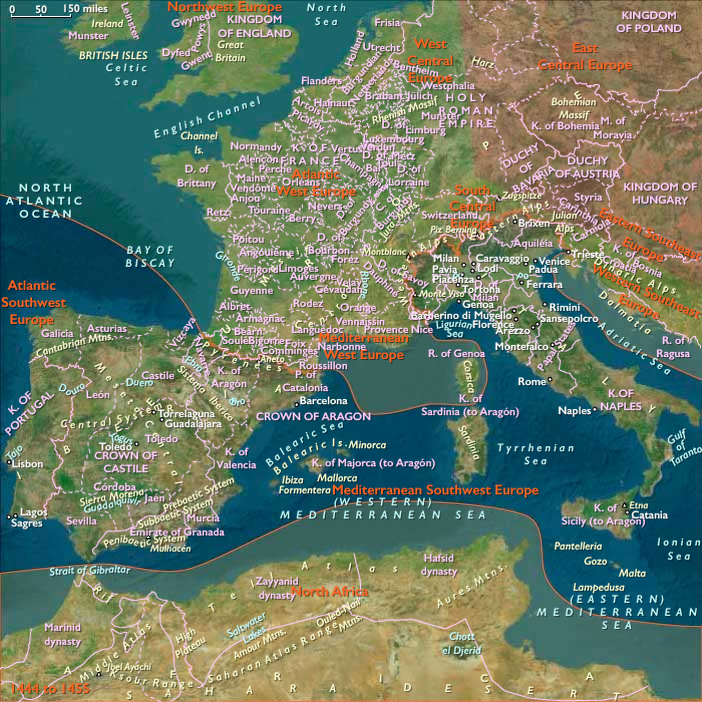
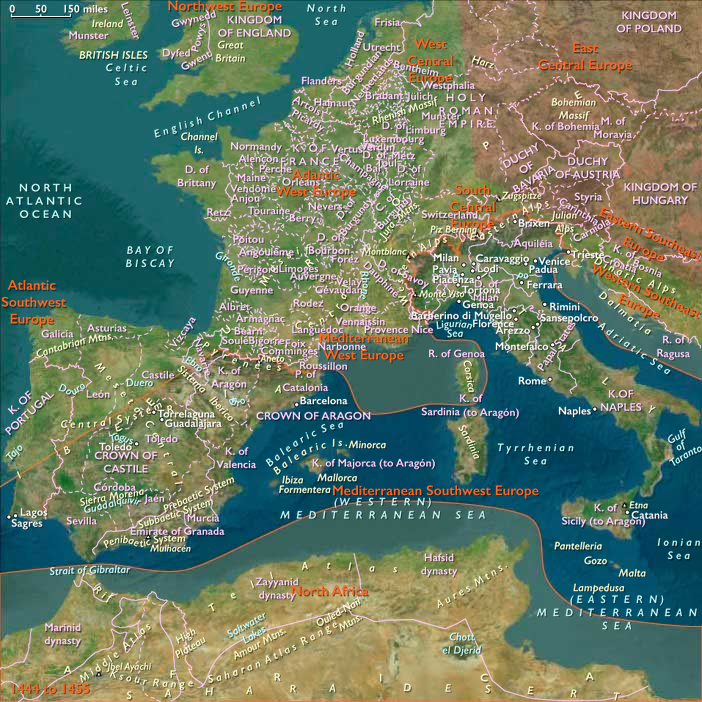
Filippo Maria Visconti, under whom the family has recouped its fortunes, seeks to maintain Visconti control over Lombardy and opposes Venice's expansion in mainland Italy.
At his death on August 13, 1447 without a clear male heir, the city is into confusion by the unexpectedness of the Duke's expiration and the quick way in which the claimants to the title act.
Filippo Maria had no heir through male bloodlines, but the day before his death had written a will dedicating the Duchy to Alfonso V of Aragon.
Among the other claimants are Charles, Duke of Orléans, nephew of Filippo Maria through his mother Valentina Visconti, Filippo's cousins Albert and Sigismund of the House of Habsburg, great-grandsons of Bernabò Visconti, and Frederick III, Holy Roman Emperor, who declares that the Duchy reverts back to the Holy Roman Empire on the extinction of male heirs.
The two most prominent candidates supported by the Milanese population are Alfonso of Aragon and Francesco Sforza, the late Duke's son-in-law by his marriage to Bianca Maria Visconti.
The Bracceschi, supporters of the King of Aragon, seize the Castello on the night of the 13th, almost before Filippo Maria dies, forcing the captains to swear allegiance to Alfonso.
Despite the general support for either Alfonso or Sforza, other influential citizens believe that the old republic can be restored.
Learned bodies, such as the College of Jurisprudence in Pavia, paint the days of the old republic as a golden age.
The merchants, seeing the prosperity of Republican Venice, are behind this idea.
On the morning of the 14th, Republicans stir the populace to rise against the Bracceschi, led by Antonio Trivulzio, Giorgio Lampugnano, Innocenzo Cotta, and Teodoro Bossi, members of the College of Jurisprudence.
A Republic is declared behind the Palace of the Commune, and the captains abandon their oaths to Alfonso and turn in favor of the Republic.
The Bracceschi are driven from Milan, and the new republic is called the Golden Ambrosian Republic, named for St. Ambrose, the fourth century bishop of Milan, who is taken on as the Republic's patron.
They take the old constitution and revise it that same day as suits their needs, electing twenty-four Capitani e difensori della libertà, or "Captains and Defenders of Liberty," to frame laws, elected regularly and later reduced to twelve.
The idea of a radical renovation of liberties in the cities does not suit the powers of North Italy, who have been in league against the Visconti territorial gains in a decades-long series of wars interrupted by truces, most recently the Peace of Cremona of November 20, 1441.
Venice is already at war with Milan, and the Republic is struck a sore blow as previously Milanese cities, including Pavia, Lodi, and Piacenza, defect or declare their independence.
Besides the loss of support and defensive locations, the drop in revenue also causes a brief financial crisis resolved by the imposition of new taxes.
Venice, now occupying Lodi and Piacenza, refuses to listen to Milan's pleas for peace.
Milan turns to Francesco Sforza, the greatest military leader of his day, offering him the position of Captain-General and the city of Brescia.
Although he had wished to succeed Visconti, he decides to accept the position and promised rewards.
A draft is declared in Milan on September 13.
Locations
People
- Alfonso V of Aragon
- Battista Sforza
- Charles of Orléans
- Filippo Maria Visconti
- Francesco I Sforza
- Frederick III
Groups
Topics
Commodoties
Subjects
Regions
Subregions
Years: 1447 - 1447
Locations
People
- Alfonso V of Aragon
- Battista Sforza
- Charles of Orléans
- Filippo Maria Visconti
- Francesco I Sforza
- Frederick III
Groups
Topics
Commodoties
Subjects
Regions
Subregions