Filippino Lippi, after 1488, paints important frescoes …
Years: 1489 - 1489
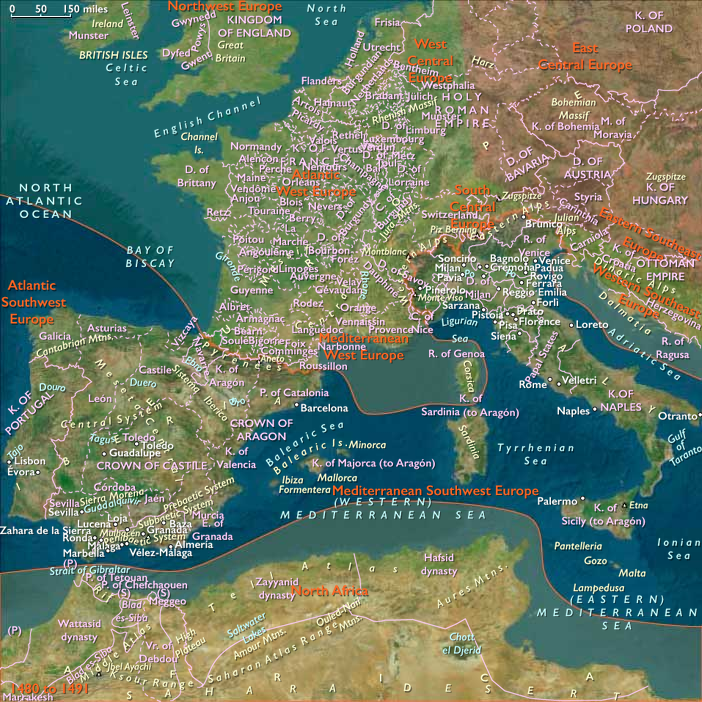
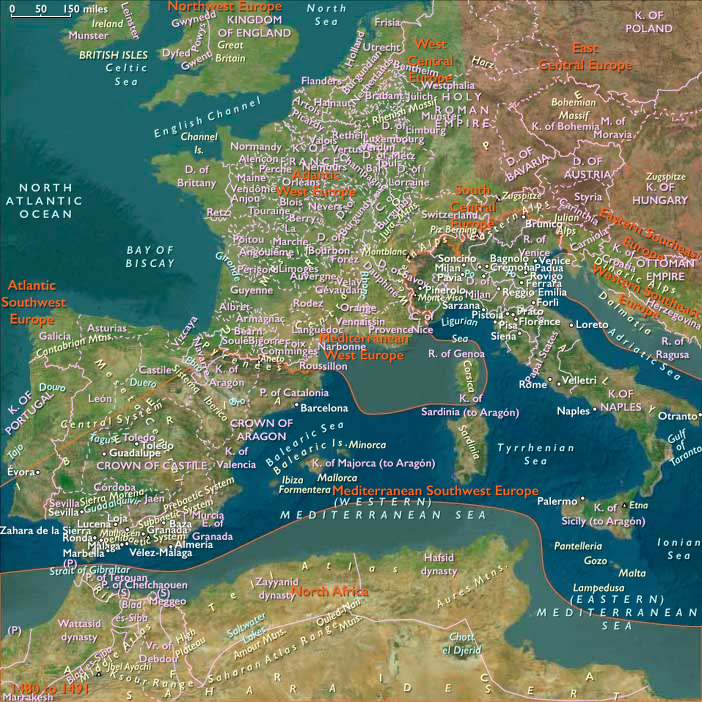
Filippino Lippi, after 1488, paints important frescoes in Rome, such as the “Santa Maria sopra Minerva,” executed in 1489.
Locations
People
Groups
Topics
Subjects
Regions
Subregions
Related Events
Filter results
Showing 10 events out of 40446 total
Moscow in 1489 annexes the fort of Khlynov (present Kirov), situated on the west bank of the Vyatka River just west of the Ural Mountains, and founded by Novgorodian entrepreneurs in 1181 as a virtually independent Russian colony, the nucleus of the "Vyatka Lands."
First mentioned as a town in documents from 1374, Khlynov is incorporated into the Grand Duchy of Moscow in 1489 and will become known throughout Russia for its clay statuettes and whistles.
It is also managed by the Khanate of Kazan and known as "Hılın".
Bahlul Lodi, in the nearly four decades of Pashtun rule over the Delhi Sultanate, has expanded the miniscule territory bequeathed by the last Sayyid ruler to include all of Punjab and the present state of Uttar Pradesh, as well as parts of Rajasthan.
Sikandar, the son of Sultan Bahlul Khan Lodi and Bibi Ambha, the daughter of a Hindu goldsmith of Sirhind, had become Sultan upon the death of his father on July 17, 1489.
His rise to power was troubled, as his older brother, Barbak Shah, the viceroy of Jaunpur, also lays claim to the throne, even though their father had nominated Sikandar.
However, Sikandar is able to ascend to the throne without massive bloodshed, and even allowshis brother to continue ruling Jaunpur.
He also settles differences with an uncle, Alam Khan, who is also suspected of seeking to seize power.
The Kingdom of Cyprus, ruled by the Lusignan family since 1192, has long since declined, and has been a tributary state of the Mamluks since 1426.
Following the death of James II, the last Lusignan king, in 1473, Venetian merchants had assumed control of the island, while the late king's Venetian widow, Queen Catherine Cornaro, reigned as figurehead.
The Republic of Venice formally annexes Cyprus on March 14, 1489, following the Catherine’s forced abdication.
Thus has the last Crusader state become a Venetian colony.
As compensation, Catherine is allowed to retain the title of Queen and in 1489 is made the Sovereign Lady of Asolo, a county in the Veneto of Italy.
Nicosia becomes their administrative center and the seat of the Republic of Venice in Cyprus.
Aubusson turns Cem over to Pope Innocent VIII, who for the past six years has been vying with the kings of Hungary and Naples for the possession of so valuable a political weapon as the Sultan's brother.
In return, Innocent makes Aubusson a cardinal with the power to confer all benefices connected with the order without the sanction of the papacy.
In addition, the Order of St. John receives the assets of the Order of the Holy Sepulcher, which is merged into the Order of St. John, and a number of Italian commanderies of the Knights of St. Lazarus.
The merger is resisted by the order in most countries where it still retains its premises.
Almería, contested by the emirs of Granada and Valencia, has experienced many sieges, including one especially fierce siege when Christians, called to the Second Crusade by Pope Eugene III, were also encouraged to attack the Muslim 'infidels' on a more familiar coast.
On that occasion Alfonso VII, at the head of mixed forces of Catalans, Genoese, Pisans and Franks, led a crusade against the rich city, and Almería had been occupied in October 1147.
Within a decade, however, Almería had passed to the control of the puritanical Muslim Almoravid emirs, and not until the late fifteenth century does it fall permanently into Christian hands.
The city surrenders to the Catholic Monarchs, Ferndinand and Isabel, on December 26, 1489, after an extended siege.
Baza, under the Moors, had been an important frontier post along the border with the kingdom of Murcia.
It is also a major commercial center, with a population upward of fifty thousand, making it one of the three most important cities in the Emirate of Granada.
The Christian forces in 1489 begin a painfully long siege of Baza, the most important stronghold remaining to al-Zagal.
Baza is highly defensible as it requires the Christians to split their armies, and artillery is of little use against it.
Supplying the army causes a huge budget shortfall for the Castilians.
Occasional threats of deprivation of office are necessary to keep the army in the field, and Isabella comes personally to the siege to help maintain the morale of both the nobles and the soldiers.
Al-Zagal surrenders after six months, despite his garrison still being largely unharmed; he has become convinced that the Christians are serious about maintaining the siege for as long as it will take, and further resistance is useless without the hope of relief, of which there had been no sign.
Baza is granted generous surrender terms, unlike Málaga.
Domenico Ghirlandaio’s famous portrait, “Old Man With his Grandson,” painted around 1490, shows the artist’s scrupulous attention to detail.
Giacomo is appointed castellan of the fortress of Ravaldino in place of his brother, and is awarded with an order of chivalry from Ludovico il Moro.
All the contemporary chronicles report that Caterina is madly in love with the young Giacomo.
It is feared that she could strip her son Ottaviano of his future lordship, in order to give it to her lover and secret husband.
In April 1489, Caterina gives birth to Giacomo's son, Bernardino, later called Carlo in honor of King Charles VIII, who had made Giacomo a baron of France.
Also, she had replaced the castellans of the fortresses of her dominions with her closest relatives: the fortress of Imola has been given to Gian Piero Landriani, her stepfather, and the fortress of Forlimpopoli to Piero Landriani, her half-brother, while Tommaso Feo is married to Bianca Landriani, Caterina's half-sister.
At Tossignano, a conspiracy is formed to seize the fortress in the name of Ottaviano, and murder both Giacomo and Caterina.
The Countess discovers the plot and imprisons or executes those who are involved.
Immediately after this conspiracy is foiled, another plot is organized by Antonio Maria Ordelaffi, who had never become resigned to the loss of Forlí, but this also fails.
The subject of Lady with an Ermine, a portrait by Leonardo da Vinci from around 1489–1490, is identified as Cecilia Gallerani, and is probably painted at a time when she is the mistress of Lodovico Sforza, Duke of Milan and Leonardo is in the service of the Duke.
At the time of its painting, the medium of oil paint is relatively new to Italy, having been introduced in the 1470s.
Leonardo is one of those artists who has adopted the new medium and skillfully exploited its qualities.
The Breton Marriage Crisis and the Treaty of Laval (1489–1491)
Following the restrictive Treaty of Sablé (1488), the young duchess Anne of Brittany, determined to protect the sovereignty of her duchy, openly defied the French crown in 1489 by contracting a proxy marriage with the widowed Holy Roman Emperor-elect, Maximilian of Austria. This provocative act violated the terms of the earlier treaty, which explicitly required Anne to secure French royal permission before marrying. Anne’s bold decision immediately ignited a major international diplomatic crisis, drawing in major European powers including France, England, Austria, and Aragon.
Anne’s Proxy Marriage and European Responses (1489)
Anne’s proxy marriage to Maximilian profoundly alarmed King Charles VIII of France, who viewed the union as a direct threat to French interests, fearing Habsburg encirclement through Austria’s expanding territorial alliances. Charles quickly moved to counter this perceived Austrian threat by diplomatically isolating Anne and aggressively pressuring Brittany.
Simultaneously, Maximilian’s claim gained international backing, notably from King Henry VII of England and King Ferdinand II of Aragon. Both monarchs, wary of France’s growing influence, initially backed the Austrian claim to Brittany. However, Henry VII was cautious; he sought primarily to buy time, supporting a Breton regency while avoiding full-scale war with France.
Henry VII’s Diplomatic Strategy
England’s Henry VII, ever pragmatic, balanced diplomatic caution with measured military involvement. He supported the Breton regency, publicly pledged limited military assistance, and formed a strategic alliance with Aragon by arranging the future marriage of his heir, Prince Arthur, to Ferdinand’s infant daughter, Catherine of Aragon. This Anglo-Aragonese alliance was intended to counterbalance French dominance, reflecting the strategic complexity of late medieval diplomacy in Atlantic West Europe.
In practice, Henry’s military intervention remained limited and symbolic, meant more as diplomatic leverage than a genuine military challenge to France.
Treaty of Laval and Anne’s Submission (1491)
Faced with overwhelming French military pressure, Anne of Brittany's resistance ultimately proved untenable. Charles VIII, demonstrating formidable military strength by laying siege to Rennes, the Breton capital, compelled Anne into direct negotiations. Under severe pressure and increasingly isolated internationally, Anne reluctantly agreed to the Treaty of Laval (November 1491), renouncing her controversial marriage to Maximilian and consenting instead to marry Charles VIII.
Anne’s marriage to Charles was conditional: the French king was obliged, at least formally, to preserve Breton privileges and autonomy within the French state. Although Breton independence was effectively lost, Brittany maintained certain legal and administrative privileges, marking the compromise nature of Anne’s surrender.
Secret French-Aragonese Understanding
Behind the scenes, the geopolitical landscape had shifted. Aragon, previously supportive of Maximilian and allied with England, had secretly concluded a diplomatic understanding with France. This clandestine alliance, driven by mutual interest in isolating Maximilian’s expanding influence, further weakened Anne’s negotiating position and England’s diplomatic leverage. It underscored the shifting and often opaque alliances that characterized European diplomacy at this critical juncture.
Long-term Historical Significance
Anne’s marriage to Charles VIII under the Treaty of Laval fundamentally reshaped European geopolitics. Brittany was effectively annexed to France through dynastic marriage, ending centuries of fiercely defended Breton independence. For Maximilian and the Habsburgs, this represented a major diplomatic humiliation, exacerbating Franco-Habsburg rivalries that would dominate the European political landscape throughout the sixteenth century.
England, having lost its diplomatic foothold in Brittany, sought alternative alliances, notably strengthening ties with Spain through the Aragonese marriage alliance, which would later play a significant role in the complex dynastic and religious conflicts of the Tudor period.
In short, the Breton marriage crisis and the resulting Treaty of Laval profoundly reshaped the geopolitical dynamics of late medieval Atlantic West Europe, marking a pivotal step toward the consolidation of centralized monarchies and laying the groundwork for major conflicts and diplomatic alliances in the early modern era.