Fighting to restore the kingdom that his …
Years: 1551 - 1551
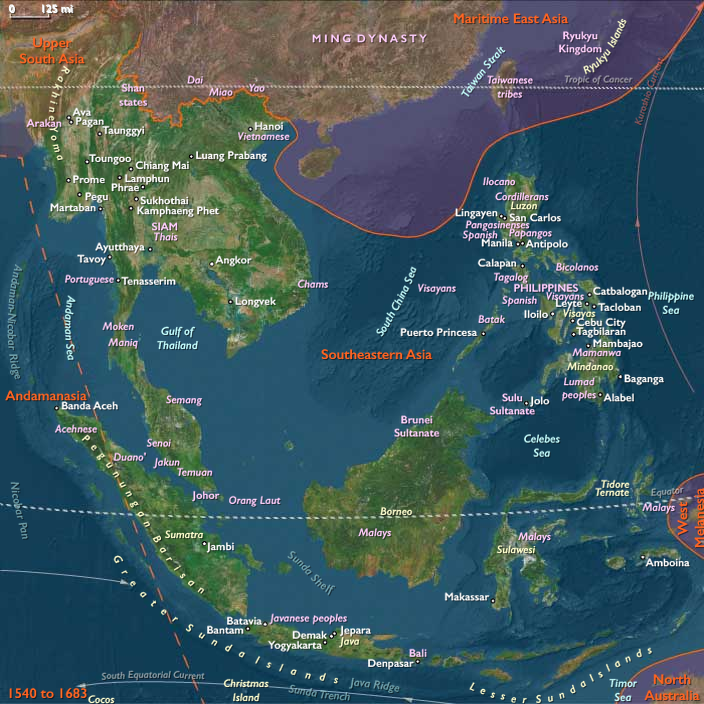
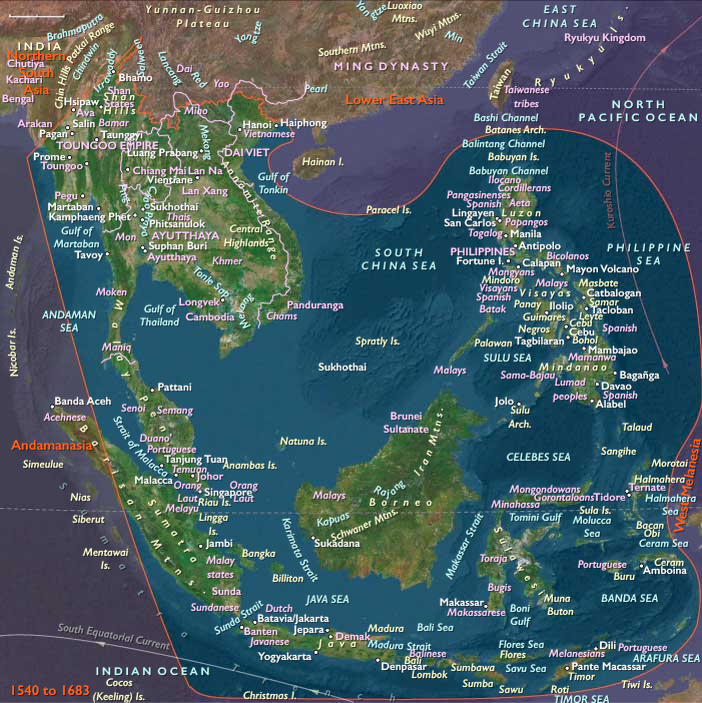
Fighting to restore the kingdom that his slain brother-in-law had built and aided by Portuguese mercenaries, Bayinnaung retakes Prome and ...
Locations
People
Groups
Topics
Commodoties
Subjects
Regions
Subregions
Related Events
Filter results
Showing 10 events out of 36328 total
Bayinnaung, moving south with his Burmese troops and Portuguese mercenaries, defeats Mon rebel leader Smim Htaw in battle outside Pegu in 1551, and soon executes him.
...Toungoo, where in 1551 he declares himself king.
During the next three decades, Bayinnaung will assemble the largest empire in the history of Southeast Asia, which includes much of modern day Burma, Manipur, Mong Mao (Chinese Shan States, Yunnan), Lan Na (northern Thailand), Siam (southern Thailand) and Lan Xang (Laos).
The use and making of icons had entered Kievan Rus' following its conversion to Orthodox Christianity in 988.
As a general rule, these icons strictly followed models and formulas hallowed by Byzantine art, led from the capital in Constantinople.
As time passed, the Russians—notably Andrei Rublev and Dionisius—had widened the vocabulary of types and styles far beyond anything found elsewhere in the Orthodox world.
A Russian church council, in response, in 1551 prescribes adherence to consecrated models, sparking a decline in icon painting that is to last until the seventeenth century.
The restless and treacherous Ferdinand, despite the peace signed with the Ottoman empire in 1547, is determined to regain control of Transylvania, and finds it intolerable that the Ottoman Pashalik of Buda separates Transylvania from Habsburg-controlled Austrian, or Royal, Hungary.
Isabella, the queen mother of Transylvania’s young vassal king, protests to the Ottoman Porte in 1551 that Martinuzzi has assumed too much power and has attempted to have her surrender Transylvania in exchange for equivalent Austrian areas, especially Silesia.
Ferdinand besieges Lippa, the Transylvanian capital, in order to ensure this exchange, for which Martinuzzi acts as go-between.
Martinuzzi finally concludes the agreement with Ferdinand in 1551, by which he continues to be governor of Transylvania and is rewarded with the archbishopric of Esztergom (Gran) and a cardinal's hat at sixty-nine.
Süleyman dispatches an Ottoman army to Lippa and establishes a garrison there.
To forestall attack by the Turks, Martinuzzi resumes payment of tribute to the Porte in early December.
Ferdinand, however, suspects the cardinal's loyalty and has him killed on December 17.
Taking the responsibility of the murder on himself, he sends to Pope Julius III an accusation of treason against Martinuzzi in eighty-seven articles.
After long hesitation, and hearing one hundred and sixteen witnesses, the pope will exonerate Ferdinand of blame.
The first edition of Calvin's Genevan Psalters appears in 1551; the work’s music editor is French composer and music theorist Loys (Louis) Bourgeois, to whom scholars attribute the Protestant doxology known as the Old 100th, one of the most famous melodies in all of Christendom.
Beza, at a loss for immediate occupation, had gone to Tübingen to see his former teacher Wolmar.
On his way home he visited Pierre Viret at Lausanne, who brought about his appointment as professor of Greek at the academy there from November, 1549).
Beza has found time to write a Biblical drama, Abraham Sacrifiant, in which he contrasts Catholicism with Protestantism, and the work has been well received.
In June, 1551, he had added a few psalms to the French version of the Psalms begun by the late Clément Marot, which is also very successful.
About the same time, he had published Passavantius, a satire directed against Pierre Lizet, the former president of the Parliament of Paris, and principal originator of the "fiery chamber" (chambre ardente), who, at is at this time abbot of St. Victor near Paris and publishing a number of polemical writings.
Of a more serious character are two controversies in which Beza is involved at this time.
The first concerns the doctrine of predestination and the controversy of Calvin with Jerome Hermes Bolsec.
A sermon which Bolsec had preached at Paris had aroused misgivings in Catholic circles regarding the soundness of his ideas, and Bolsec had left Paris.
Having separated from the Catholic Church about 1545, he had taken refuge at the Court of Renée, duchess of Ferrara, who was favorably disposed towards Protestant views.
Here he had married, and begun the study of medicine, about 1550 settling as a physician at Veigy, near Geneva.
A theological controversy with Calvin, whose doctrine of predestination he deemed an absurdity, soon ensued.
In 1551, at one of the religious conferences or public discussions held at Geneva every Friday, the orator of the day, Jean de Saint André, is speaking on predestination.
Bolsec, after interrupting him and arguing against him, is arrested, and through the influence of the reformer banished from Geneva.
Bolsec will some years later publish negative biographies of Calvin and Beza.

Andrea Cesalpino had succeeded his teacher, Luca Ghini, as professor of medicine and director of the botanical gardens at the University of Pisa.
He publishes in 1583 what is considered the first textbook of botany, De plantis libri XVI.
The brief first book presents the principles of botany using the models of Aristotle and Theophrastus; the remaining fifteen books describe and classify more than fifteen hundred plants.
Seeking a philosophical and theoretical approach to plant classification based on unified and coherent principles rather than on alphabetical sequence or medicinal properties, he helps establish botany as an independent science.
While his classification system anticipates Linnaeus' system of binomial nomenclature, Cesalpino retains the false classic divisions of woody and herbaceous plants and the belief that plants are not sexual.
His work will profoundly influence later botanists.
Duke Cosimo of Florence issues a charter in 1551 to attract Sephardic Jewish merchants from the Balkans to Pisa; ...
…they trade using routes through Ancona and …
...Pesaro.
Petrus Ramus (Pierre de la Rameé), a twenty-year-old graduate student at the College de Navarre in Paris, is an anti-Aristotelian logician who entitles his master of arts thesis "Quaecumque ab Aristotele dicta essent commentitia esse" ("Whatever Aristotle has said is a fabrication").
After receiving his degree, he teaches at the College du Mans, Paris, and continues attacking Aristotle and his modern disciples.
Spanish humanist philosopher and scholar Juan Luis Vives produces an important work, "De anima et vita libri tres" ("Three Books on the Soul and Life"), in which he discusses the association of ideas, the nature of memory, and even animal psychology.
Netherlandish painter Pieter Aertsen had, as a youth, apprenticed with Allaert Claesz.
A pioneer of still life and genre painting, he has distinguished himself by painting domestic scenes in which he reproduces articles of furniture, cooking utensils, and so on, with marvelous fidelity.
His Butcher’s Stall with the Flight into Egypt, painted in about 1551, leads northern painting of still-lifes to more conventional table arrangements of foodstuffs and meals.
Aertsen's scenes at first glance look like pure examples of still life and genre painting types, but in fact have a religious scene incorporated in them.