Fes, capital of the Almohad Empire, becomes …
Years: 1170 - 1170
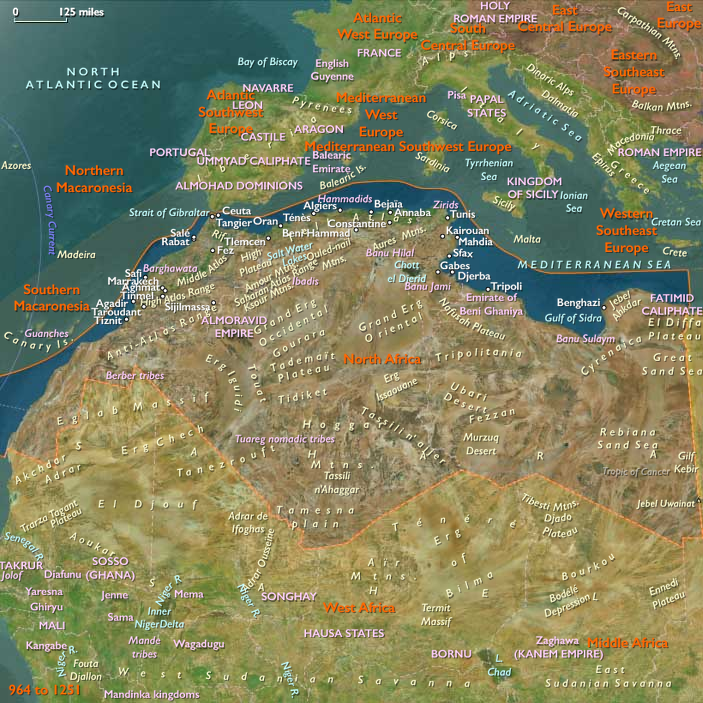
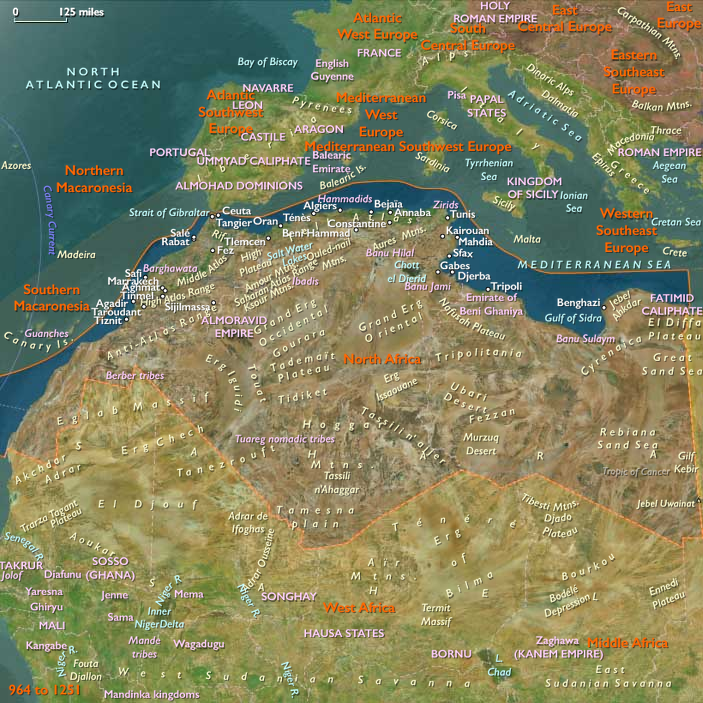
Fes, capital of the Almohad Empire, becomes in about 1170 the largest city of the world, taking the lead from Constantinople.
Locations
Groups
Subjects
Regions
Subregions
Related Events
Filter results
Showing 10 events out of 48378 total
King Jaya Indravarman IV, who had ascended the throne of Champa in 1167, launches an invasion of the wealthy Khmer empire, of which the rebel Tribhuvanadityavarman has recently become king.
Palace guards massacre the civil officials at the Korean court and place a new king on the throne.
The coup leaders abolish the privileges that have kept the aristocrats in power and appoint themselves to senior posts.
After seizing control of the government in 1170, the Goryeoan military suppresses Buddhism.
The personal relationships of Emperor Manuel with the crusaders and with other Westerners remains cordial, but his policies have antagonized the German Empire, the papacy, the Normans of southern Italy, and, not least, the Venetians, with whom mutual dislike has ripened into hatred.
The emperor encourages merchants from the Italian republics of Genoa and Pisa to compete in imperial markets.
His effort to revive imperial prestige in Italy and the Balkans, and his treaties with Genoa in 1169 and Pisa in 1170, rouse the suspicions of Venice: the Venetians respond by destroying the establishments of their rivals, sparking a seven-year war with Constantinople.
Miles of Plancy, born in Plancy-l'Abbaye, Champagne, had in the 1160s come to the east, where he has served King Amalric I, to whom he is distantly related.
Amalric had made him seneschal of Jerusalem, and in 1167 he had participated in Amalric's expedition to Egypt.
He had encouraged Amalric to make a treaty with Egypt rather than capturing it by force and submitting it to plunder; after Amalric returned home, Egypt had quickly fallen fell under the control of Nur ad-Din engi and his commander Shirkuh.
This event will eventually lead to the union of Egypt and Syria under Saladin, an inauspicious outcome for the crusader kingdom.
The Knights Templar in 1170 build a fortress at Gaza to defend against attacks from Egypt.
Miles will not allow the unarmed inhabitants of the city to take shelter inside and many of them are killed when the city is attacked.
Specific details of the life of Peter Waldo are largely unknown.
Extant sources relate that he was a wealthy clothier and merchant from Lyons and a man of some learning.
Sometime shortly before the year 1160, he had been inspired by a series of events, firstly, after hearing a sermon on the life of St. Alexius, secondly, when rejection of transubstantiation was made a capital crime, thirdly, the sudden and unexpected death of a friend during an evening meal.
From this point onward, he had begun living a radical Christian life giving his property over to his wife, while the remainder of his belongings he distributed as alms to the poor.
At about this time, Waldo began to preach and teach publicly, based on his ideas of simplicity and poverty, notably that "No man can serve two masters, God and mammon" accompanied by strong condemnations of Papal excesses and Catholic dogmas, including purgatory and transubstantiation, while accusing them of being the harlot from the book of Revelation.
By 1170, he has gathered a large number of followers who are referred to as the Poor of Lyons, the Poor of Lombardy, or the Poor of God, who spread their teaching abroad while disguised as peddlers.
Often referred to as the Waldensians (or Waldenses), they are distinct from the Albigensians or Cathari.

Catania, constructed on lava left by eruptions of Mount Etna, is rebuilt after the earthquake of 1169.
Reliquaries of the twelfth century sometimes take the form of miniature church buildings such as the so-called Eltenberg Reliquary, executed around 1170 in the Rhineland.
Seated figures of Christ and the Apostles, standing figures of prophets, and scenes from the life of Christ decorate the small golden structure.
Only one other example of this type of reliquary is known.
Owned by the Kunstgewerbemuseum in Berlin, the so-called Welfenschatz reliquary is very similar in shape, scale and decorative design; so much so, that the idea of them being produced by the same workshop has been suggested.
Rhys benefits in 1169 and 1170 from the Norman invasion of Ireland, which is largely led by the Cambro-Norman lords of south Wales.
The departure of the Norman lords enables Rhys to strengthen his position, and the death of Owain Gwynedd in late 1170 leaves him as the acknowledged leader of the Welsh princes.
Strongbow himself arrives in August 1170.
He soon marries Diarmait's daughter, Aoife, and is named as heir to the Kingdom of Leinster.
This latter development causes consternation to Henry II, who fears the establishment of a rival Norman state in Ireland.
Accordingly, he resolves to visit Leinster to establish his authority.
The Anglo-Norman poet Thomas relates, around 1170, the tale of Tristan and Isolde, or Tristram and Iseult, the famous lovers in Celtic and Arthurian legend, who become tragically enmeshed in adulterous passion, secrecy, and intrigue, after Tristan, nephew of King Mark of Cornwall, drinks a love potion and falls in love with Mark’s wife Isolde.