Ferdinand II outlaws all religions in Bohemia …
Years: 1627 - 1627
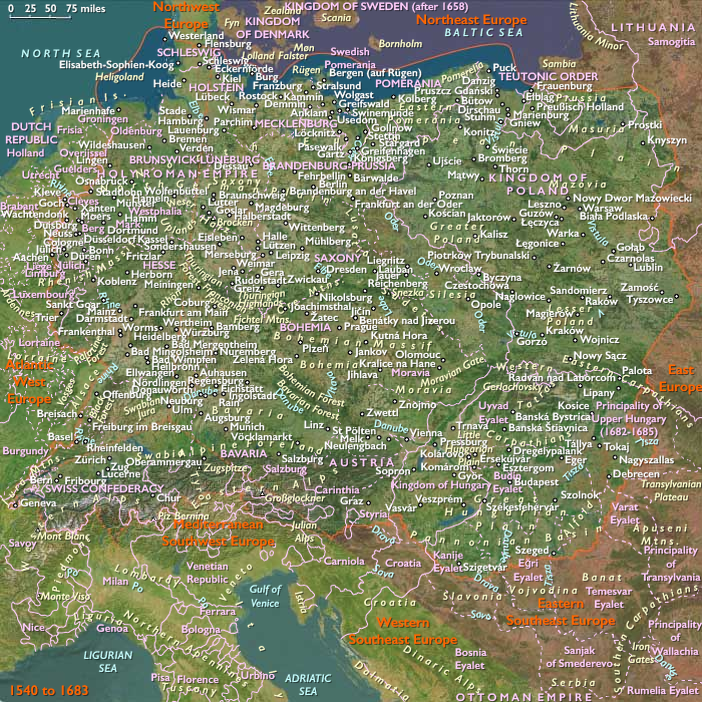
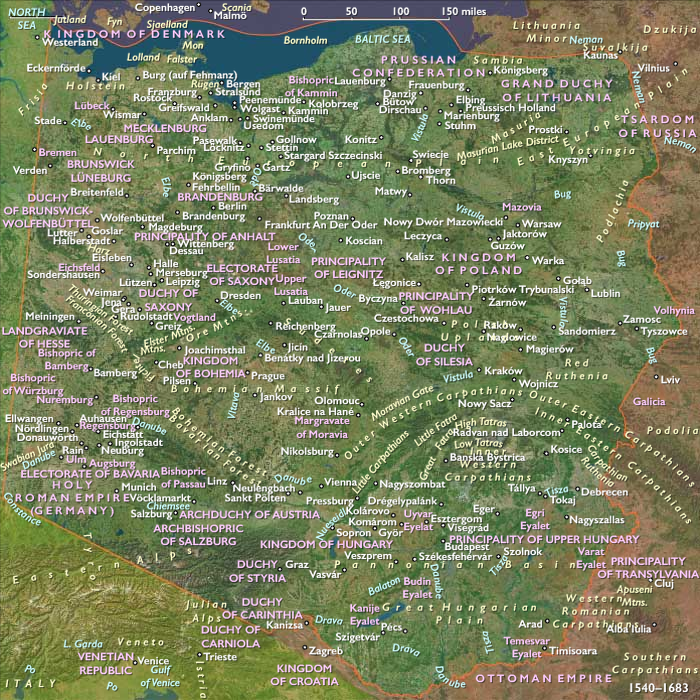
Ferdinand II outlaws all religions in Bohemia other than Roman Catholicism in 1627.
Locations
People
Groups
Topics
- Protestant Reformation
- Counter-Reformation (also Catholic Reformation or Catholic Revival)
- Thirty Years' War
Commodoties
Subjects
Regions
Subregions
Related Events
Filter results
Showing 10 events out of 32758 total
Ayutthaya exchanges embassies with the Tokugawa Shogunate.
Japanese national Yamada Nagamasa lives in the Japanese quarters of Ayutthaya, home to another fifteen hundred Japanese inhabitants (some estimates run as high as seven thousand).
The community, called "Ban Yipun" in Thai, and headed by a Japanese chief nominated by Thai authorities, is apparently a combination of traders, Christian converts who had fled their home country following the persecutions of Toyotomi Hideyoshi and Tokugawa Ieyasu, and unemployed former samurai who had been on the losing side at the battle of Sekigahara.
The Christian community seems to have been in the hundreds, as described by Padre Antonio Francisco Cardim, who will recount having administered sacrament to around four hundred Japanese Christians in 1627 in the Thai capital.
The colony is active in trade, particularly in the export of deer hide to Japan in exchange for Japanese silver and Japanese handicrafts (swords, lacquered boxes, high-quality papers).
They are noted by the Dutch for challenging the trade monopoly of the Dutch East India Company (VOC).
The colony also has an important military role in Ayutthaya, organized under a "Department of Japanese Volunteers" (Krom Asa Yipun) by the Thai king.
Yamada Nagamasa is alleged to have carried on the business of a corsair or pirate from the period of 1620, attacking and plundering Dutch ships in and around Batavia (present day Jakarta).
In the space of fifteen years, Yamada Nagamasa has risen from the low Thai nobility rank of Khun to the senior of Ok-ya, his title becoming Ok-ya Senaphimuk.
He has become the head of the Japanese colony, and in this position supports the military campaigns of the Thai king Songtham, at the head of a Japanese army flying the Japanese flag.
After more than twelve years in Siam, Yamada Nagamasa had gone to Japan in 1624 aboard one of his ships, where he had sold a cargo of Siamese deer hide in Nagasaki.
He had stayed in Japan for three years, trying to obtain a Red Seal permit, but finally left in 1627, with the simple status of a foreign ship.
Nagamasa had in 1626 offered a painting of one of his fighting ships to a temple of his hometown in Shizuoka.
That painting will be lost in a fire, but a copy of it remains to this day, portraying a ship with Western-style rigging, eighteen cannons, and sailors in samurai gear.
He returns to Siam in 1627.
Court eunuch leaders of the Directorate of Ceremony, such as Wei Zhongxian in the 1620s, have acted as virtual, de facto dictators of the state, since the assumption of power by court eunuchs under the Wanli emperor.
Wei Zhongxian, considered by most historians as the most powerful and notorious eunuch in Chinese history, had taken the step of becoming a eunuch and entering palace service to escape from his creditors, taking the name Li Jinzhong.
After entering the palace, he had become attached to the service of Madam Ke, the wet-nurse of the future emperor.
The couple had begun manipulating the Tianqi Emperor, who had renamed him Wei Zhongxian.
Zhu Youxiao had become the Tianqi emperor at the age of fifteen, on the death of his father who had ruled less than a month.
He pays little attention to affairs of state, and is accused of failing in his filial duties to his dead father by not continuing his father's wishes.
It is possible that Zhu Youxiao suffers from a learning disability or something more: he is illiterate and shows no interest in his studies.
Because he is unable to read memorials and uninterested in the affairs of state, his head eunuch, Wei Zhongxian has usurped the power along with Madam Ke.
The young emperor apparently devotes his time to carpentry.
Wei has taken advantage of the situation and begun appointing the people he trusts to important positions in the palace.
Meanwhile Madam Ke seeks to retain power by removing all other women from the emperor's harem by locking away the concubines of the emperor and starving them to death.
The emperor's favor had soon given Wei absolute power over the court, enabling Wei to persecute anyone who opposes his decisions, resulting in the death and imprisonment of many officials.
One Confucian moralist group, the Donglin Party, had expressed distress at the conditions of the Imperial State.
In response, the palace had covertly ordered the execution of a number of officials associated with the Donglin.
Living conditions have worsened during Tianqi’s reign and he has faced several popular uprisings.
Wei Zhongxian had eventually proclaimed himself to be Nine-Thousand Years, which means that he is symbolically the second most important person in the country, just after the emperor, who is called the Ten-Thousand Years.
Wei also builds many shrines and erects god-like statues of himself in them.
His control of the court ends in 1627 with the death of the Tianqi Emperor, whose brother and successor promptly eliminates him.
He is forced to commit suicide (some sources say executed by strangulation) and his corpse is disemboweled.

The Manchu, under Hong Taiji, initiate a war of conquest against the Koreans in 1627.
Yuan, taking advantage of Nurhaci's death, reoccupies Jinzhou, which is further north of Ningyuan.
The Imperial Ming army adopts the same strategy of developing Jinzhou into another military stronghold.
Ningyuan has become the headquarters of the Imperial Ming army, with Yuan Chonghuan stationed here.
When the Manchus reappear in June, 1627, Hung Taiji, like his father, is defeated in the very long and fierce Second Battle of Ningyuan, involving both Ningyuan and Jinzhou.
It is a great tactical and strategic defeat for the Manchus, who withdraw after a series of indecisive battles.
Yuan is criticized by the partisans of the eunuch official Wèi Zhōngxián, stating that he had taken too long to fight off the "barbarian" Manchurians, and shortly thereafter Yuan retires.
Hung Taiji now plots the death of Yuan Chonghuan.
Huang Taiji in 1627 dispatches Amin, Jirgalang, Ajige and Yoto to Korea, guided by Gang Hong-rip and other Koreans.
The Korean army, having still not recovered from Seven-Year War against Japan, is ill-prepared for defense against the Manchus, who manage to march deep within Korean territory and defeat Mao Wenlong's troops but fail to capture the commander.
When the Manchus advance southward to Hwangju, ...
...King Injo flees from Hanseong (Seoul) to Ganghwa Island in panic.
The Manchus, despite their dominance over the situation, push for peace negotiations, probably because Hong Taiji is concerned about home defenses.
Their peace offer to Korea is soon accepted, despite the opposition of some anti-Manchu statesmen who fail to appreciate the strong position of Manchus.
The following settlement is agreed upon in Ganghwa Island:
1.Korea will abandon the Ming era name Tianqi.
2.Korea will offer Yi Gak as a hostage as a substitute for a royal prince.
3. (Later) Jin and Korea will not violate each others' territory.
In the meantime, Amin in Pyongyang loots the city for days, before he is ordered by Hang Taji to sign the peace agreement, which is more favorable to the Manchus.
After the four month expedition, the Manchu army withdraws to Mukden.
The two sides conduct postwar negotiations.
The Manchus force Korea to open markets near the borders because the long conflict with Ming China has brought economic hardship to the Manchus.
Korea also returns the Warka tribe to Later Jin.
The Manchus are to exact regular tribute from Korea for the next several years.
The aurochs or urus (Bos primigenius), the ancestor of domestic cattle, a type of huge wild cattle which has long inhabited Europe, Asia and North Africa, is far larger than most modern domestic cattle with a shoulder height of two meters (6.6 ft) and weighing one3 thousand kilograms (twenty-two hundred pounds).
Domestication of bovines had occurred in several parts of the world at roughly the same time, about eight thousand years ago.
The original range of the aurochs was from Britain and Ireland and southern Scandinavia, to northern Africa, the Middle East, India and central Asia.
The aurochs was regarded as a challenging quarry, contributing to its eventual extinction.
The aurochs' range was by the thirteenth century CE restricted to Poland, Lithuania, Moldavia, Transylvania and East Prussia.
The right to hunt large animals on any land was restricted to nobles and gradually to the royal household.
As the population of aurochs declined, hunting ceased but the royal court still required gamekeepers to provide open fields for the aurochs to graze in.
The gamekeepers were exempted from local taxes in exchange for their service and a decree made poaching an aurochs punishable by death.
The gamekeepers in 1564 knew of only thirty-eight animals, according to the royal survey.
The last recorded live aurochs, a female, dies in 1627 in the Jaktorów Forest, Poland, from natural causes.
Rock blasting is invented when gunpowder is first used in mining in 1627 in a mineshaft under Banská Štiavnica, Slovakia.
Sweden’s King Gustavus Adolphus II Vasa is reported to have entered battle without wearing any armor, proclaiming, "The Lord God, is my armor!"
It is more likely that he simply wore a leather cuirass rather than going into battle wearing no battle protection whatsoever.
Near Dirschau in Prussia in 1627, a Polish soldier shoots him in the muscles above his shoulders.
He will survive, but the doctors cannot remove the bullet, so he will be unable to wear an iron suit of armor from this point on.
Also, two fingers of his right hand are now paralyzed.
Years: 1627 - 1627
Locations
People
Groups
Topics
- Protestant Reformation
- Counter-Reformation (also Catholic Reformation or Catholic Revival)
- Thirty Years' War