
The Imperial Title and Death of Ferdinand …
Years: 1065 - 1065
The Imperial Title and Death of Ferdinand I of León and Castile (1036–1065 CE)
Ferdinand I of León and Castile is first titled "emperor" not by his own court, but by the notaries of his half-brother, Ramiro I of Aragon. Ramiro’s scribes had previously used the title for Ferdinand’s predecessor, recognizing León’s preeminence among the Christian kingdoms of Iberia.
In a royal Aragonese charter of 1036, before the Battle of Tamarón, Ramiro refers to Ferdinand as "emperor in Castile and in León and in Astorga."
- A similar phrase appears in a 1041 charter, and again in 1061, though with the order reversed: "emperor in León and in Castile", omitting Astorga.
- The first recorded use of the imperial style in Ferdinand’s own documents appears in 1056, in a charter preserved in the cartulary of Arlanza:
"Under the rule of the emperor King Ferdinand and the empress Queen Sancha ruling the kingdom in León and in Galicia as well as in Castile."
On this basis, some historians suggest that Ferdinand had himself crowned emperor in 1056. However, he rarely used the imperial title, employing it only once more in a 1058 document, which refers to him as:
"The most serene prince Lord Ferdinand and his consort Queen Sancha" and later as "this emperor, the aforesaid Ferdinand."
Final Years and Death (1065 CE)
After falling ill during the Siege of Valencia and the Battle of Paterna, Ferdinand I dies on December 24, 1065, in León. He embraces ardent piety in his final moments, laying aside his crown and royal mantle, dressing in the robe of a monk, and placing himself before the altar of the Basilica of San Isidoro, lying on a bier covered in ashes.
The Partition of the Kingdom Among His Children
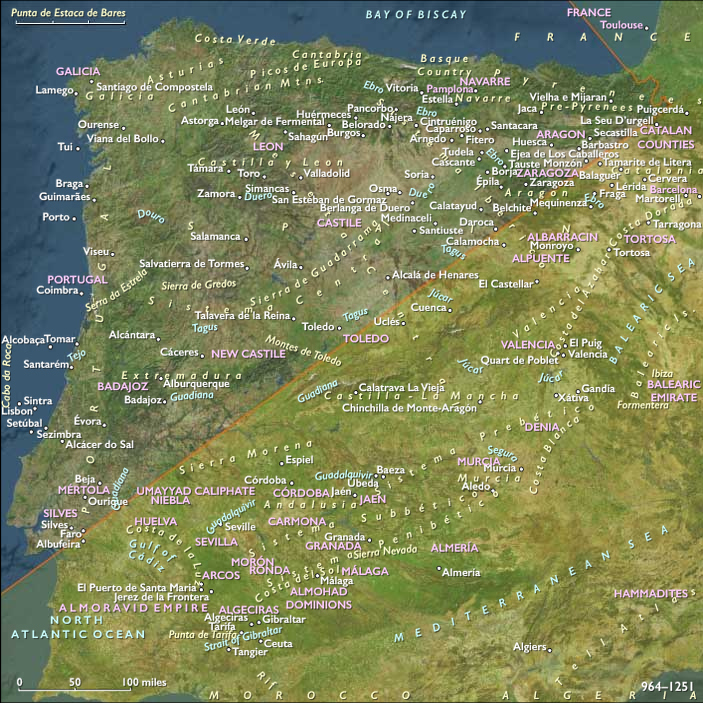
By his will, Ferdinand divides his kingdom among his three sons and two daughters:
- Sancho II receives Castile.
- Alfonso VI receives León.
- García II is given Galicia, carved out of León as a separate kingdom.
- Elvira receives Toro.
- Urraca receives Zamora.
Ferdinand expresses his desire for peace among his heirs, instructing them to respect the partition. However, his plan quickly unravels: soon after his death, Sancho and Alfonso turn against García, defeating him and setting the stage for further dynastic struggles in the Christian kingdoms of Iberia.
Locations
People
- Alfonso VI of León and Castile
- Ferdinand I of León and Castile
- García II of Galicia
- Sancho II of León and Castile
- Sancho IV Garcés
Groups
- Galicia, Kingdom of
- Navarre, Kingdom of
- León, Kingdom of
- Valencia, Muslim statelet, or taifa, of
- Castile, Kingdom of
Topics
Commodoties
Subjects
Regions

Subregions
Years: 1065 - 1065
Locations
People
- Alfonso VI of León and Castile
- Ferdinand I of León and Castile
- García II of Galicia
- Sancho II of León and Castile
- Sancho IV Garcés
Groups
- Galicia, Kingdom of
- Navarre, Kingdom of
- León, Kingdom of
- Valencia, Muslim statelet, or taifa, of
- Castile, Kingdom of
Topics
Commodoties
Subjects
Regions
Subregions