
Russian exploration and annexation by the middle …
Years: 1672 - 1683
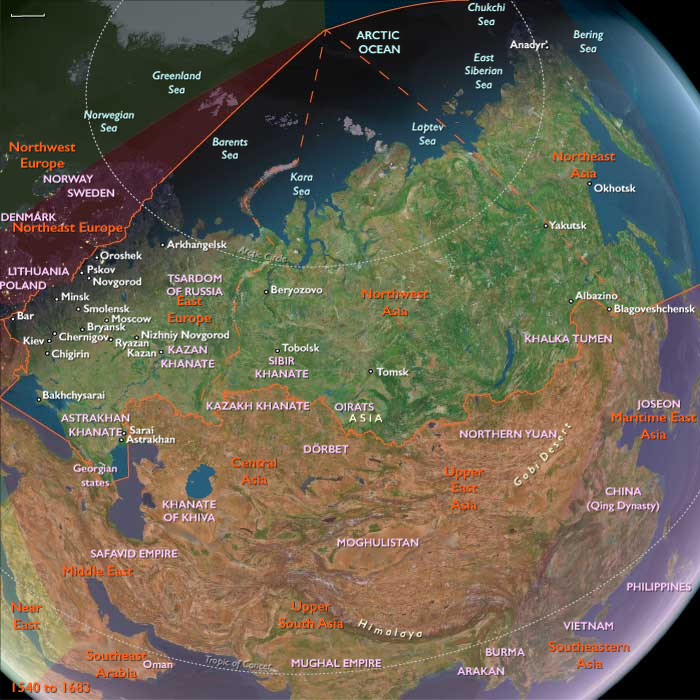
Russian exploration and annexation by the middle of the seventeenth century had become very worrisome to the Mongols and the Turks to the southwest.
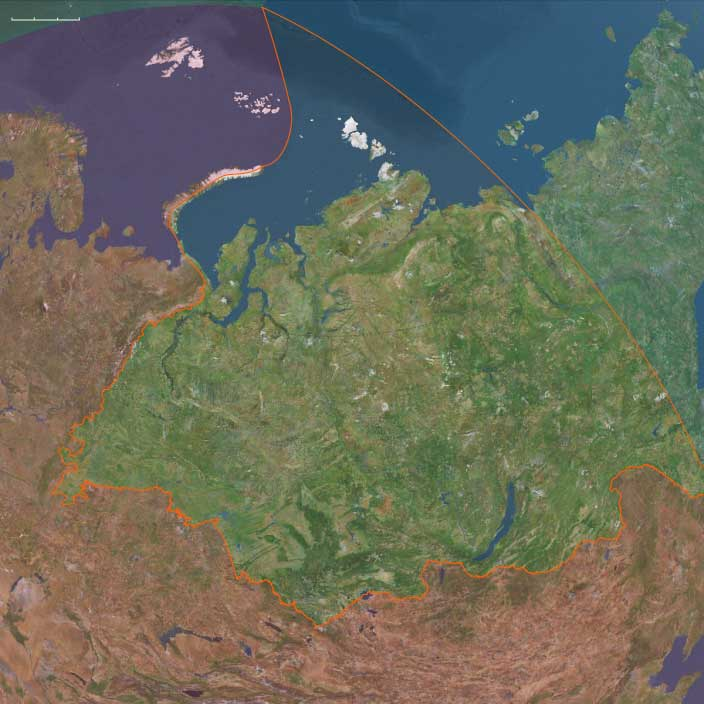
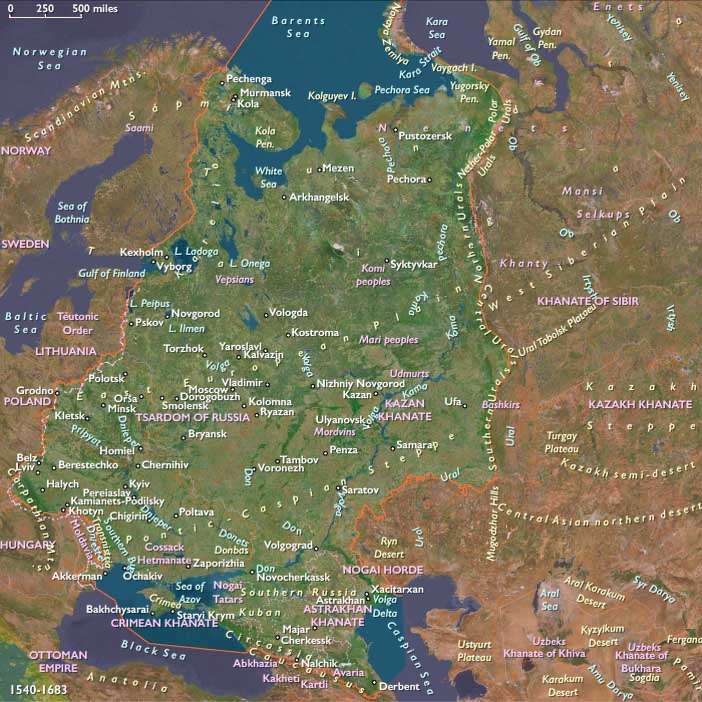
In response to this pressure, in 1672 Ayuka Khan of the Torgut Mongols raids through western Siberia, across the Urals and the Volga, and into Russia.
He then makes peace with the Russians on terms that enable him to continue to control his lands in relative tranquility for the remainder of the century.
People
Groups
- Turkmens (Central Asia)
- Mongols
- Torghut
- Russians (East Slavs)
- Russia, Tsardom of
- Kalmyk people
- Kalmyk Khanate
Subjects
Regions
Subregions
Related Events
Filter results
Showing 9 events out of 9 total
Upper South Asia (1972–1983 CE): New Nations, Political Turmoil, and Regional Realignments
India: Centralization, Emergency, and Political Realignment
From 1972 to 1983, India experienced significant political upheaval under the leadership of Prime Minister Indira Gandhi. Following the victory over Pakistan in 1971 and the creation of Bangladesh, Gandhi consolidated political power, emphasizing centralized authority and socialist economic policies.
In 1975, facing political opposition and charges of electoral malpractice, Gandhi declared a state of Emergency, suspending democratic rights, censoring the press, and arresting opposition leaders. The Emergency, lasting until 1977, profoundly impacted Indian politics, leaving deep scars on the country’s democratic institutions.
Following public backlash, Gandhi’s Congress Party suffered a significant defeat in the 1977 general elections, ushering in the first non-Congress government under Prime Minister Morarji Desai and the Janata Party coalition. However, the coalition proved unstable, collapsing by 1979, and paving the way for Gandhi’s return to power in 1980, this time with a diminished political base.
Pakistan: Bhutto’s Leadership and Military Coup
In Pakistan, Prime Minister Zulfikar Ali Bhutto (1971–1977) initiated extensive economic and social reforms, nationalizing key industries and promoting Islamic identity to bolster national unity. Despite initial popularity, Bhutto’s increasingly authoritarian methods provoked domestic unrest and accusations of election fraud in 1977, triggering widespread opposition.
Amid escalating political turmoil, General Muhammad Zia-ul-Haq staged a military coup in July 1977, removing Bhutto from power. Bhutto was controversially sentenced to death and executed in 1979, dramatically reshaping Pakistani politics. Zia-ul-Haq introduced strict Islamic laws (Islamization), reinforcing conservative religious norms and sharply altering Pakistan's political and social trajectory. Pakistan’s foreign policy during Zia’s regime moved closer to the United States, especially following the 1979 Soviet invasion of Afghanistan.
Bangladesh: Challenges of Nation-Building
The newly independent Bangladesh faced enormous economic, social, and political challenges. Initially led by Sheikh Mujibur Rahman, the country adopted a parliamentary democracy. However, internal divisions, corruption, famine (notably the devastating 1974 famine), and economic hardships eroded Mujib’s popularity.
In 1975, Sheikh Mujibur Rahman was assassinated in a military coup, plunging the country into political instability and military rule. General Ziaur Rahman (1977–1981) assumed power, initially restoring stability, promoting economic liberalization, and shifting foreign policy toward stronger relations with China, Pakistan, and the Middle East. However, Ziaur Rahman himself was assassinated in another military coup attempt in 1981, highlighting persistent volatility.
Afghanistan: Republic, Soviet Invasion, and Resistance
In Afghanistan, the monarchy was overthrown in 1973 by former Prime Minister Mohammed Daoud Khan, who established the Republic of Afghanistan and promoted modernization. However, Daoud Khan’s rule ended abruptly in 1978 with a Soviet-backed coup (Saur Revolution), bringing the People's Democratic Party of Afghanistan (PDPA) to power under Nur Muhammad Taraki and then Hafizullah Amin.
Amid rapid, controversial socialist reforms and severe repression, widespread resistance emerged. In December 1979, the Soviet Union invaded Afghanistan, assassinating Amin, and installing Babrak Karmal as leader, triggering a prolonged conflict that transformed the country into a Cold War battleground. Resistance movements, notably the mujahideen supported by Pakistan, Saudi Arabia, and the United States, fought fiercely against Soviet and Afghan forces, destabilizing the region profoundly.
Nepal: Panchayat System and Calls for Democracy
In Nepal, the authoritarian Panchayat System remained entrenched under King Birendra Bir Bikram Shah (r. 1972–2001). Despite modest developmental progress and diplomatic balance, political opposition grew, demanding greater democratic freedoms and accountability. The period witnessed increasing internal tension between modernizers advocating political reform and traditional royalists preserving absolute monarchy.
Bhutan: Gradual Modernization and Sovereignty
Bhutan, under King Jigme Singye Wangchuck (r. 1972–2006), pursued careful modernization policies emphasizing the preservation of national sovereignty, culture, and environmental sustainability. In 1974, Bhutan formally opened to international relations by inviting foreign dignitaries to the coronation of the king, symbolizing a cautious expansion of external engagements. Bhutan maintained close but carefully managed relations with India, strengthening its position as an independent Himalayan kingdom.
Regional and Cultural Dynamics
This era saw substantial cultural developments across Northern South Asia. In India, cinema, literature, and music reflected socio-political tensions, notably capturing Emergency-era repression and its aftermath. In Pakistan, literature and arts wrestled with themes of political suppression and social change under Zia’s Islamic laws. Bangladesh experienced a cultural renaissance, emphasizing Bengali identity, language, and liberation narratives. Afghanistan’s cultural scene was dramatically affected by war, with many intellectuals and artists fleeing the country, leading to an Afghan diaspora culture.
Legacy of the Age
The years 1972–1983 reshaped Upper South Asia profoundly. In India and Pakistan, centralization and authoritarian periods tested democratic resilience. Bangladesh struggled toward stability amid violence and coups. Afghanistan descended into war and foreign occupation, fundamentally altering regional geopolitics. Nepal and Bhutan navigated cautiously between tradition and modernity, setting trajectories for future democratic movements. The events and transformations of this era continue influencing the contemporary politics, cultures, and identities of Northern South Asia.
Upper South Asia (1984–1995 CE): Turbulence, Transition, and Transformation
India: Assassinations and Sociopolitical Unrest
From 1984 to 1995, India faced severe challenges marked by internal conflict, political violence, and significant economic transformation. In 1984, Prime Minister Indira Gandhi was assassinated by her Sikh bodyguards following the Indian military’s controversial assault on the Golden Temple (Operation Blue Star) in Amritsar, Punjab. Her assassination triggered violent anti-Sikh riots across India, resulting in thousands of deaths, most notably in Delhi.
Indira Gandhi’s son, Rajiv Gandhi, succeeded her as Prime Minister, launching ambitious modernization programs that promoted technology, infrastructure, and economic liberalization. Rajiv’s tenure saw improved relations with the United States and China, but deteriorating ties with Sri Lanka, culminating in the ill-fated Indian Peace Keeping Force (IPKF) deployment (1987–1990).
Rajiv Gandhi’s administration was weakened by corruption scandals (notably the Bofors scandal) and regional separatist movements, especially in Punjab and Jammu and Kashmir. In 1991, Rajiv Gandhi himself was assassinated by the Sri Lankan Tamil separatist group, the Liberation Tigers of Tamil Eelam (LTTE), dramatically altering India’s political landscape.
India’s Economic Liberalization
Following a severe balance-of-payments crisis in 1991, Prime Minister P.V. Narasimha Rao and his Finance Minister, Manmohan Singh, initiated extensive economic reforms, dismantling the License Raj and introducing liberalization policies. These reforms opened India’s economy to foreign investment, reduced bureaucratic controls, and laid the foundation for rapid economic growth and globalization in subsequent decades.
Pakistan: Zia-ul-Haq’s Rule and Return to Civilian Government
In Pakistan, General Muhammad Zia-ul-Haq’s authoritarian rule continued until his death in a mysterious plane crash in 1988. His regime maintained stringent Islamic laws (Islamization), suppressing political dissent but strengthening ties with the United States due to Pakistan’s strategic role in supporting Afghan resistance against the Soviet Union.
Following Zia’s death, civilian rule briefly returned under Benazir Bhutto, daughter of former Prime Minister Zulfikar Ali Bhutto, who became the first woman Prime Minister in the Muslim world. Her two terms (1988–1990, 1993–1996) were characterized by attempts at democratic consolidation, social reforms, and liberalization, but marred by allegations of corruption and political instability. Pakistan’s internal situation remained turbulent, notably in Sindh and Punjab, amid ethnic, sectarian, and political violence.
Afghanistan: Soviet Withdrawal and Civil War
In Afghanistan, the prolonged Soviet occupation ended in 1989, following the Geneva Accords (1988). Soviet withdrawal, however, plunged the country into a chaotic civil war among rival mujahideen factions. The Afghan government of President Mohammad Najibullah initially survived Soviet withdrawal but eventually collapsed in 1992, leading to the mujahideen takeover of Kabul.
Infighting among mujahideen factions led by commanders such as Ahmad Shah Massoud, Gulbuddin Hekmatyar, and Abdul Rashid Dostum devastated Afghanistan, with severe humanitarian consequences. This civil conflict set the stage for the rise of the Taliban by the mid-1990s.
Bangladesh: Democracy Restored
In Bangladesh, after nearly a decade of military rule under General Hussain Muhammad Ershad, popular protests and political activism led to his resignation in 1990. The restoration of democracy paved the way for multiparty elections and a fragile democratic experiment. Political rivalry intensified between the Awami League, led by Sheikh Hasina, and the Bangladesh Nationalist Party (BNP), led by Khaleda Zia, widow of former President Ziaur Rahman. Khaleda Zia’s BNP took power (1991–1996), implementing liberal economic policies and struggling to stabilize political tensions.
Nepal: Push for Democracy
Nepal experienced significant political shifts as anti-monarchy sentiments surged. In 1990, massive pro-democracy protests compelled King Birendra Bir Bikram Shah to end the autocratic Panchayat System. A new constitution was promulgated, establishing multiparty democracy and significantly reducing royal authority. This democratic opening led to intense political competition and frequent government turnovers throughout the 1990s.
Bhutan: "Gross National Happiness" and Gradual Change
In Bhutan, King Jigme Singye Wangchuck emphasized gradual modernization while maintaining Bhutan’s unique cultural identity and sovereignty. Bhutan’s developmental strategy centered around the concept of Gross National Happiness (GNH), prioritizing sustainable and culturally conscious progress. Bhutan cautiously opened to international tourism and external economic relations, carefully balancing modernization with tradition.
Myanmar’s Northwestern States: Continued Ethnic Conflict
In northwestern Myanmar (Burma), notably in Kachin, Sagaing, Chin, and northern Rakhine states, ethnic insurgencies continued against the Burmese military government. Groups like the Kachin Independence Army (KIA) and various Chin insurgencies maintained resistance, driven by demands for autonomy, cultural recognition, and religious freedom, facing severe military repression and displacement.
Cultural and Social Transformations
Across the subregion, cultural dynamism persisted amid political instability. In India and Pakistan, cinema, literature, and music tackled themes of identity, political oppression, and rapid modernization. Afghanistan’s prolonged conflict created a vast diaspora, spreading Afghan culture globally, notably through literature and music. Bangladesh witnessed cultural and literary movements centered around democracy, secularism, and Bengali nationalism.
Legacy of the Age
The period 1984–1995 was transformative yet turbulent for Upper South Asia. India transitioned toward economic openness despite severe internal conflict. Pakistan alternated between authoritarian rule and fragile democracy. Afghanistan descended further into civil war, while Bangladesh restored democracy amid political volatility. Nepal embarked on a democratic journey, and Bhutan pursued its cautious, distinct modernization path. This era significantly reshaped the region’s political, economic, and cultural landscapes, with consequences still unfolding in contemporary times.
Following the Soviet withdrawal from Afghanistan, Hekmatyar allies himself with Tanai, a prominent member of the communist Khalq (Masses) party, and in 1990 mounts a failed coup against Najibullah's government.
The opposition parties form an alliance as the United Islamic Front for the Salvation of Afghanistan (UIFSA).
This essentially anti-Taliban coalition includes the Tajik-dominated Jamiat-i Islami of Rabbani and Massoud; the predominantly Pashtun Hizb-i Islami of Hekmatyar, the Uzbek-dominated Junbish of General Abdul Rashid Dostum; and the Hazara Hizb-i Wahdat with its stronghold in the central mountainous region of the country known as Hazarajat.
Pakistan reportedly is again instrumental in providing support for the Taliban offensive on the northern provinces that begins in July 1998.
As the Taliban near Mazar this time, a number of opposition commanders, including Dostum, vacate the city, and Jamiat fighters reportedly loot their own office.
The UIFSA virtually collapses.
As before, the Taliban count on defectors to clear a way into the city for them, but this time they demand guarantees that they will not be double-crossed.
Pashtun militia commanders from Balkh who have grown disillusioned with Hekmatyar agree to join forces with the Taliban and move in behind the main Hizb-i Wahdat force encamped at Qala Zaini, a walled area west of the city.
Thus surrounded, virtually the entire Hizb-i Wahdat force, estimated at between 1,500 and 3,000, is killed there or on the roads leading north and east of the city.
A smaller contingent of some 700 Hizb-i Wahdat troops flees south from the city to the mountains, and the way is opened for the main Taliban force to enter Mazar.
After capturing Mazar on August 18, Taliban troops reportedly massacre between 2,000 and 5,000 men, women and children, mostly Hazaras.
During the massacre, the Taliban forces carry out a systematic search for male members for the ethnic Hazara, Tajik, and Uzbek communities in the city.
Human Rights Watch estimates that scores, perhaps hundreds, of Hazara men and boys are summarily executed.
There are also reports that women and girls are raped and abducted during the Taliban takeover of the city.
Following the assassination of ethnic Tajik Jamiat-I-Islami commander Massoud in September 2001, his intelligence chief, General Mohammed Fahim Khan, is named as the new military leader of the Northern Alliance.
In the west-central Ghor and Herat provinces, Isma'il Khan, a member of Jamiat-I-Islami and former Herat governor, is also an important figure.
The second main grouping is the ethnic Uzbek Junbish-i-Milli-yi Islami, led by General Abdur Rashid Dostum, a former opponent of General Massoud who joined the alliance earlier this year.
The third main element is the ethnic Hazara Shi'a grouping of the Hizb-i Wahdat led by Karim Khalili and Mohaqiq.
In addition, some of the commanders formerly under the leadership of the Pashtun leader Gulbuddin Hekmatyar are now fighting with the alliance.
Sayed Hussain Anwari, a member of the Harakat-e Inqelab-e Islami (Islamic Revolutionary Movement) party, serves as the military spokesperson for the United Front.
The alliance controls under 5% of Afghanistan: the Panjshir valley, stronghold and birthplace of the late General Massoud, and a small enclave in the mountainous northeast.
Ousted President Burhanuddin Rabbani remains the official head of the Northern Alliance.
The alliance itself has been accused of spectacular corruption, shelling civilians, carrying out torture and summary executions, and engaging in opium and weapons trafficking, according to human rights groups.
The groups say the alliance has also burned and looted the houses of suspected Taliban sympathizers.
Some of the commanders in the largely Tajik north reportedly use torture routinely to extract information from and break the will of prisoners and political opponents; some of the victims are reportedly tortured to death.
For the past several years, the group has been almost entirely armed and supported by the Russian military and, to a lesser extent, by Iran.
Following US moves to take military action against Osama Bin Laden and his Taliban backers, the alliance's political leaders express confidence that their enemy will be eliminated and state that their 12,000 to 15,000 lightly-armed troops are willing to fight alongside the Americans against the Taliban.
The discredited fundamentalist Pashtun leader Hekmatyar, however, alleges that the Americans are wrong to blame Osama Bin Laden for the attacks in New York and Washington.
He says Americans have no right to attack Afghanistan and warns that his Hizb-e Islami party and other groups will fight against them.
The Northern Alliance follows a milder form of Islam than the Taliban.
In Faizabad, women can work and girls can gain higher education.
During Rabbani's period in office, however, the mujahideen government was not notably respectful of human rights, and proved unable to unite the country when it held power briefly after the expulsion of Soviet forces from the country.
There is talk of restoring the monarchy of King Zaher Shah, ousted in 1973 by the Saour Revolution.
The king and the Northern Alliance are now in the process of appointing 120 persons to form a council, a type of small Loya Jirga.
This council will decide on the composition of a transitional government (to last from six months to a year) to replace the Taliban.
During this transitional period, a full Loya Jirga will be formed to elect a new government.
On November 27th, representatives of four Afghan factions begin talks in Bonn on forming a government.
On November 27, representatives of four Afghan factions begin talks in Bonn on forming a government.
On December 5th, four Afghan factions sign an agreement in Bonn on an interim government led by a Pashtun, Hamid Karzai.
Years: 1672 - 1683
People
Groups
- Turkmens (Central Asia)
- Mongols
- Torghut
- Russians (East Slavs)
- Russia, Tsardom of
- Kalmyk people
- Kalmyk Khanate
Subjects
Regions
Subregions