
Fan Hu Ta takes the throne of …
Years: 376 - 387
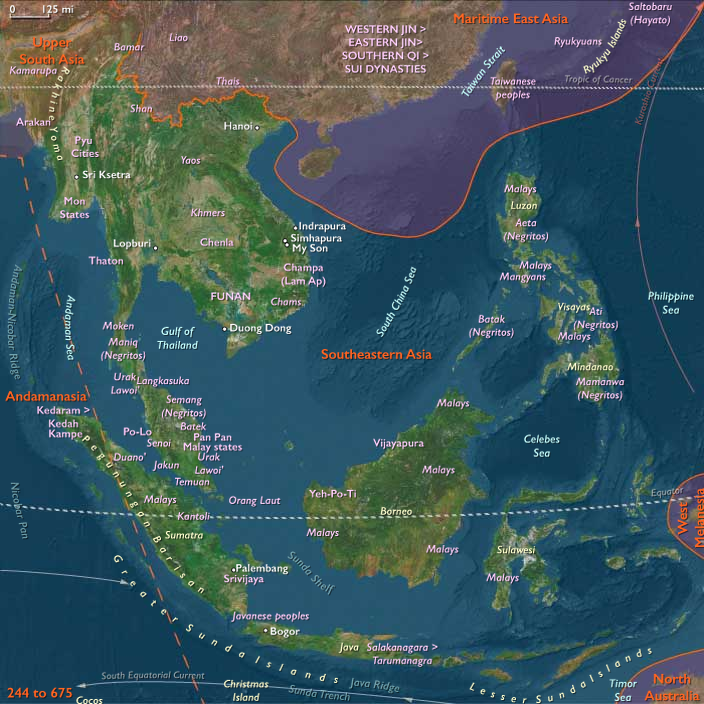
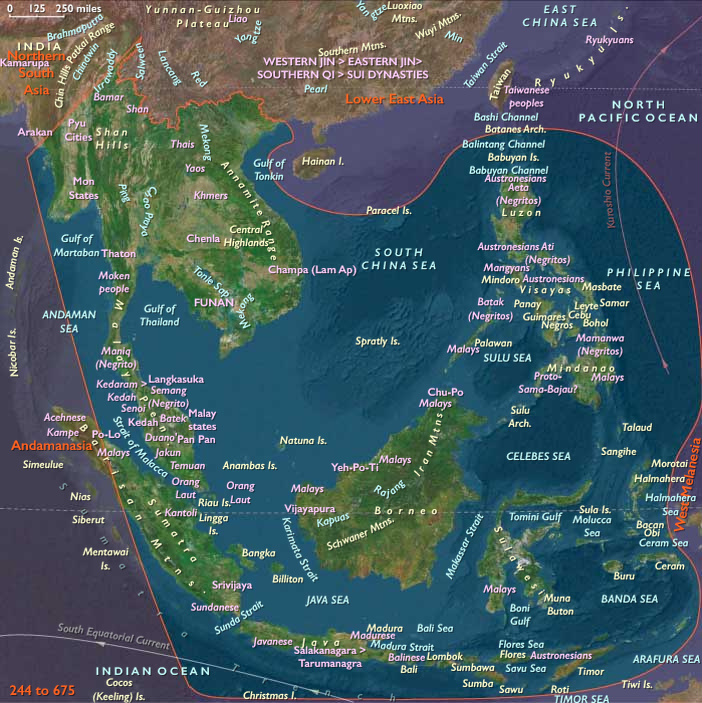
Fan Hu Ta takes the throne of Champa and the regnal name Bhadravarman I in 380.
Also in this year, the King moves the capital to Indrapura in Quang Nam.
Locations
People
Groups
Subjects
Regions
Subregions
Related Events
Filter results
Showing 10 events out of 59617 total
Fan Hu Ta builds temples and palaces, all facing north, at My Son and Tra Kieu.
Kumarajiva, a Kuchean Buddhist monk, scholar and translator whose father was from an Indian noble family, and whose mother was a Kuchean princess who significantly influenced his early studies, had first studied teachings of the Sarvastivada schools, later studied under Buddhasvamin, and finally became a Mahayana adherent, studying the Madhyamika doctrine of Nagarjuna.
He is mostly remembered for the prolific translation of Buddhist texts written in Sanskrit to Chinese he carried out during his later life.
His translation of Mahayana Buddhist texts from Indian into Chinese greatly facilitates the spread of Buddhism in China, but political fragmentation retards cultural development.
East Central Europe (376–387 CE): Gothic Migration, Adrianople, and Frontier Upheaval
Between 376 and 387 CE, East Central Europe—covering Poland, Czechia, Slovakia, Hungary, and those portions of Germany and Austria lying east of 10°E and north of a line stretching from roughly 48.2°N at 10°E southeastward to the Austro-Slovenian border near 46.7°N, 15.4°E—experienced profound regional upheaval driven by major Gothic migrations and the catastrophic Battle of Adrianople (378 CE). The large-scale crossing of the Danube by Gothic tribes in 376 CE dramatically altered frontier stability, undermining Roman control in provinces like Pannonia Prima, Pannonia Secunda, Pannonia Savia, Pannonia Valeria, and Noricum, and profoundly affecting the political and social landscape. Amid this turmoil, previously stable communities such as the Rugii maintained their established positions near the upper Tisza, while proto-Slavic peoples persisted largely undisturbed, adapting cautiously to the shifting regional conditions.
Political and Military Developments
Gothic Migration and Frontier Collapse
-
In 376 CE, Gothic tribes crossed the Danube in massive numbers, fleeing pressure from Hunnic advances from the east. This mass migration overwhelmed Roman frontier defenses, triggering widespread turmoil and instability across East Central Europe and neighboring Roman provinces.
-
The devastating Roman defeat at the Battle of Adrianople (378 CE) resulted in Emperor Valens’s death, significantly weakening imperial authority and frontier control in the region.
Theodosius I’s Attempts at Stabilization
-
Emperor Theodosius I (379–395 CE) worked vigorously to restore stability along the Danube frontier, negotiating settlements with the Goths and reorganizing frontier defenses. Although partially successful, lasting damage to Roman provincial stability was already extensive.
Rugian Stability Amid Turmoil
-
Despite dramatic regional instability, the Rugii’s presence along the upper Tisza remained relatively secure. Their settlements provided stability amidst surrounding chaos, maintaining diplomatic relationships with weakened Roman authorities.
Economic and Technological Developments
Frontier Economic Disruption
-
The Gothic migrations and ensuing warfare disrupted frontier commerce severely, sharply reducing trade activity and causing economic hardship throughout the region.
Limited Infrastructure Maintenance
-
Roman infrastructure suffered significantly, with limited resources allocated primarily toward urgent military repairs and minimal maintenance of essential defensive networks.
Cultural and Artistic Developments
Artistic Expressions Reflecting Crisis
-
Cultural production emphasized survival, defense, and resilience. Material culture from this period, such as metalwork and ceramics, became simpler and more utilitarian, reflecting practical needs in uncertain times.
Continued Proto-Slavic Cultural Resilience
-
Proto-Slavic communities persisted culturally stable, cautiously adapting to regional instability without substantial cultural disruption.
Settlement and Urban Development
Frontier Towns under Severe Strain
-
Roman frontier towns (Carnuntum, Vindobona, Aquincum) struggled significantly, facing population losses, economic hardships, and damage from repeated incursions and disruptions.
Rugian Settlement Stability
-
Rugian settlements remained stable and relatively prosperous, providing crucial regional continuity amid the broader instability and migratory turmoil.
Social and Religious Developments
Rugian Leadership Continuity
-
Rugian leadership maintained social cohesion and strong local control, successfully navigating the complexities of regional instability.
Proto-Slavic Community Resilience
-
Proto-Slavic societies maintained resilient social structures and religious practices, reinforcing internal stability despite the external chaos brought by Gothic migrations and warfare.
Long-Term Consequences and Historical Significance
The era 376–387 CE dramatically reshaped the geopolitical landscape of East Central Europe. The Gothic migrations and the decisive Battle of Adrianople undermined Roman frontier security, triggering significant political realignments and long-lasting instability. However, communities such as the Rugii and proto-Slavic populations provided critical continuity, preserving social cohesion amid regional chaos. These events set the stage for profound historical transformations, influencing East Central Europe’s political, social, and cultural trajectory into the subsequent decades.
Eastern Southeast Europe (376–387 CE): Gothic Crisis and the Battle of Adrianople
Settlement and Migration Patterns
Arrival and Settlement of the Goths
In 376 CE, a massive influx of displaced Goths, primarily the Thervingi, led by Fritigern, arrived at the banks of the Danube River, fleeing from the advancing Huns. They requested refuge within the Roman Empire, and Emperor Valens allowed their settlement on the empire’s southern frontier, promising land, protection, and food provisions in exchange for their status as foederati (allied peoples serving Roman interests).
Roman Mismanagement and Humanitarian Crisis
Despite assurances, Roman corruption and logistical failures resulted in inadequate provisions, severe famine, and inhumane conditions. The Goths, largely retaining their arms due to Roman corruption, were confined without sufficient food, forced into the desperate measure of trading their own people—especially children and women—as slaves in exchange for dog meat to survive. This severe humanitarian crisis precipitated open revolt.
Military Developments and Conflict
Outbreak of Gothic Revolt
Frustrated by Roman treachery and incompetence, the Goths began open rebellion following a failed assassination attempt on their leaders in the city of Marcianople. By 377 CE, the Goths had organized into a substantial military threat, systematically plundering the countryside, overwhelming weak Roman defenses, and laying waste to significant areas of Thrace and the Balkans.
Battle of Adrianople (378 CE)
Emperor Valens personally led a Roman army north from Constantinople in an attempt to defeat the Gothic rebellion decisively. However, the Roman forces suffered a catastrophic defeat at the Battle of Adrianople (378 CE), in which Valens himself was killed. This event marked a pivotal turning point, severely weakening the empire’s military capabilities and prestige.
Subsequent Gothic Raids and Roman Response
Following their victory, the Goths gained almost unchecked freedom to raid and pillage. In 379 CE, they moved northwest, ravaging the region of Dacia, and subsequently split into two factions due to logistical strain: the Tervingi under Fritigern moved southeast toward Macedonia, while the Greuthungi traveled north into Pannonia, where they suffered defeat by the Western Roman Emperor Gratian.
Economic and Technological Developments
Devastation of Regional Economy
The Gothic incursions severely disrupted the local economies. Agricultural production collapsed, trade routes were compromised, and significant damage to urban centers and rural infrastructure created economic instability. Many regions of the Roman Balkans experienced long-term economic stagnation, with some areas never fully recovering.
Changes in Military Logistics
The crisis compelled the Romans to rethink their military strategies and logistics, prompting significant adaptations, including reliance on allied barbarian foederati troops. This shift in military policy laid groundwork for future Roman-barbarian relations, altering military provisioning and infrastructure demands.
Cultural and Artistic Developments
Cultural Displacement and Decline
The widespread destruction and demographic upheaval significantly disrupted cultural continuity. Cities like Adrianople and Marcianople witnessed destruction or severe damage, impacting the preservation and transmission of classical traditions. Cultural activities increasingly shifted toward defensive and survivalist priorities.
Social and Religious Developments
Emergence of Foederati System
Following the Gothic victory, Rome, facing irreversible territorial and military realities, formally recognized the Goths as an autonomous people within imperial boundaries. The peace treaty of October 3, 382 CE, represented a monumental shift in imperial policy, setting a precedent for future barbarian settlements within the empire, effectively institutionalizing the foederati system.
Religious and Social Adaptations
Amidst this turmoil, social structures and religious practices adapted to new realities. Indigenous and Roman traditions persisted, though significantly challenged by the profound instability and shifting demographics resulting from Gothic integration.
Long-Term Consequences and Historical Significance
The era from 376 to 387 CE represented one of the most significant turning points in Roman and European history. The catastrophic Roman defeat at Adrianople symbolized the empire’s increasing inability to manage internal crises and external threats effectively. For the first time, Rome accommodated a substantial autonomous barbarian group within its borders, establishing a critical precedent that hastened the eventual fragmentation of Roman authority and the rise of successor barbarian kingdoms throughout Europe.
Displaced Goths and other tribes arrive in the summer and fall of 376 on the Danube River, on the border of the Roman Empire, requesting asylum from the Huns.
Fritigern, a leader of the Thervingi, appeas to the Roman emperor Valens to be allowed to settle with his people on the south bank of the Danube, where they hope to find refuge from the Huns, who lack the ability to cross the wide river in force.
Valens permits this, and promises the Goths farming land, grain rations, and protection under the Roman armies as “allies” (foederati).
The ones that crossed are supposed to have their weapons confiscated; however, the Romans in charge accept bribes to allow the Goths to retain their weapons.
With so many people in such a small area, famine strikes the Goths, and Rome is unable to supply them with either the food they were promised or the land; they herd the Goths into a temporary holding area surrounded by an armed Roman garrison.
There is only enough grain left for the Roman garrison, who simply let the Goths starve.
The Romans provide a grim alternative: the trade of slaves (often children and young women) for dog meat.
When Fritigern appeals to Valens for help, he is told that his people will find food and trade in the markets of the distant city of Marcianople.
Having no alternative, some of the Goths trek south in a death march, losing the sickly and old along the path.
When they finally reach Marcianople's gates, they are barred by the city's military garrison and denied entry; moreover, the Romans unsuccessfully try to assassinate the Goth leaders during a banquet.
Open revolt begins.
The main body of Goths spend the rest of 376 and early 377 near the Danube plundering food from the immediate region.
Roman garrisons are able to defend isolated forts but most of the country is vulnerable to Gothic plunder.
War begins in earnest in late winter 377.
The remaining Goths move south from the Danube to Marcianople, and next appear near Adrianople (modern Edirne).
The Roman response is to send a force under Valens to meet and defeat the Goths.
Valens moves north from Constantinople in 378 and is defeated (and himself killed) at the Battle of Adrianople.
The victory gives the Goths freedom to roam at will, plundering throughout Thrace for the rest of 378.
The Goths meet only light Roman resistance in 379 and advance northwest into Dacia, plundering that region.
The Goths divide in 380 into Terving and Greuthung armies, in part because of the difficulty of keeping such a large number supplied.
The Greuthungi move north into Pannonia, where they are defeated by western emperor Gratian.
The Tervingi under Fritigern move south and east to Macedonia, where they take "protection money" from towns and cities rather than sacking them outright.
Forces of the western Empire in 381 drive the Goths back to Thrace, where finally, peace is made on October 3, 382.
The Goths by the end of the war have killed a Roman emperor, destroyed a Roman army and laid waste large tracts of the Roman Balkans, much of which will never recover.
The Roman Empire has for the first time negotiated a peace settlement with an autonomous barbarian tribe inside the borders of the Empire, a situation that a generation before would have been unthinkable.
The lesson is not lost on other tribes, including the Goths themselves, who will not long remain peaceful.
Rome, after the crushing defeat, is no longer in a position to drive all its enemies from its territories.
Tribes that can no longer be expelled begin to be settled within the empire as foederati, receiving subsidies and in return supplying troops.
The Western Empire under the pressure of continued invasions will collapse within a century and be carved up into barbarian kingdoms.
The Middle East: 376–387 CE
Imperial Struggles and Renewed Roman–Sassanid Tensions
The period 376 to 387 CE witnesses renewed geopolitical tensions and strategic realignments in the Middle East, marking another chapter in the enduring rivalry between the Roman Empire and the Sassanid Persians. While previously established diplomatic accords between Emperor Valens and King Shapur II had provided a temporary respite, the late fourth century again sees escalating friction as both powers seek to extend influence and consolidate control over contested territories, notably Armenia and Mesopotamia.
The death of Shapur II in 379 CE, after a long and vigorous reign, leads to a brief period of internal instability within the Persian Empire. His successors, Ardashir II (379–383 CE) and Shapur III (383–388 CE), face internal challenges, including court intrigues and regional rebellions, limiting Persia’s immediate ability to capitalize on Roman distractions elsewhere.
On the Roman side, the disastrous defeat at Adrianople in 378 CE, in which Emperor Valens is killed, diverts Roman military resources to the northern frontier to counter Gothic incursions. This crisis compels Emperor Theodosius I (379–395 CE) to seek diplomatic solutions rather than prolonged warfare with Persia. Armenia, the perennial focal point of rivalry, is once again partitioned in 387 CE through the diplomatic initiative known as the Peace of Acilisene, with Rome and Persia agreeing to divide the kingdom along a negotiated boundary. The western portion of Armenia falls under Roman influence, while Persia secures the larger, strategically significant eastern region.
Culturally, this era remains a vibrant period of religious and intellectual consolidation in the Middle East. Christianity further solidifies its presence within the Roman sphere, strengthening its ecclesiastical institutions and establishing theological foundations that significantly influence both eastern and western Christendom. Meanwhile, Persia maintains its tradition of religious pluralism, with Zoroastrianism flourishing alongside Jewish and emerging Christian communities.
The Peace of Acilisene thus represents a pivotal diplomatic achievement, temporarily stabilizing the eastern frontier. However, the division of Armenia underscores a persistent geopolitical rivalry that will continue to shape regional dynamics for centuries to come.
The Himyarite kingdom makes a major break with the past when the polytheistic religion of the earlier cultures is replaced in the late fourth century by a monotheistic cult of “The Merciful, Lord of heaven and earth”.
There is also an increasing interest, both friendly and hostile, in central Arabia.
Later in the century, both Christianity and Judaism will gain firm footholds in the area of Sanaa'.
Mediterranean Southwest Europe (376–387 CE): Gothic Crisis and Imperial Struggles
The era 376–387 CE in Mediterranean Southwest Europe is dominated by severe external pressures, internal divisions, and significant cultural and religious developments. The dramatic entry of Gothic tribes into the Roman Empire and subsequent military confrontations underscore the growing vulnerability of Roman borders and imperial cohesion.
Gothic Influx and the Battle of Adrianople
In 376 CE, large groups of Visigothic refugees cross into Roman territory to escape Hunnic invasions, triggering a profound military and humanitarian crisis. The failure of Roman authorities to adequately manage the settlement of these groups leads to escalating tensions and the catastrophic Battle of Adrianople in 378 CE, where Emperor Valens and much of his army perish. This event dramatically shifts power dynamics within the empire, exposing significant vulnerabilities.
Rise of Theodosius I and Imperial Recovery
Following Adrianople, Theodosius I emerges as a prominent military and political leader, becoming emperor in the East in 379 CE. His efforts focus on restoring stability, rebuilding Roman military forces, and negotiating strategic settlements with Gothic leaders. By 382 CE, he successfully establishes treaties that incorporate Goths into the empire as federate allies, temporarily stabilizing Roman frontiers.
Religious Consolidation under Theodosius
Theodosius I actively supports Nicene Christianity, significantly influencing religious policy throughout the empire. In 380 CE, he issues the Edict of Thessalonica, declaring Nicene Christianity the official imperial faith, leading to greater religious uniformity but also increasing tensions with non-Nicene groups and traditional pagan practices.
Political Realignments and Western Leadership
The Western Empire, under Gratian and later Valentinian II, experiences continuing political realignments and instability. Gratian’s reign (367–383 CE) is marked by internal dissent and military revolts, culminating in his assassination in 383 CE by the usurper Magnus Maximus, who briefly controls Britain, Gaul, and Spain, further complicating imperial governance.
Economic Resilience Amidst Instability
Despite these turbulent political developments, Mediterranean Southwest Europe continues to demonstrate economic resilience. Regional infrastructure, commerce, and agricultural productivity sustain relative prosperity, supported by effective local administration and ongoing trade networks.
Cultural Continuity and Christian Dominance
Cultural life remains dynamic, increasingly shaped by the prominence of Christianity. Artistic, literary, and philosophical activities reflect a rich synthesis of classical Roman heritage and Christian themes, illustrating the adaptability and vitality of Roman cultural traditions in a changing social environment.
Legacy of the Era
The era 376–387 CE highlights the complexity of managing external threats, internal divisions, and religious transformations. The Gothic crisis, the establishment of Nicene Christianity as the imperial religion, and ongoing political volatility significantly reshape the empire’s political and cultural landscape, laying foundations for profound historical transitions in Mediterranean Southwest Europe.
North Africa (376–387 CE)
Imperial Challenges, Regional Resilience, and Cultural Continuity
Imperial Turmoil and Regional Stability
Between 376 and 387 CE, North Africa experiences imperial instability due to broader crises within the Roman Empire, including tensions arising from the Battle of Adrianople (378 CE). Despite these upheavals, the region maintains considerable administrative stability, relying on established governance systems and resilient economic structures.
Military Defense and Frontier Vigilance
Roman military units stationed along the strategic frontier, particularly from Vescera (Biskra) to Ad Majores (Hennchir Besseriani), continue vigilant defense against persistent threats from Berber incursions and Saharan nomadic groups. Effective military oversight ensures the ongoing security of vital agricultural and trade activities.
Sustained Economic Strength and Agricultural Productivity
North Africa sustains its robust economic activity, notably in grain and olive oil production, which remain essential commodities within the Roman economy. Prominent trade cities including Utica, Leptis Magna, and Caesarea (Cherchell) continue thriving, leveraging active Mediterranean commerce despite broader imperial uncertainties.
Numidia and Mauretania: Economic Stability and Cultural Integration
Numidia maintains economic stability and social cohesion through sustained Roman infrastructural investments and effective governance. The integration of indigenous traditions within the Roman administrative framework continues to support regional stability.
Mauretania remains prosperous through dynamic trade activities, notably in grain, olive oil, and luxury goods. The city of Caesarea consistently reinforces its status as an influential economic and cultural center, benefiting from continued Roman support and investment.
Cyrenaica: Cultural Continuity and Economic Stability
Cyrenaica preserves its intellectual prominence and economic strength. The Greek Pentapolis—Cyrene, Barce (Al Marj), Euhesperides (Benghazi), Teuchira (Tukrah), and Apollonia (Susah)—remains actively engaged in Mediterranean commerce and scholarly activities, contributing significantly to regional stability and cultural vitality.
Tripolitania: Ongoing Prosperity and Cultural Heritage
Tripolitania continues its economic prosperity through robust olive oil production and active trans-Saharan commerce facilitated by the Garamantes. Punic cultural heritage remains vibrant, especially in cities such as Leptis Magna, sustaining their distinctive identity within the broader Roman context.
Berber, Garamantian, and Saharan Communities
Berber communities remain economically engaged through vibrant coastal cities, particularly Oea (Tripoli). Inland Berber tribes sustain traditional governance systems and benefit indirectly from coastal prosperity.
The Garamantes retain their essential role as trans-Saharan trade facilitators, ensuring sustained economic and cultural exchanges between sub-Saharan Africa and Mediterranean markets.
Pastoral communities including the Mauri (Moors) continue serving as critical intermediaries, reinforcing inland and coastal trade networks and significantly enhancing regional economic stability.
Christianity: Continued Influence and Social Resilience
Christianity maintains its influential role, supporting regional cohesion and identity despite broader imperial instability. Christian communities remain resilient, adapting effectively to changing political and social dynamics, and continue to expand their influence within North African society.
Cultural Syncretism and Continued Vibrancy
Persistent interactions among diverse cultural and religious communities—including Berber, Roman, Greek, Jewish, Garamantian, Mauri, and Saharan nomads—continue enriching North Africa’s cultural fabric. Ongoing cultural syncretism ensures adaptability and vibrancy, blending indigenous Berber customs with Roman, Greek, Phoenician, and Saharan traditions.
Regional Resilience and Strategic Importance
By 387 CE, North Africa demonstrates impressive resilience, maintaining robust economic productivity, vigilant frontier defenses, and dynamic cultural interactions despite broader imperial uncertainties. The region’s sustained stability underscores its enduring strategic importance within the Roman Empire.
Atlantic Southwest Europe (376–387 CE): Regional Stability Amid Imperial Crisis, Economic Adaptation, and Established Christian Dominance
Between 376 and 387 CE, Atlantic Southwest Europe—covering northern and central Portugal, Galicia, Asturias, Cantabria, and northern Spain south of the Franco-Spanish border (43.05548° N, 1.22924° W)—encountered a period marked by increasing imperial instability and external crises, notably the Gothic incursions and the disastrous Roman defeat at Adrianople (378 CE). Despite broader turmoil affecting the Roman Empire, the region sustained considerable internal stability, economic resilience, and deepening institutionalization of Christianity. Strong local governance, adaptive economic strategies, and cultural resilience allowed Atlantic Southwest Europe to effectively navigate imperial uncertainties, solidifying its long-term regional identity.
Political and Military Developments
Continued Provincial Stability Amid Broader Imperial Crisis
-
Following Emperor Valens’s defeat and death at Adrianople in 378 CE, the empire faced severe military and political crises. However, Atlantic Southwest Europe remained largely insulated from direct external threats due to geographical distance and established regional governance systems. Local civic elites effectively managed administration, security, and economic resources, maintaining internal peace and administrative continuity.
-
Emperor Theodosius I (379–395 CE), originally from the neighboring province of Hispania, emerged as the dominant imperial authority by 379 CE, restoring a degree of central stability that further reinforced the region’s internal security and effective provincial governance.
Continued Stability and Integration of Northern Tribes
-
Northern tribes—including the Gallaeci, Astures, and Cantabri—remained stable, prosperous, and closely integrated into provincial governance structures. Their continued cooperation with provincial authorities preserved regional stability and cohesion amid broader imperial instability.
-
The Vascones successfully preserved their territorial autonomy, diplomatic neutrality, cultural distinctiveness, and internal stability, significantly contributing to regional resilience and continuity.
Economic and Technological Developments
Economic Adaptation and Continued Regional Prosperity
-
Atlantic Southwest Europe maintained economic resilience through effective local adaptation and sustainable regional strategies. Robust agricultural productivity, livestock husbandry, mining (silver, copper, tin), timber, textiles, pottery production, and resilient local trade networks preserved economic stability, despite disruptions elsewhere in the empire.
-
Provincial elites adeptly managed regional resources and imperial taxation demands, ensuring ongoing economic stability and sustainability amid changing external conditions.
Final Stages in the Transition from Slavery to Localized Labor
-
The transition away from traditional widespread slavery reached advanced stages, with regional economies relying predominantly on tenant farmers, semi-free laborers (coloni), free artisans, and localized, community-based labor systems.
Infrastructure Maintenance and Local Technological Innovation
-
Infrastructure—including roads, aqueducts, urban fortifications, public amenities, bridges, and temples—continued receiving necessary maintenance and targeted improvements, sustaining provincial connectivity, urban resilience, and economic efficiency.
-
Local technological innovations, especially in agriculture, metallurgy, and construction, supported continued productivity, resource management, and economic adaptation.
Cultural and Religious Developments
Established Dominance of Christianity
-
Christianity firmly established its dominance within the region, profoundly reshaping religious institutions, cultural identities, and social structures. Churches, bishoprics, monasteries, and urban Christian communities expanded significantly, embedding Christian leadership deeply into local governance and regional administration.
-
Bishops and clergy solidified their roles as influential civic leaders, further integrating religious authority into provincial administration and social frameworks.
Enduring Cultural Traditions and Syncretic Practices
-
Indigenous Iberian, Celtic, and traditional Roman cultural practices persisted robustly, dynamically integrated within an increasingly dominant Christian cultural context. Material culture—metalwork, jewelry, pottery, and ceremonial artifacts—continued reflecting resilient regional identities and adaptive cultural vitality.
-
Traditional ancestral rites, warrior rituals, and local festivals remained prevalent, increasingly blending Christian symbolism and practices, creating distinctive regional religious syncretism.
Civic Identity and Imperial Integration Under Theodosius I
-
Civic identity during Theodosius I’s reign balanced strong local traditions, deeply rooted Roman civic structures, and firmly institutionalized Christian affiliations. Universal citizenship continued influencing civic identity, now intertwined closely with emerging Christian regional frameworks.
Notable Tribal Groups and Settlements
-
Lusitanians: Maintained economic prosperity, vibrant cultural traditions, and profound institutional integration of Christianity, significantly influencing local governance and cultural identity.
-
Vettones and Vaccaei: Sustained regional stability, prosperity, and effective autonomy, adapting effectively to religious transformations and deepening Christian institutional influence.
-
Gallaeci, Astures, Cantabri: Continued prosperous integration and active preservation of indigenous traditions alongside firmly established Christianity.
-
Vascones: Successfully preserved diplomatic neutrality, territorial autonomy, internal stability, and cultural distinctiveness, significantly contributing to regional resilience.
Long-Term Significance and Legacy
Between 376 and 387 CE, Atlantic Southwest Europe:
-
Demonstrated remarkable provincial resilience and internal stability amid broader imperial crises, navigating external uncertainties through effective local governance, regional autonomy, and resilient civic institutions.
-
Sustained adaptive economic prosperity, significantly completing transitions away from traditional slavery toward sustainable local labor systems, establishing enduring regional economic foundations.
-
Firmly established Christianity as the dominant religious and cultural framework, profoundly reshaping social institutions, cultural identities, and governance structures, significantly influencing the region’s subsequent historical and cultural development.
This era decisively consolidated Atlantic Southwest Europe's historical legacy as a resilient, economically adaptive, culturally vibrant region experiencing profound religious and social transformation, laying enduring foundations for future regional stability, identity, and institutional continuity.
Years: 376 - 387
Locations
People
Groups
Subjects
Regions
Subregions