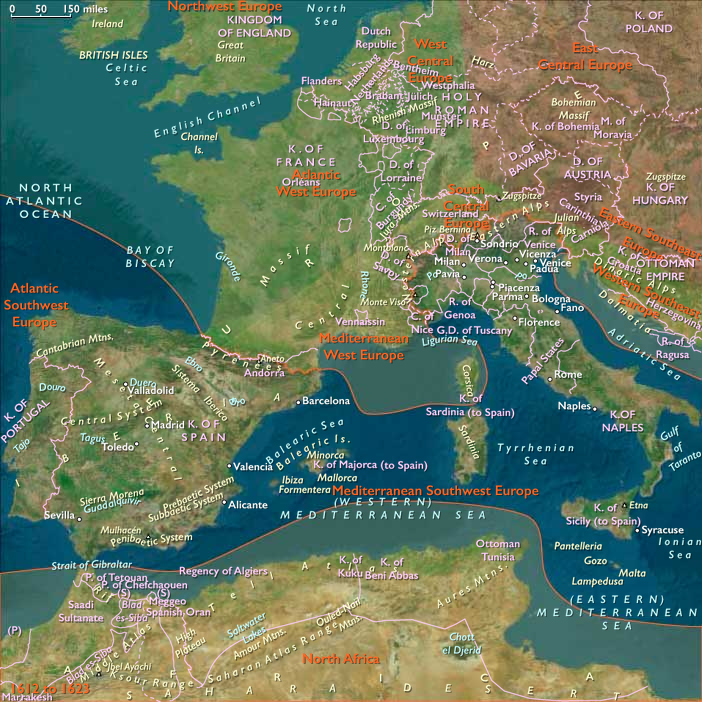
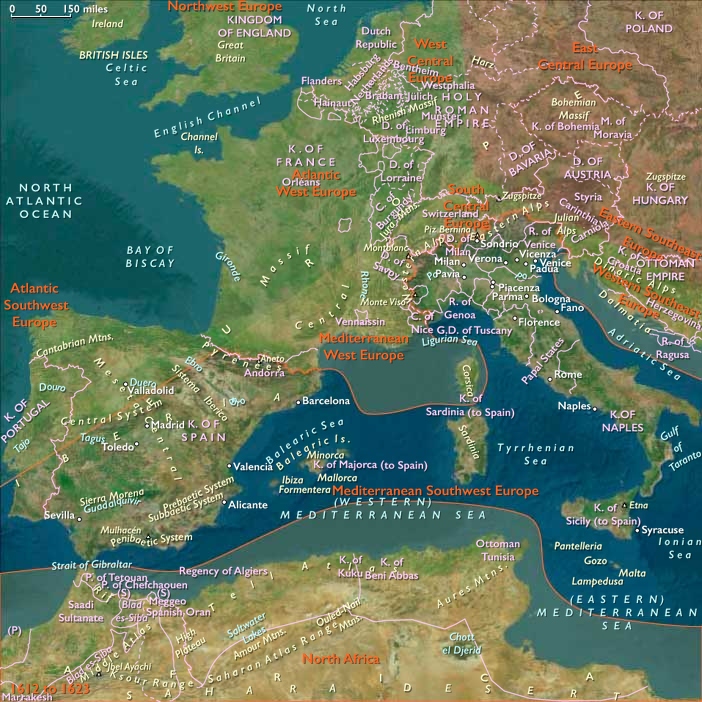
Fakhr-al-Din is welcomed in Tuscany by the …
Years: 1613 - 1613
Fakhr-al-Din is welcomed in Tuscany by the grand duke Cosimo II, who will house him through his stay.
Fakhr-al-Din wishes to plan military operations with Tuscan cooperation to free Lebanon, but is met with a refusal since Tuscany is unable to afford such an expedition, and the prince soon gives up this idea, realizing eventually that such cooperation would only subject Lebanon to new occupation.
His stay in Italy will allow him to explore the era of European cultural revival in the seventeenth century.
Locations
People
Groups
Topics
Commodoties
Subjects
Regions
Subregions
Related Events
Filter results
Showing 10 events out of 33264 total
The reign of Matarams' sultan Panembahan Seda ing Krapyak (circa 1601-1613), the son of Senapati, has been dominated by further warfare, especially against powerful Surabaya, already a major center in East Java.
Krapyak had faced rebellion from his relatives who were installed in the newly conquered area of Demak (1602), Ponorogo (1607-8) and Kediri (1608).
The first contact between Mataram and the Dutch East India Company (VOC) had occurred under Krapyak.
Dutch activities at the time are limited to trading from limited coastal settlements, so their interactions with the inland Mataram kingdom are limited, although they do form an alliance against Surabaya in 1613.
Krapyak dies in this year and is succeeded by his son, Raden Mas Rangsang, who assumes the title Panembahan ing Alaga and is later to assume the title of Sultan Agung Hanyokrokusumo ("Great Sultan") after obtaining permission from the authorities at Mecca to use the title "Sultan”.
Agung is to be responsible for the great expansion and lasting historical legacy of Mataram due to the extensive military conquests of his long reign from 1613 to 1646.
Svalbard had been discovered in 1596 by the Dutch navigator Willem Barentsz.
The English Muscovy Company, encouraged by reports of whales off the coast of Spitsbergen in 1610,had sent a whaling expedition there the following year.
The expedition was a disaster, with both ships sent being lost.
The crews returned to England in a ship from Hull.
The following year two more ships were sent.
Other countries followed suit, with Amsterdam and San Sebastian each sending a ship north.
The latter ship returned to Spain with a full cargo of oil.
Such a fabulous return resulted in a fleet of whaleships being sent to Spitsbergen in 1613.
The Muscovy Company sends seven, backed by a monopoly charter granted by King James I.
They meet with twenty other whaleships (eleven-twelve Basque, five French, and three Dutch), as well as a London interloper, which are either ordered away or forced to pay a fine of some sort.
The United Provinces, France, and Spain all protest against this treatment, but James I holds fast to his claim of sovereignty over Spitsbergen.
The company's royal charter of 1613 grants a monopoly on whaling in Spitsbergen, based on the (erroneous) claim that Hugh Willoughby had discovered the land in 1553.
Not only had they wrongly assumed a 1553 English voyage had reached the area, but on June 27, 1607, during his first voyage in search of a "northeast passage" on behalf of the company, Henry Hudson had sighted "Newland" (i.e., Spitsbergen), near the mouth of the great bay Hudson later simply named the Great Indraught (Isfjorden).
The English hope in this way to head off expansion by the Dutch in the region, at this time their major rival.
The following three and a half decades are to witness numerous clashes between the various nations (as well as infighting among the English), often merely posturing, but sometimes resulting in bloodshed.
This jealousy stems as much from the mechanics of early whaling as from straightforward international animosities.
In the first years of the fishery, England, France, the United Provinces and later Denmark-Norway ship expert Basque whalemen for their expeditions.
At this time Basque whaling relies on the utilization of stations ashore where blubber could be processed into oil.
In order to allow a rapid transference of this technique to Spitsbergen, suitable anchorages have to be selected, of which there are only a limited number, in particular on the west coast of the island.

Poland is further moved into the enemy camp from the Ottoman point of view when Sigismund signs a de facto anti-Turkish defensive treaty in 1613 with the Habsburgs, counting on their support for his restoration to the Swedish throne.
The union of Protestant princes, formed at the beginning of the dispute over the duchies of the late and childless duke of Jülich-Cleves-Berg, still lacks several powerful Protestant rulers, such as the Elector of Saxony.
The conduct of the Union in the Jülich dispute and the warlike operations of the Union army in Alsace appear to make inevitable a battle between the Union and ...
...the military league of important Catholic states formed in response.
When Austria and Salzburg finally join in 1613, at Ratisbon, the assembly now appoints no less than three war-directors: Duke Maximilian, and Archdukes Albert and Maximilian of Austria.
The object of the League is now declared "a Christian legal defense."
Gábor Iktári Bethlen, born into a leading Protestant family of northern Hungary, had been sent as a young man to the court of Prince Sigismund Báthory of Transylvania.
He had later helped István Bocskay gain the throne of Transylvania and has supported his successor, Gábor Báthory, who has turned out to be a tyrant.
Differences between Bethlen and Báthory have forced Bethlen to take refuge with the Turks.
Ottoman sultan Ahmed, suzerain of Transylvania, provides Bethlen with an army and proclaims him prince of Transylvania, a status that the Porte compels the Transylvanians to accept.
When Báthory is driven from power, a Diet at Kolozsvár in 1613 proclaims Bethlen prince.
The popularity of Druse leader Fakhr-al-Din has alarmed the Ottomans, who issue authority for Hafiz Ahmed Pasha, Muhafiz of Damascus, to mount an attack on Lebanon in 1613, in order to reduce Fakhr-al-Din's growing power.
Facing Hafez's army of fifty thousand men, Fakhr-al-Din chooses exile to Italy, where in Tuscany he will be received by the Medici Family, leaving affairs in the hands of his brother Emir Yunus and his son Emir Ali Beg.
Fakhr-al-Din's exile does not prompt the Lebanese army to surrender to Hafiz Ahmed Pasha's army.
They maintain their positions while the military operations rage until Emir Yunus manages through negotiations and persuasion to bring an end to the killings, securing the retreat of the Ottoman army.
The Beta-Israel, despite attempts by Ethiopian Christian regimes to exterminate the Ethiopian Jews in the fifteenth and sixteenth centuries, partly retain their independence until the seventeenth century, when the emperor Susenyos utterly crushes them and confiscates their lands.
Susenyos is interested in Catholicism, in part due to Pedro Páez' persuasion, but also hoping for military help from Portugal and Spain (in union at this time).
Some decades earlier, in 1541, Christopher da Gama (son of the legendary Portuguese explorer Vasco da Gama) had been in charge of a military expedition to save the Ethiopian emperor Gelawdewos from the onslaught of Ahmed Gragn, a Muslim Imam who almost destroyed the existence of the Ethiopian state.
Susenyos hopes to receive a new contingent of well-armed European soldiers, this time against another enemy, the Oromo who are invading from the south, and to put down constant internal rebellion.
He shows the Jesuit missionaries his favor by a number of land grants, most importantly those at Gorgora, located on a peninsula on the northern shore of Lake Tana.
Susenyos sends a mission heading for Madrid and Rome in 1613, led by Fr. Antonio Fernandes.
The plan is to head south, in an attempt to reach Malindi, a port on the Indian Ocean in what is Kenya today, hoping to break through the effective blockade that the Ottoman conquests have created around the Ethiopian empire by sailing all the way around the southern tip of Africa.
They fail, however, to reach Malindi due to delays caused by local Christians hostile to the mission.
She had in 1612 been denied access to the all-male professional academies for art, her early talent notwithstanding.
Her father had been working with Agostino Tassi to decorate the vaults of Casino della Rose inside the Pallavicini Rospigliosi Palace in Rome, so Orazio had hired the painter to tutor his daughter privately.
During this tutelage, Tassi had raped Artemisia.
Another man, Cosimo Quorlis, had helped Tassi with the rape.
After the initial rape, Artemisia had continued to have sexual relations with Tassi, with the expectation that they were going to be married.
However, Tassi had reneged on his promise to marry Artemisia after he heard the rumor that she was having an affair with another man.
Quorlis had threatened that if he could not have her, he would publicly humiliate her.
Orazio had pressed charges against Tassi only after he learned that Artemisia and Tassi were not going to be married.
Orazio also claimed that Tassi had stolen a painting of Judith from the Gentileschi household.
The major issue of this trial was the fact that Tassi had deflowered Artemisia.
If Artemisia had not been a virgin before Tassi raped her, the Gentileschis would not have been able to press charges.
In the ensuing seven-month trial, it is discovered that Tassi had planned to murder his wife, had enjoined in adultery with his sister-in-law, and had planned to steal some of Orazio’s paintings.
During the trial, Artemisia had been given a gynecological examination and had been tortured using thumbscrews.
At the end of the trial Tassi had been sentenced to one year's imprisonment.
The trial subsequently will influence the feminist view of Artemisia Gentileschi during the late twentieth century.
One month after the trial, in order to restore his daughter's honor, Orazio had arranged for her to marry Pierantonio Stiattesi, a modest artist from Florence.
She had learned drawing, how to mix color and how to paint.
Since her father's style had taken inspiration from Caravaggio during that period, her style had been just as heavily influenced in turn, but her approach to subject matter is different from her father's, as her paintings are highly naturalistic, where Orazio's are idealized.
The first work of the young seventeen-year-old Artemisia (even if many at the time suspected that she was helped by her father) had been the Susanna e i Vecchioni (Susanna and the Elders) (1610, Schönborn collection in Pommersfelden).
The picture shows how Artemisia has assimilated the realism of Caravaggio without being indifferent to the language of the Bologna school (which had had Annibale Carracci among its major artists).
It is one of the few Susanna paintings showing the two men planning their sexual harassment.
It is likely that Artemisia had been sexually harassed and has painted Susanna as a reflection.