
Fakhr-al-Din, holding territories from Nazareth in the …
Years: 1611 - 1611
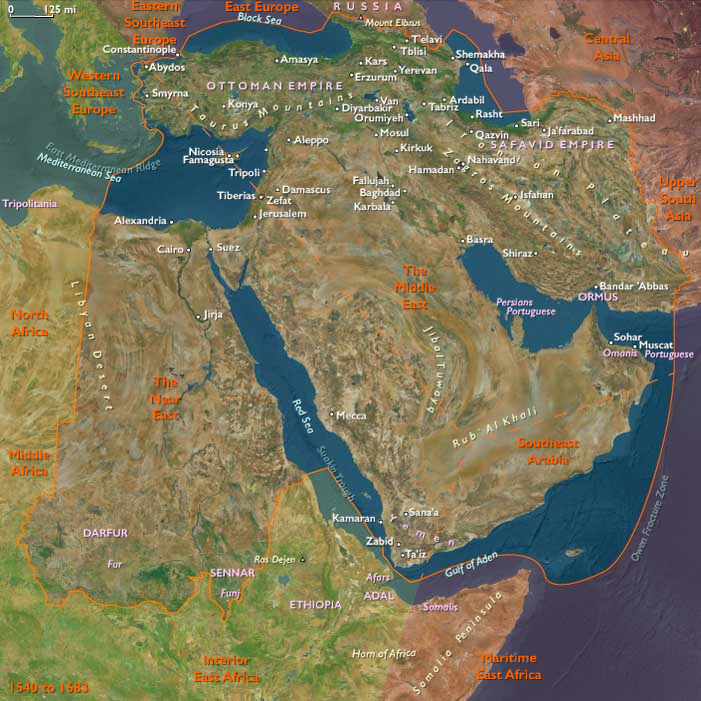
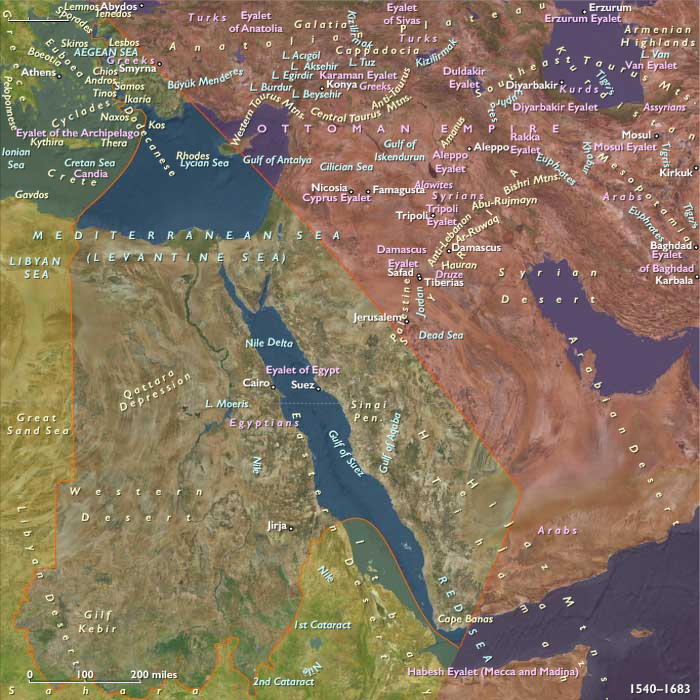
Fakhr-al-Din, holding territories from Nazareth in the south to Mount Carmel in the north, and supported by a forty thousand-man army, is a difficult opponent, and the Ottoman police action against him fails initially.
Locations
People
Groups
- Christians, Maronite
- Muslims, Shi'a
- Druze, or Druse, the
- Ottoman Empire
- Mount Lebanon Emirate
- Tuscany, Grand Duchy of
Topics
Subjects
Regions
Subregions
Related Events
Filter results
Showing 10 events out of 33373 total
The VOC establishes another permanent Dutch trading post at Jayakarta (later 'Batavia' and then 'Jakarta') in 1611.
Miguel de Benavides, who had come to the Philippines with the first Dominican mission in 1587, had gone on to become bishop of Nueva Segovia, and had been named archbishop of Manila in 1601.
Upon Benavides’ death in July 1605, he had bequeathed his library and personal property worth 1,500 pesos to be used as the seed fund for the establishment of an institution of higher learning.
Fr. Bernardo de Santa Catalina had carried out Benavides’ wishes and was able to secure a building near the Dominican church and convent in Intramuros for the College.
Permission to open the College had been requested in 1609 from King Philip III of Spain; this only reached Manila in 1611.
The Colegio de Nuestra Señora del Santísimo Rosario is established on April 28, 1611.
Later renamed Colegio de Santo Tomás, it will be elevated by Pope Innocent X to a university on November 20, 1645.
This makes the university the second royal and pontifical institution in the Philippines, after the Jesuit's Universidad de San Ignacio, which had been founded in 1590 but will be closed in 1768 following the expulsion of the Society of Jesus from the Philippines.
Ekatotsarot, mourning the suicide of his eldest son, reportedly had died of depression in 1610, and his second son Prince Sri Saowabhak succeeds to the throne.
His incompetent rule provides opportunities for the nobility to usurp the throne.
The Royal Chronicles relate that Chameun Sri Sorarak, the adoptive son of Songtham, a minor prince born to Ekatotsarot with one of his concubines, foments a rebellion, marches to the palace in 1611 and oversees the execution of the king at Wat Kok Phraya.
However, other chronicles state that it was Songtham’s younger brother Si Sin who did this.
In any case, the popular and religious Songtham is given the Ayutthayan throne.
Songtham had appointed Sri Soralak the Uparaja but he had died after only a week.
Certain Siamese noblemen had cheated the Japanese merchants in trade agreements and Ekatotsarot had executed their master Ok Krom Nai Wai (a title for Japanese mercenary commander) in 1610.
Not long after Songtham’s coronation, the king had been attending a Buddhist ceremony when the disgruntled Japanese stormed the palace, taking Songtham captive and calling for the life of the Siamese merchants who they hold responsible for the injustice.
Songtham manages to calm the attackers and sends them off the Menam valley but the Japanese rebels capture the town of Phetchaburi, at the northern end of the Thai Peninsula.
Songtham responds by sending an army to pursue and suppress them.
Druze ruler Fakhr ad-Din II, unlike his Yamani party foe, Yusuf Sayfa, the Shi’i ruler of Tripoli, has cultivated friendships and support among both Sunnis and Shi’ites, and he is the first to have united the city’s Druze and Maronite Christian districts.
By 1600, the military activity by his private army has gained him control of Sidon and Beirut on the coast as well as the enmity of both the Porte and Tripoli’s ruler; as a consequence, fighting has begun between Fakhr ad-Dion’s Kaysis party and the Yamanis.
The Porte had continued to waver in its support, favoring first one party and then the other, until Fakhr ad-Din’s victories became consistent.
With the defeat of Yusuf Sayfa in 1607, the Ottomans, who had aided Fakhr ad-Din in this triumph, had finally recognized his authority over the Druze and Maronite districts of the Lebanon Mountains.
To prevent Ottoman interference in his emirate, he has regularly sent ambassadors and bribes to Istanbul.
However, because Fakhr ad-Din is still uncertain of Ottoman support, however, and is aware of the Ottoman preoccupation with war in Europe and Asia, he had secretly allied the region with Ferdinand I, duke of Tuscany, in 1608, seeking trade and security, the two parties pledging to support each other against the Ottomans.
Abbas forces the Ottomans to cede Shirvan and ...
...Kurdistan to Persia in 1611.
Fakhr ad-Din’s increasing ties with the Grand Duchy of Tuscany have aroused the suspicion of the Ottomans.
Ahmed, informed of Fakhr’s secret treaty with Tuscany, is alarmed by this development, regarding it as making possible a crusader state in the Fertile Crescent.
The sultan in 1611 orders Ahmad al Hafiz, the pasha of Damascus, to begin a punitive expedition against Fakhr ad-Din.
Captain Hawkins has persisted at Surat for over two years.
Portuguese pirates have stolen his gold, and tried several times to murder him while on shore.
He returns to England empty-handed.
The next envoy, Paul Canning, lasts only a few months.
Farrukh Beg, a Kalmyk of Central Asia, had first worked at Kabul under Mirza Hakim, the half brother of the Mughal emperor Akbar.
After Hakim died Farrukh Beg had joined Akbar's service in about 1585.
His earliest paintings are strongly Persian in character, and he continues to be a conservative painter, not modifying his style to any considerable extent in the new environment.
Several features of his later paintings—the large plants, color scheme, and treatment of drapery—have suggested that he might have spent some years in the Deccan.
An outstanding painter, he is praised by the Indian Mughal emperor Jahangir as “unrivaled in the age.”
Captain William Hawkins, leading the first voyage of the British East India Company to India, had sailed into the Gujarat port of Surat on August 24, 1608, carrying with him twenty-five thousand pieces of gold and a personal letter to the Mughal Emperor Jahangir from King James I seeking trade concessions.
He had persisted for over two years, however Portuguese pirates had stolen his gold, and had tried several times to murder him while on shore.
He had returned to England empty-handed.
The next envoy, Paul Canning, had lasted only a few months.
The Company had by 1611 managed to build its first factory (as the trading posts are known) in the town of Machilipatnam on the Coromandel Coast of the Bay of Bengal, the major port of Golconda kingdom.
This is one of the earliest known British settlements in the Indian subcontinent.
The high profits reported by the Company after landing in India (presumably owing to a reduction in overhead costs affected by the transit points), had initially prompted King James I to grant subsidiary licenses to other trading companies in England, but in 1609 he had renewed the charter given to the Company for an indefinite period, including a clause which specified that the charter would cease to be in force if the trade turned unprofitable for three consecutive years.
Years: 1611 - 1611
Locations
People
Groups
- Christians, Maronite
- Muslims, Shi'a
- Druze, or Druse, the
- Ottoman Empire
- Mount Lebanon Emirate
- Tuscany, Grand Duchy of
