
Ivan IV is succeeded by his son …
Years: 1600 - 1611
Ivan IV is succeeded by his son Feodor, who is mentally deficient.
Actual power goes to Feodor's brother-in-law, the boyar Boris Godunov.
Perhaps the most important event of Fedor's reign is the proclamation of the patriarchate of Moscow in 1589.
The creation of the patriarchate climaxes the evolution of a separate and totally independent Russian Orthodox Church.
In 1598 Feodor dies without an heir, ending the Rurik Dynasty.
Boris Godunov then convenes a zemskiy sobor, a national assembly of boyars, church officials, and commoners, which proclaim him tsar, although various boyar factions refuse to recognize the decision.
Widespread crop failures cause a famine between 1601 and 1603, and during the ensuing discontent, a man emerges who claims to be Dmitriy, Ivan IV's son who had died in 1591.
This pretender to the throne, who comes to be known as the first False Dmitriy, gains support in Poland and marches to Moscow, gathering followers among the boyars and other elements as he goes.
Historians speculate that Godunov would have weathered this crisis, but he dies in 1605.
As a result, the first False Dmitriy enters Moscow and is crowned tsar that year, following the murder of Tsar Fyodor II, Godunov's son.
Locations
People
Groups
- Lithuanians (Eastern Balts)
- Danes (Scandinavians)
- Poles (West Slavs)
- Swedes (Scandinavians)
- Russians (East Slavs)
- Belarusians (East Slavs)
- Ukrainians (East Slavs)
- Moscow, Grand Principality of
- Tatars
- Poland of the Jagiellonians, Kingdom of
- Lithuania, Grand Duchy of
- Kazan, Khanate of
- Astrakhan Khanate
- Sibir, Khanate of
- Sweden, (second) Kingdom of
- Denmark-Norway, Kingdom of
- Livonia, Duchy of (Polish Estonia and Latvia)
- Siberian Tatars
Topics
- Russian Colonization of Siberia
- Russo-Swedish War of 1554–1557
- Siberia, Conquest of
- “Time of Troubles,” Russian
Subjects
Regions
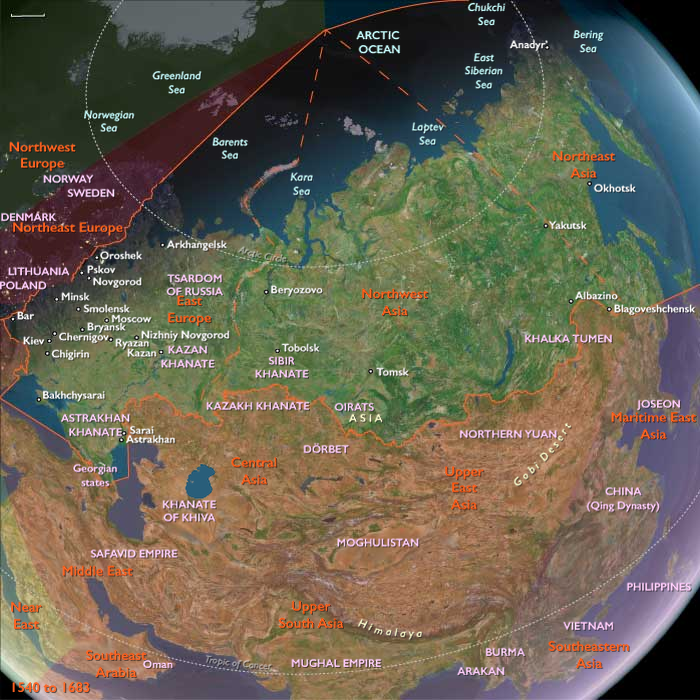
Subregions
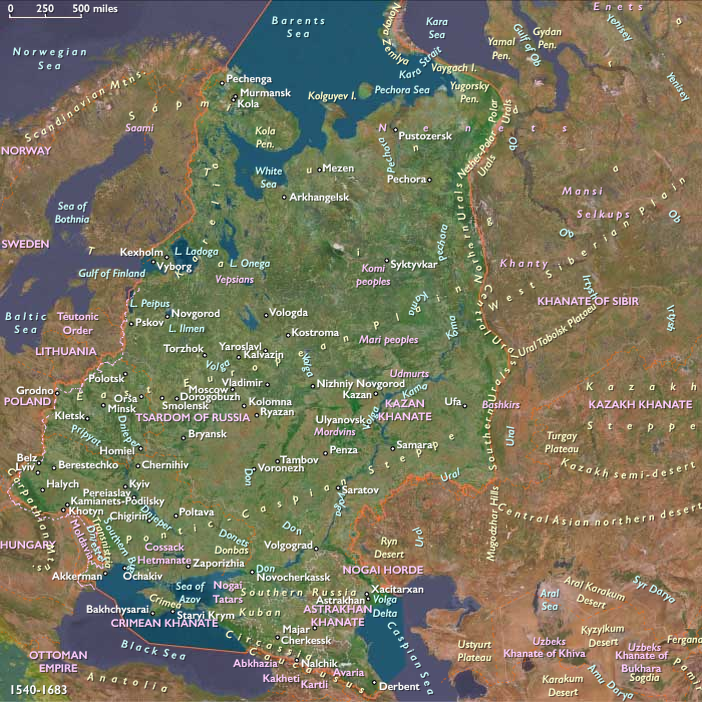
Years: 1600 - 1611
Locations
People
Groups
- Lithuanians (Eastern Balts)
- Danes (Scandinavians)
- Poles (West Slavs)
- Swedes (Scandinavians)
- Russians (East Slavs)
- Belarusians (East Slavs)
- Ukrainians (East Slavs)
- Moscow, Grand Principality of
- Tatars
- Poland of the Jagiellonians, Kingdom of
- Lithuania, Grand Duchy of
- Kazan, Khanate of
- Astrakhan Khanate
- Sibir, Khanate of
- Sweden, (second) Kingdom of
- Denmark-Norway, Kingdom of
- Livonia, Duchy of (Polish Estonia and Latvia)
- Siberian Tatars
Topics
- Russian Colonization of Siberia
- Russo-Swedish War of 1554–1557
- Siberia, Conquest of
- “Time of Troubles,” Russian
Subjects
Regions
Subregions