
Only a few sporadic contacts with the …
Years: 1840 - 1851
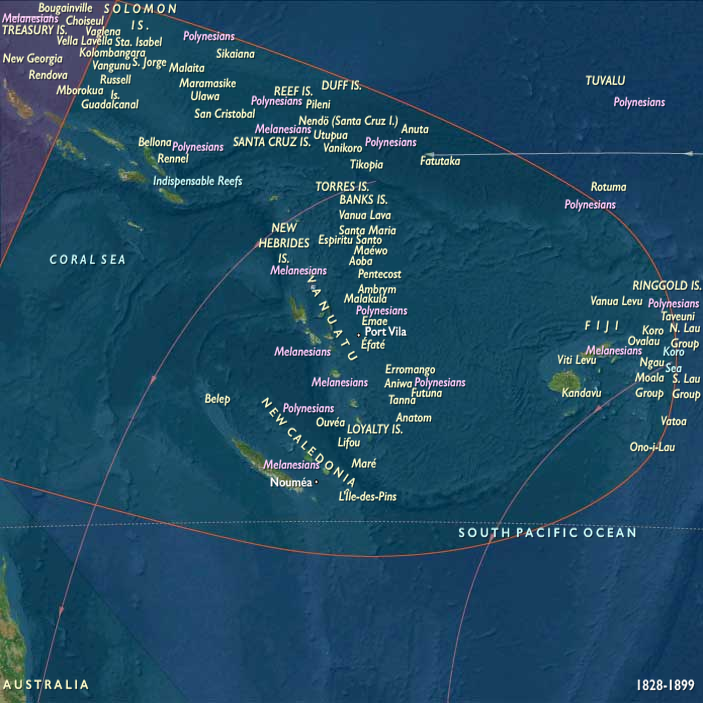
Only a few sporadic contacts with the New Caledonian archipelago are recorded from 1796 until 1840.
About fifty American whalers (identified by Robert Langsom from their log books) are recorded in the region (Grande Terre, Loyalty Is., Walpole and Hunter) between 1793 and 1887.
Contacts become more frequent after 1840, because of the interest in sandalwood.
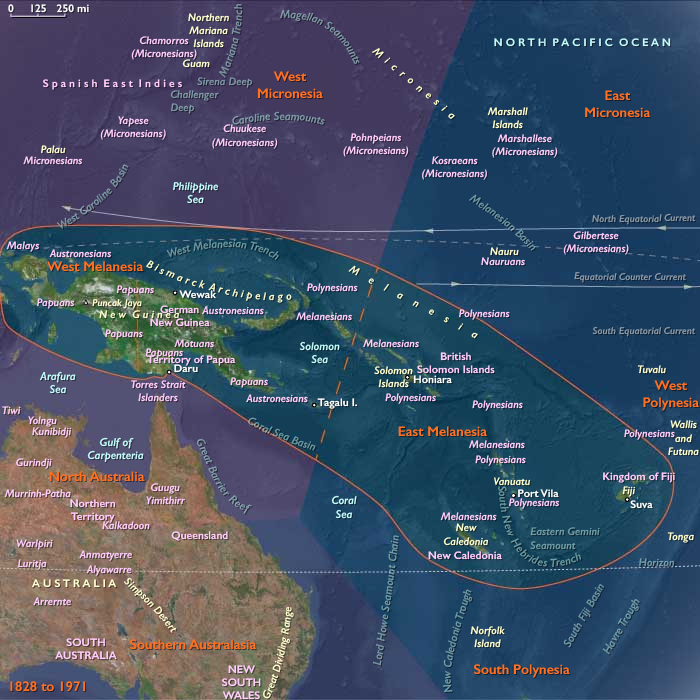
As trade in sandalwood declines, it is replaced by a new business enterprise, "blackbirding", a euphemism for taking Melanesian or Western Pacific Islanders from New Caledonia, the Loyalty Islands, New Hebrides, New Guinea, and the Solomon Islands into indentured or forced labor in the sugar cane plantations in Fiji and Queensland by various methods of trickery and deception.
In the early years of the trade, coercion is used to lure Melanesian islanders onto ships.
In later years indenture systems will be developed; however, when it comes to the French slave trade, which takes place between its Melanesian colonies of the New Hebrides and New Caledonia, very few regulations are implemented.
This represented a departure from the British experience, since increased regulations will be developed to mitigate the abuses of blackbirding and 'recruitment' strategies on the coastlines.
The first missionaries from the London Missionary Society and the Marist Brothers arrive in the 1840s.
In 1849, the crew of the American ship Cutter is killed and eaten by the Pouma clan.
Cannibalism is widespread throughout New Caledonia.
Locations
Groups
- Christians, Roman Catholic
- Anglicans (Episcopal Church of England)
- London Missionary Society
- Marist Brothers
- France, Second Empire of
- New Caledonia and Dependencies (French overseas Territory)
Topics
Commodoties
Subjects
Regions
Subregions
Years: 1840 - 1851
Locations
Groups
- Christians, Roman Catholic
- Anglicans (Episcopal Church of England)
- London Missionary Society
- Marist Brothers
- France, Second Empire of
- New Caledonia and Dependencies (French overseas Territory)
Topics
Commodoties
Subjects
Regions
Subregions