
Excavations at Ban Chiang, a site in …
Years: 1629BCE - 1486BCE
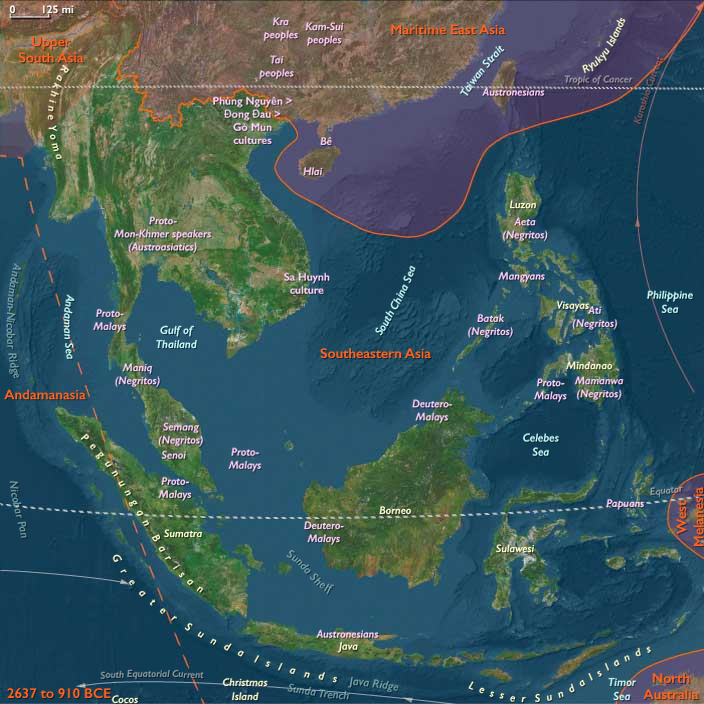
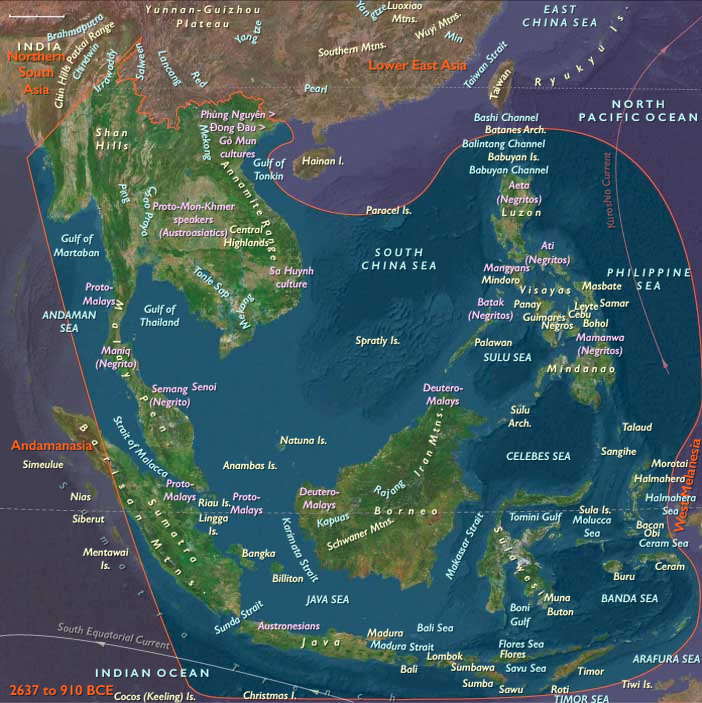
Excavations at Ban Chiang, a site in present Thailand, plus survey and excavation at sites such as Non Nok Tha, Ban Pak Top, Ban Tong, and Don Klang, have demonstrated that Southeast Asia had developed a sophisticated metallurgical industry as early as the first half of the second millennium BCE.
Locations
Topics
Commodoties
Subjects
Regions
Subregions
Related Events
Filter results
Showing 10 events out of 88 total
Near East (909 BCE – 819 CE) Early Iron and Antiquity — Greeks of Ionia, Levantine Tyre, Roman–Byzantine Egypt, Arabia’s Caravans
Geographic and Environmental Context
The Near East includes Egypt, Sudan, Israel, most of Jordan, western Saudi Arabia, western Yemen, southwestern Cyprus, and western Turkey (Aeolis, Ionia, Doris, Lydia, Caria, Lycia, Troas) plus Tyre (extreme SW Lebanon).-
Anchors: the Nile Valley and Delta; Sinai–Negev–Arabah; the southern Levant (with Tyre as the sole Levantine node in this subregion); Hejaz–Asir–Tihāma on the Red Sea; Yemen’s western uplands/coast; southwestern Cyprus; western Anatolian littoral (Smyrna–Ephesus–Miletus–Halicarnassus–Xanthos; Troad).
Climate & Environment
-
Nile’s late antique variability; Aegean storms seasonal; Arabian aridity persistent but terraces/cisterns mitigated.
Societies & Political Developments
-
Western Anatolia Greek city-states (Ionia–Aeolia–Doria, with Troad): Miletus, Ephesus, Smyrna, etc.
-
Tyre (sole Near-Eastern Levantine node here) dominated Phoenician seafaring.
-
Egypt (Ptolemaic → Roman → Byzantine): Nile granary and Christianizing hub.
-
Arabian west: caravan kingdoms and Hejaz–Asir oases; western Yemen incense terraces and caravan polities.
-
Southwestern Cyprus embedded in Hellenistic–Roman maritime circuits.
Economy & Trade
-
Grain–papyrus–linen from the Nile; olive–wine Aegean; incense–myrrh from Yemen; Red Sea lanes linked to Aden–Berenike nodes (outside core but connected).
-
Tyre exported craft goods and purple dye.
Technology & Material Culture
-
Iron agriculture and tools; triremes and merchant galleys; advanced terracing, cisterns; lighthouse/harbor works.
Belief & Symbolism
-
Egyptian polytheism → Christianity (Alexandria); Greek civic cults; Tyrian traditions; Arabian deities; monasticism along Nile/Desert.
Adaptation & Resilience
-
Canal maintenance buffered Nile shocks; terraces/cisterns stabilized Arabian farming; Aegean coastal redundancy protected shipping routes.
Transition
By 819 CE, the Near East was a multi-corridor world of Nile granaries, Ionia’s city-coasts, Tyre’s Phoenician legacy, and Arabian incense roads — a foundation for the medieval dynamics ahead (Ayyubids in Syria/Egypt next door, Abbasids beyond, and the Ionian–Anatolian littoral under Byzantine/Nicaean arcs).
Middle East (909 BCE – 819 CE) Early Iron and Antiquity — Urartu, Achaemenids, Parthians, Sasanian Frontiers
Geographic and Environmental Context
The Middle East includes Iraq, Iran, Syria, Armenia, Georgia, Azerbaijan, eastern Jordan, most of Turkey’s central/eastern uplands (including Cilicia), eastern Saudi Arabia, northern Oman, Qatar, Bahrain, the UAE, northeastern Cyprus, and all but the southernmost Lebanon.-
Anchors: the Tigris–Euphrates alluvium and marshes; the Zagros (Luristan, Fars), Alborz, Caucasus (Armenia–Georgia–Azerbaijan); northern Syrian plains and Cilicia; Khuzestan and Fars lowlands; the Arabian/Persian Gulf littoral (al-Ahsa–Qatar–Bahrain–UAE–northern Oman); northeastern Cyprus and the Lebanon coastal elbow (north).
Climate & Environment
-
Continental variability; oases survived by canal upkeep; Gulf fisheries stable; Caucasus snows fed headwaters.
Societies & Political Developments
-
Urartu (9th–6th c. BCE) fortified Armenian highlands;
-
Achaemenid Persia (6th–4th c. BCE) organized satrapies across Iran, Armenia, Syria uplands, Cilicia; Royal Road linked Susa–Sardis through our zone.
-
Hellenistic Seleucids, then Parthians (3rd c. BCE–3rd c. CE) and Sasanians (3rd–7th c. CE) ruled Iran–Mesopotamia; oases prospered under qanat/karez and canal regimes.
-
Transcaucasus (Armenia, Iberia/Georgia, Albania/Azerbaijan) oscillated between Iranian and Roman/Byzantine influence; northeastern Cyprus joined Hellenistic–Roman networks.
-
Arabian Gulf littoral hosted pearling/fishing and entrepôts (al-Ahsa–Qatif–Bahrain).
Economy & Trade
-
Irrigated cereals, dates, cotton, wine; transhumant pastoralism; Gulf pearls and dates.
-
Long-haul Silk Road and Royal Road flows; qanat irrigation expanded in Iran.
Technology & Material Culture
-
Iron plowshares, tools, and weapons; fortifications; qanat engineering; road stations (caravanserais earlier variants).
-
Arts: Urartian bronzes; Achaemenid stonework; Sasanian silver; Armenian and Georgian ecclesiastical arts (late).
Belief & Symbolism
-
Zoroastrianism, Armenian/Georgian Christianity, local cults; Jewish and early Christian communities in oases/ports; syncretism in frontier cities.
Adaptation & Resilience
-
Canal/qanat redundancy, pasture–oasis integration, distributed entrepôts (northeastern Cyprus, Gulf) hedged war and drought.
Transition
By 819 CE, the Middle East was a layered highland–oasis–Gulf system under Sasanian–Byzantine frontiers giving way to Islamic polities.
The Middle East: 189–46 BCE
From Seleucid Decline to Roman-Parthian Rivalry
The period from 189 to 46 BCE sees a dramatic reshaping of power dynamics in the Middle East, marked by the disintegration of Seleucid authority, the ascendance of Parthian power, and increasing Roman intervention in the region.
Seleucid Decline and Parthian Ascendancy
Following its defeat by Rome, the Seleucid Empire is severely weakened, as Rome rewards its allies—particularly Pergamon and Rhodes—with territories previously held by Seleucid kings. The Seleucids rapidly lose their grip, exacerbated by internal instability and external pressures. By 141 BCE, all Seleucid lands east of the Euphrates are lost, with the critical eastern capital of Seleucia falling under Parthian control.
Under the dynamic Parthian king Mithridates II (123–87 BCE), Parthian dominion reaches its zenith, stretching from India to Armenia, encompassing Bactria, Babylonia, Susiana, and Media. The Parthians, originally nomadic people from Turkestan, leverage their strategic position to control trade between East and West, greatly enriching Mesopotamia. Despite their dominance, the Parthians govern with minimal interference, often retaining existing social structures and allowing local autonomy, exemplified by their respectful treatment of Seleucia.
Roman and Parthian Rivalries
Roman ambitions clash with Parthian interests in the region. The disastrous Roman campaign led by Marcus Licinius Crassus into Mesopotamia in 53 BCE culminates in a catastrophic defeat at the Battle of Carrhae, marking one of Rome's worst military setbacks since the Battle of Cannae. Crassus’s death at Carrhae precipitates the collapse of Rome's First Triumvirate, igniting internal Roman strife between Julius Caesar and Pompey. Parthian incursions into Syria in 52 BCE further exploit Rome’s weakened stance, although a major Parthian invasion in 51 BCE is repelled near Antigonea.
Mithridatic Wars and Roman Expansion
Concurrently, the region witnesses Rome's persistent campaigns against Mithridates VI of Pontus, whose efforts to resist Roman hegemony result in three protracted Mithridatic Wars (89–63 BCE). Rome’s victories under generals like Lucullus and Pompey further entrench Roman influence in the eastern Mediterranean and the Caucasus, resulting in kingdoms like Armenia and Iberia becoming Roman client states. Armenia, under Tigranes II (95–55 BCE), reaches its greatest territorial extent and becomes a significant buffer state between Rome and Persia, a thriving center of Hellenistic culture.
Cultural and Economic Transformations
Significant cultural exchanges occur during this era, notably between the Greco-Roman and Persian worlds. Greek cultural practices deeply influence Armenia, Cyprus, and Georgia, with Cyprus annexed by Rome in 58 BCE, administratively integrated into Cilicia, and renowned for its copper (Latin aes Cyprium). Georgia (Kartli-Iberia) also becomes a Roman ally and client state following Pompey’s campaign in 65 BCE, reflecting Rome's eastward expansionist policy.
Emergence of New Centers
Cities like Hatra and Dura-Europos rise prominently due to their strategic locations along key trade routes. Hatra becomes an influential religious and commercial hub under Parthian influence, while Dura-Europos flourishes as a multicultural frontier city of the Parthian Empire, reflecting diverse cultural influences including Greek, Latin, Hebrew, Syriac, and Aramaic.
Ethnic and Cultural Developments
The Kurdish people, historically linked to the ancient Medes, become prominent in this period, settling in northern Mesopotamia and the Zagros Mountains. Despite uncertainties about their precise origins, Kurdish tribes solidify their presence as a significant ethnic group in the region.
Thus, the era 189–46 BCE encapsulates profound geopolitical shifts: the definitive decline of the Seleucid Empire, the meteoric rise of Parthian power, and escalating Roman ambitions and rivalries. These transformations fundamentally redefine the political and cultural landscape of the Middle East, setting the stage for centuries of interaction, competition, and exchange between these powerful civilizations.
Armenia, ruled for many centuries by the Persians, has become a buffer state between the Greeks and Romans to the west and the Persians and Arabs of the Middle East.
It reaches its greatest size and influence under King Tigran II, also known as Tigranes or Tigran the Great (r. 95-55 BCE).
Armenia during his reign stretches from the Mediterranean Sea northeast to the Mtkvari River (called the Kura in Azerbaijan) in present-day Georgia.
Tigran and his son, Artavazdes II, make Armenia a center of Hellenic culture during their reigns.
The Middle East: 69–58 BCE
Roman Expansion and the Subjugation of the Caucasus
Between 69 and 58 BCE, Rome continues its assertive expansion into the Near East, notably through General Pompey the Great, who significantly reshapes the region's political landscape following the prolonged Third Mithridatic War (73–63 BCE).
In 65 BCE, Pompey undertakes the Georgian campaign as a direct consequence of Rome's victory in the Mithridatic Wars. Having successfully subdued the Kingdom of Pontus and significantly weakened the Kingdom of Armenia, Pompey directs Roman ambitions toward the strategic kingdoms of the Caucasus. Rome's interests lie particularly in the Caucasian Iberian Kingdom, ruled by King Artag (Artoces), who had supported Pontus against Rome. Pompey's predecessor, Lucius Licinius Lucullus, had conducted earlier military campaigns from 74 to 66 BCE, laying critical groundwork for Pompey's subsequent success.
Pompey's decisive victory against the Armenians and Pontians in 66 BCE forces the resilient Mithridates VI into exile in Colchis. Following this, Roman attention intensifies toward Iberia (Caucasian Iberia) and neighboring Albania. After initial resistance, King Artag eventually capitulates, submitting to Rome by delivering his children as hostages and agreeing to a treaty that reduces Iberia to a vassal status, henceforth becoming a "friend and ally" of Rome.
Pompey next advances towards Colchis, systematically subduing key fortresses and local tribes through a combination of tactical diplomacy and military might. Upon reaching the port of Phasis, Pompey coordinates with the Roman fleet, instructing them to pursue and capture Mithridates VI, effectively neutralizing the threat from this persistent adversary. With the subjugation of these strategic territories completed, Pompey prepares to return triumphantly to Rome, having significantly solidified Roman influence throughout the Near East and the Caucasus region.
This period, therefore, from 69 to 58 BCE, marks a critical phase in the expansion and consolidation of Roman power in the Middle East, dramatically altering the regional balance of power and laying the foundations for sustained Roman hegemony.
Pompey, now free to plan the consolidation of the eastern provinces and frontier kingdoms, receives Tigranes graciously and for six thousand talents …
…he restores the king to the Armenian throne in exchange for Syria and other southern conquests, thereby establishing Tigranes as a friend and ally of Rome—and as his own protégé.
Tigranes continues to rule over Armenia as a Roman client-king, though he has lost all his conquests except Sophene and Corduene.
Rejecting a request by Parthian king Phraates III to recognize the Euphrates as the limit of Roman control, …
…Pompey extends the Roman chain of protectorates to include Colchis, on the Black Sea, and the states south of the Caucasus.
The organization of the East remains Pompey's greatest achievement.
His sound appreciation of the geographical and political factors involved has enabled him to impose an overall settlement that is to form the basis of the defensive frontier system and is to last, with few important changes, for more than five hundred years.
Orodes himself invades Armenia and forces King Artavasdes, the son of Tigranes the Great, to abandon the Romans.
By the victory of Carrhae the countries east of the Euphrates are secured to the Parthians.
Plutarch relates that Orodes understood Greek very well.
After the death of Crassus, the Bacchae of Euripides is presented at Artavasdes' court, with the head of Crassus himself allegedly being used as an accessory for a scene actually including a severed head, on the order of the king.
Years: 1629BCE - 1486BCE
Locations
Topics
Commodoties
Subjects
Regions
Subregions