
European influence has been noticeable in Ethiopia …
Years: 1493 - 1493
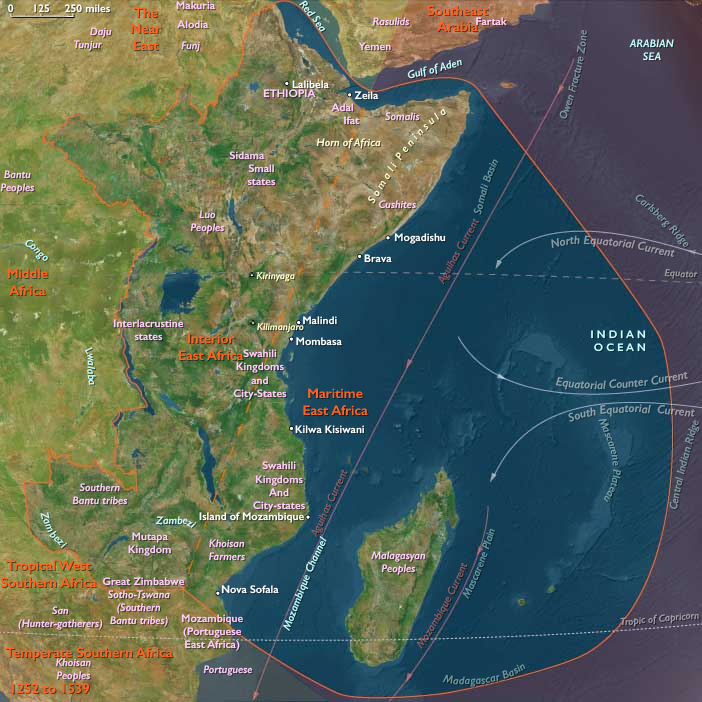
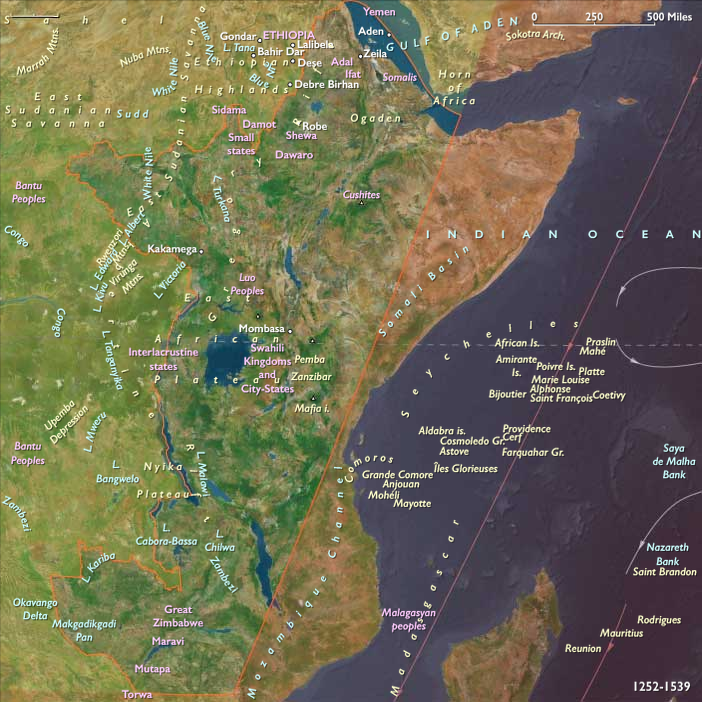
European influence has been noticeable in Ethiopia during the reign of Eskander.
In a manuscript written by Francesco Suriano (dated to 1482 by Somigli), Suriano describes finding ten Italians "of good repute" residing at Eskender's court, some who had been living there for twenty-five years.
Suriano adds that since 1480, seven more had traveled to the Ethiopian court "to seek jewels and precious stones", but "since the king did not allow them to return, they were all ill content, although they were all well rewarded, each in accordance with his rank." (O.G.S. Crawford, Ethiopian Itineraries, circa 1400-1524 (Cambridge: Hakluyt Society, 1958), pp. 40-54.)
It is in the last years of Eskender's reign that Pêro da Covilhã arrives in Ethiopia, as an envoy from king John II of Portugal.
However, Covilhã is not allowed to return to Portugal, and will be forced to live out his days in Ethiopia—although as a trusted advisor to the Emperors.
Europeans quickly identify Ethiopia’s Coptic Christian rulers with the legendary Christian emperor Prester John.
There are conflicting versions of Emperor Eskender's death, which occurs when he is only twenty-two.
One source holds he was killed fighting the Maya, a vanished ethnic group known for using poisoned arrows, east of Enderta.
On the other hand, both Bruce and the explorer Richard Burton write that Eskender was assassinated at Tegulet: Bruce stating that Zasillus of Amhara was responsible while Burton claiming that the predatory Mahfuz of Zeila had him assassinated.
He is buried in the church of Atronsa Maryam, which his father had begun construction on.
His early death immediately leads to civil war.
While the court keeps the Emperor's death a secret, one major noble, Zasillus, immediately marches to the royal prison of Amba Geshen, frees Na'od, the second son of Baeda Maryam I and his second wife Kalyupe (also called "Calliope"), and proclaims him Emperor.
Another noble, Tekle Kristos, who had remained at the Imperial court, champions Eskender's son Amda Seyon II as emperor.
Although Tekle Kristos' forces defeat the followers of Zasillus, warfare continues through the realm.
People
Groups
- Coptic Orthodox Church of Alexandria
- Italians (Latins)
- Ethiopia, Solomonid Dynasty of
- Portugal, Avizan (Joannine) Kingdom of
Topics
- Exploration of Asia, European
- Sub-Saharan Africa, Medieval
- Interaction with Subsaharan Africa, Early European
- Age of Discovery
Commodoties
Subjects
Regions
Subregions
Years: 1493 - 1493
People
Groups
- Coptic Orthodox Church of Alexandria
- Italians (Latins)
- Ethiopia, Solomonid Dynasty of
- Portugal, Avizan (Joannine) Kingdom of
Topics
- Exploration of Asia, European
- Sub-Saharan Africa, Medieval
- Interaction with Subsaharan Africa, Early European
- Age of Discovery
Commodoties
Subjects
Regions
Subregions