
A treaty between the Ashanti kingdom and …
Years: 1831 - 1831
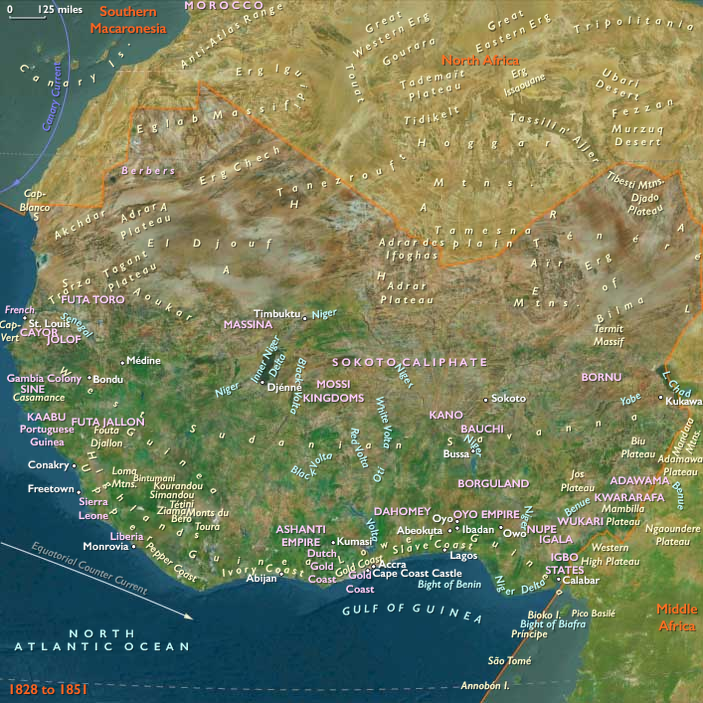
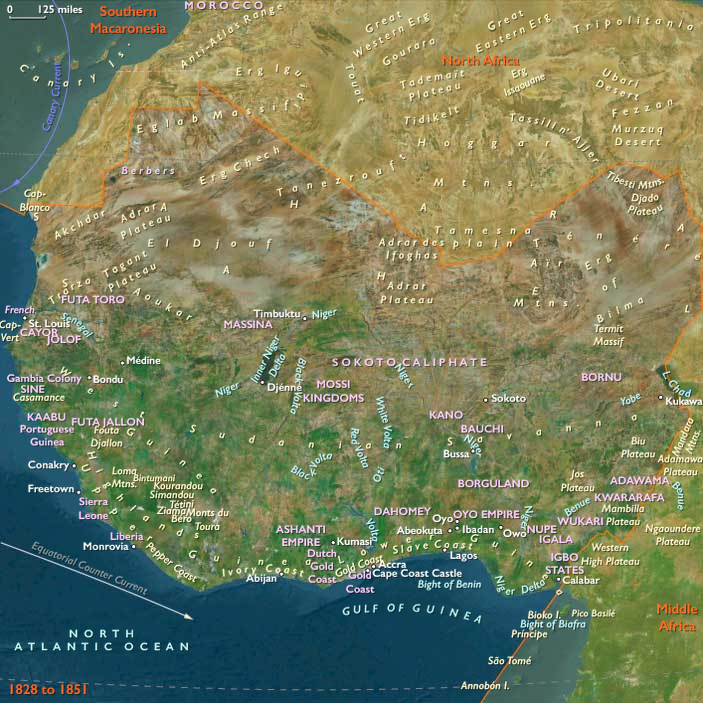
A treaty between the Ashanti kingdom and the British Gold Coast in 1831 will lead to thirty years of peace with the Pra River as the accepted border.
European contact with the Ivory Coast region of Africa, beginning in the 1400s, had led to trade in ivory, slaves, and other goods which has given rise to such kingdoms such as that of the Ashanti.
From 1806, the Asante Union has been in a perpetual state of war involving expansion or defense of its domain.
The Asante's exploits against native African forces make it the paramount power in the region.
Its impressive performance against the British also earns it the respect of European powers.
Far less known than its Zulu contemporaries, the Ashanti Empire is one of the few African states to decisively defeat the British Empire in not only a battle but a war.
The British had been drawn into three earlier wars.
In the Ashanti-Fante War of 1806-07, the British had refused to hand over two rebels pursued by the Asante, but eventually handed one over (the other escaped).
In the Ga-Fante War of 1811, the Akwapim had captured a British fort at Tantamkweri and a Dutch fort at Apam.
In the Ashanti-Akim-Akwapim War of 1814-16, the Ashanti had defeated the Akim-Akwapim alliance.
Local British, Dutch, and Danish authorities had all had to come to terms with the Ashanti.
In 1817 the (British) African Company of Merchants had signed a treaty of friendship that recognized Ashanti claims to sovereignty over much of the coast.
The British Gold Coast had been formed in 1821 when the British government abolished the African Company of Merchants and seized privately held lands along the coast.
The first of the Anglo-Asante Wars had begun in 1823 when Sir Charles MacCarthy, rejecting Ashanti claims to Fanti areas of the coast and resisting all overtures by the Ashanti to negotiate, led an invading force.
The Ashanti had defeated this force, killing MacCarthy and one Ensign Wetherall, taking their heads for trophies, and swept on to the coast.
However, disease had forced them back.
Major Alexander Gordon Laing had returned to Britain with news of their fate.
The Ashanti had been so successful in subsequent fighting that in 1826 they again moved on the coast.
At first they fought very impressively in an open battle against superior numbers of British allied forces, including Denkyirans.
However, the novelty of British rockets caused the Ashanti army to withdraw.
Locations
Groups
- Ashanti of Kumasi, Kingdom of the
- Fante (Fanti), southern Akan state of
- Britain (United Kingdom of Great Britain and Ireland)
- Gold Coast, British colony
Topics
Commodoties
Subjects
Regions
Subregions
Related Events
Showing 10 events out of 18983 total
Years: 1831 - 1831
Locations
Groups
- Ashanti of Kumasi, Kingdom of the
- Fante (Fanti), southern Akan state of
- Britain (United Kingdom of Great Britain and Ireland)
- Gold Coast, British colony
Topics
Commodoties
Subjects
Regions
Subregions