Euric conquers Hispania and the harbor city …
Years: 466 - 466
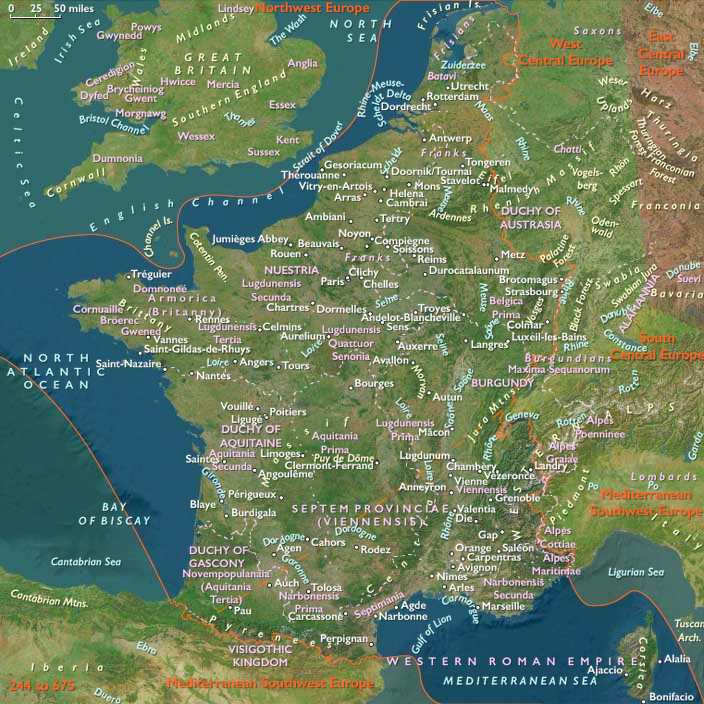
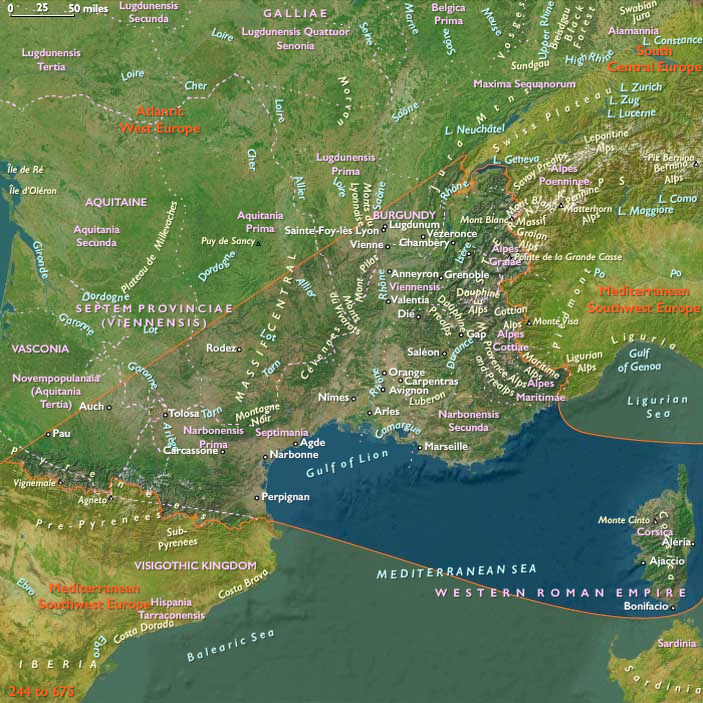
Euric conquers Hispania and the harbor city of Marseille in southern Gaul, adding them to the existing Visigothic Kingdom.
Locations
People
Groups
- Goths (East Germanic tribe)
- Roman Empire, Western (Ravenna)
- Suebic Kingdom of Galicia
- Visigothic Kingdom of Toulouse
- Vandals and the Alans, Kingdom of the
- Francia (Merovingians)
- Soissons, (Gallo-Roman) Domain of
Topics
- Migration Period
- Fall of the Western Roman Empire
- Vandal Raids on the Roman Empire
- Visigothic Raids on the Roman Empire, Later
Commodoties
Subjects
Regions
Subregions
Related Events
Filter results
Showing 10 events out of 58595 total
Emperor Leo I repels a Hunnish invasion of Dacia (modern Romania): they ravage the Balkans but are unable to take Constantinople thanks to the city walls, which are rebuilt and reinforced.
Not content to be Aspar's puppet, Leo has begun to rely increasingly on his Isaurian supporters, led by one Tarasis.
According to ancient sources, the earliest reference to Tarasis dates back to 464, when he put his hands on some letters written by Aspar's son, Ardabur, which proved that the son of the magister militum had incited the Sassanid King to invade Roman territory, promising to support the invasion.
Through these letters, which Tarasis gave to Leo, the Emperor could dismiss Ardabur, who at this time is magister militum per Orientem and patricius, thus reducing Aspar's influence and ambition.
As reward for his loyalty, which Leo praises with Daniel the Stylite, Tarasis had been appointed comes domesticorum, an office of great influence and prestige.
This appointment could mean that Tarasis had been a protector domesticus, either at Leo's court in Constantinople, or attached at Ardabur's staff in Antioch.
Leo and Aspar had quarreled in 465, about the appointment of consuls for the following year; it was in this occasion that Tarasis' position had been strengthened, as he had become friend and ally of the Emperor.
Tarasis comes in 466 with evidence that Aspar's son, Ardabur, the magister militum, is forming a conspiracy against Leo I. Ardabur is arrested for treason.
To make himself more acceptable to the Roman hierarchy and the population of Constantinople, Tarasis adopts the Greek name of Zeno; he will use it for the rest of his life.
King Theodoric II is killed by his younger brother Euric, who succeeds him on the throne.
Upon becoming king, Euric defeats several other Visigothic kings and chieftains in a series of civil wars and soon became the first ruler of a truly unified Visigothic nation.
Euric sends an embassy to the Eastern Roman Empire for recognition of the Visigoth sovereignty, and forms an alliance with the Suebi and the Vandals.
With his capital at Toulouse, Euric inherits a large portion of the Visigothic possessions in the Aquitaine region of Gaul, an area that has been under Visigothic control since 415.
A council of twelve townships emerges on the islands in the Venetian lagoon to form a basic system of governance.
The Suebi in Hispania likely remained mostly pagan until 466 CE, when an Arian missionary named Ajax, sent by Visigothic King Theodoric II at the request of Suebic ruler Remismund, successfully converts the Suebi nobility to Arian Christianity.
Ajax’s mission establishes a lasting Arian church, which remains dominant among the Suebi until their conversion to Catholicism in the 560s.
Zeno had married Ariadne, elder daughter of Leo I and Verina, in mid-late 466; as there is no reference to a divorce with Arcadia, she should have died in those years.
The next year their son was born, and Zeno became father of the heir apparent to the throne, as the only son of Leo I's had died in his infancy; to stress his claim to the throne, the boy was called Leo.
Zeno, however, is not present at the birth of his son, as in 467, he participates in a military campaign against the Goths.
Ricimer has maintained his power during the past several years despite serious threats to his position from Aegidius in Soissons and from Marcellinus, who rules a virtually independent state in Dalmatia.
Leo, emperor in the East, who had recognized Majorian as emperor in the West, had withheld recognition of Severus, who reigned as titular Western emperor for a little more than two years before dying on August 15, 465.
Nearly two years pass before the installation of Anthemius, the son-in-law of the Eastern emperor Marcian, on April 12, 467.
Appointed to his office by Marcian's successor, Leo, who wants help in attacking the Vandals in North Africa, Anthemius is accepted by Ricimer with the stipulation that his daughter, Alypia, marry him.
To the Eastern Empire, Anthemius is the first legitimate emperor since the death of Valentinian III in 455.
King Genseric extends his pirate raids in the Mediterranean Sea in summer 467.
The Vandals sack Illyricum, the Peloponnese and other parts of Greece, enslaving the inhabitants.
Leo I joins forces with the Western Empire to suppress the Vandal menace.
Basiliscus, likely of Balkan origin, is the brother of Aelia Verina, wife of Leo I.
It has been argued that Basiliscus was uncle to the chieftain of the Heruli, Odoacer.
This link is based on the interpretation of a fragment by John of Antioch (209.1), which states that Odoacer and Armatus, Basiliscus' nephew, were brothers.
However, not all scholars accept this interpretation, since sources do not say anything about the foreign origin of Basiliscus.
It is known that Basiliscus had a wife, Zenonis, and at least one son, Marcus.
Basiliscus' military career had started under Leo I, when the Emperor conferred upon his brother-in-law the dignities of dux, or commander-in-chief, in Thrace.
In this country, Basiliscus had led a successful military campaign against the Bulgars in 463.
Succeeding Rusticius as magister militum per Thracias in 464, he had had several successes against the Goths and Huns (466 or 467).
Basiliscus's value had risen in Leo's consideration.
Verina's intercession in favor of her brother has helped Basiliscus' military and political career, with the conferral of the consulship in 465 and possibly of the rank of patricius.
However, his rise is soon to meet a serious reversal.
In 468, Leo chooses Basiliscus as leader of the later famous military expedition against Carthage.
The invasion of the kingdom of the Vandals is one of the greatest military undertakings recorded in the annals of history, a combined amphibious operation with over ten thousand ships and one hundred thousand soldiers.
The purpose of the operation is to punish the Vandal king Genseric for the sacking of Rome in 455, in which the former capital of the Western Roman Empire had been overwhelmed, and the Empress Licinia Eudoxia (widow of Emperor Valentinian III) and her daughters had been taken as hostages.
Ancient and modern historians provide different estimations for the number of ships and troops under the command of Basiliscus, as well as for the expenses of the expedition.
Both are enormous; Nicephorus Gregoras speaks of one hundred thousand ships, the more reliable Cedrenus says that the fleet that attacked Carthage consisted of eleven hundred and thirteen ships, having each one hundred men on board.
The most conservative estimation for expedition expenses is of sixty-four thousand pounds of gold, a sum that exceeds a whole year's revenue.
It is the greatest fleet ever sent against the Vandals; the expense brings Leo near to bankruptcy.

The Utigurs (Onogurs), the western wing of the Huns, had first crossed the river Volga (according to Zacharias Rhetor) at some time during the reign of Dengizich, son of Attila the Hun.
Priscus is clearer, saying that in 463 a mixed Saragur, Urog and Unogur embassy asked Constantinople for an alliance, having been dislodged by the Avars' drive towards the west.
In 468, Dengizich sends an embassy to Constantinople to demand money.
Emperor Leo offers the Huns settlement in Thrace in exchange for recognition of his authority.
Dengizich refuses and, having recovering from the defeat at Nedao in 454, launches an invasion across the Danube with a large force.
Anagast or Anagastes (fl.
466–470), who is probably a Goth, as his name (as well as that of his father, Arnegisc(clus)) seems to be of Gothic origin, is a magister militum in the army of the Eastern Roman Empire and a politician.
He is sent to negotiate with Dengizich when the Onogurs invade the empire with the intention to finally conquer its capital Constantinople.
However, Dengizich refuses to negotiate with him and demands to speak directly with the emperor.
The Onogurs have already reached the Danube, but are defeated by the Romans.
Dengizich is killed and his head is paraded through the streets of Constantinople.
Stuck on the end of a wooden pole, it is displayed above the Xylokerkos Gate.
Jordanes writes that in turn the Huns "for ever after" left the Goths in peace.
Marcellinus was supposed to have a command of some ten thousand to twenty thousand troops.
Marcellinus had never sailed for Africa, perhaps due to Ricimer's veto; either he would not spare so many troops to become bogged in a campaign in Africa, hoping the East would do the job for him, or he resented the military capabilities of Marcellinus who was obviously the favorite of Anthemius.
Regardless of the reason, Marcellinus’s inabiity to participate in the campaign, coupled with Basiliscus’s blundering in the Battle of Cape Bon, assured that the operation would result in failure.
The West has lost its only chance to regain Africa from the Vandals and possibly stave off its demise.
Marcellinus is reached in Sicily by Basiliscus; the general is, however, assassinated, perhaps at the instigation of Ricimer, by one of his own captains; and the king of the Vandals expresses his surprise and satisfaction that the Romans themselves would remove from the world his most formidable antagonists.
The Vandals reconquer Sicily, administering a decisive defeat to the Western forces.
Years: 466 - 466
Locations
People
Groups
- Goths (East Germanic tribe)
- Roman Empire, Western (Ravenna)
- Suebic Kingdom of Galicia
- Visigothic Kingdom of Toulouse
- Vandals and the Alans, Kingdom of the
- Francia (Merovingians)
- Soissons, (Gallo-Roman) Domain of
Topics
- Migration Period
- Fall of the Western Roman Empire
- Vandal Raids on the Roman Empire
- Visigothic Raids on the Roman Empire, Later