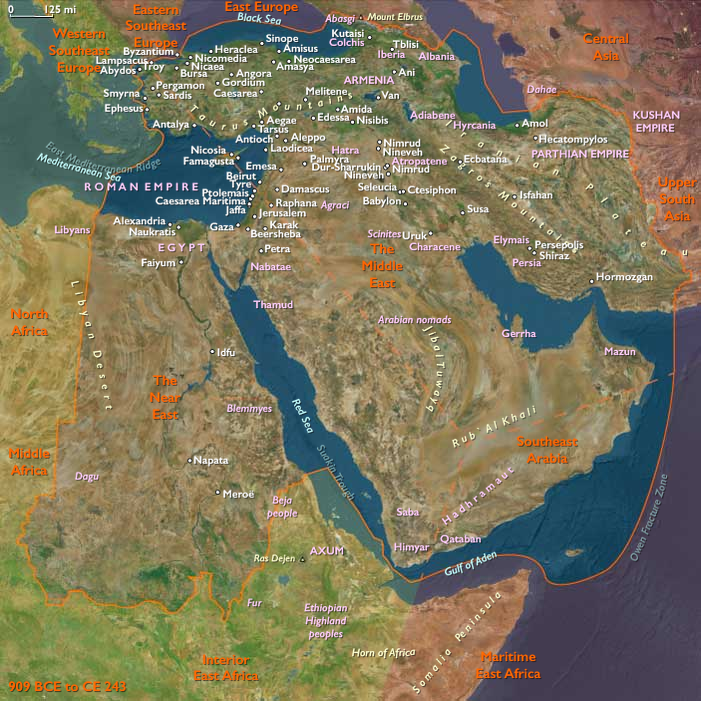
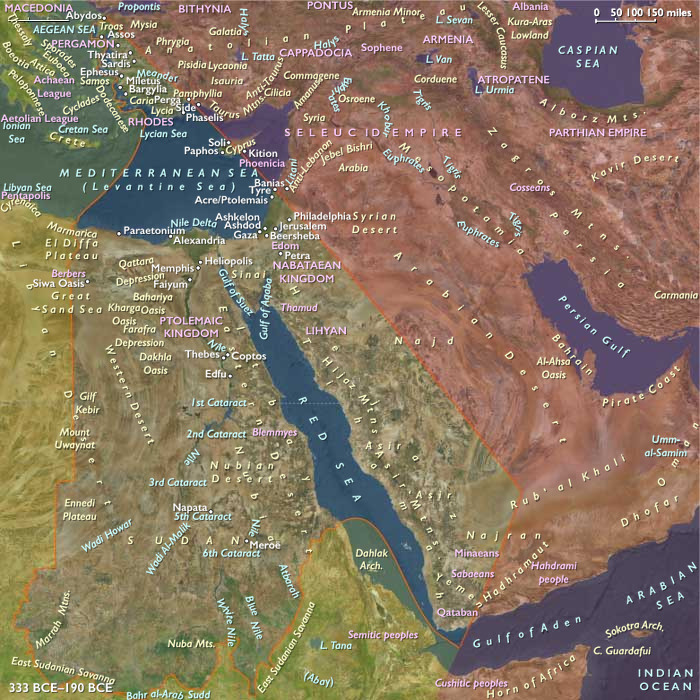
Philo of Byzantium, who flourishes around 250 BCE, writes a textbook on mechanics (one of the earliest such known).
He is apparently supported by a wealthy patron, Ariston (to whom each extant section of his great book, three chapters of which survive in fragments, is dedicated).
Philo discusses in a probable nine chapters the lever, the construction of seaports and fortresses, catapults, pneumatics, automatic theaters, and military tactics. (Little else is known of Philo, although both Hero and Vitruvius mention him in their writings.)
Philo is supposedly the author of a work entitled Peri ton hepta theamaton (“Concerning the Seven Wonders of the World”).
In his listing of the monuments, the Pharos of Alexandria replaces the Walls of Babylon.
According to recent research, a section of Philo's Pneumatics which so far has been regarded as a later Arabic interpolation, includes the first description of a water mill in history, placing the invention of the water mill in the mid-third century BCE by the Greeks.
Philo's works also contain the oldest known application of a chain drive in a repeating crossbow.
Two flat-linked chains are connected to a windlass, which by winding back and forth will automatically fire the machine's arrows until its magazine is empty.
Philon also is the first to describe a gimbal: an eight-sided ink pot with an opening on each side could be turned so that any face is on top, dip in a pen and ink it-yet the ink never runs out through the holes of the side.
This is done by the suspension of the inkwell at the center, which is mounted on a series of concentric metal rings that remain stationary no matter which way the pot turns itself.
In his Pneumatics (chapter 31) Philon describes an escapement mechanism, the earliest known, as part of a washstand.
A counterweighted spoon, supplied by a water tank, tips over in a basin when full releasing a pumice in the process.
Once the spoon has emptied, it is pulled up again by the counterweight, closing the door on the pumice by the tightening string.
Philo’s comment that "its construction is similar to that of clocks" indicates that such escapements mechanism were already integrated in ancient water clocks.
In mathematics, Philo tackles the challenge of doubling the cube, necessitated by the following problem: given a catapult, construct a second catapult that is capable of firing a projectile twice as heavy as the projectile of the first catapult.
His solution is to find the point of intersection of a rectangular hyperbola and a circle, a solution that is similar to Heron's solution several centuries later.