
Commerce had developed in Livonia rapidly because …
Years: 1540 - 1683
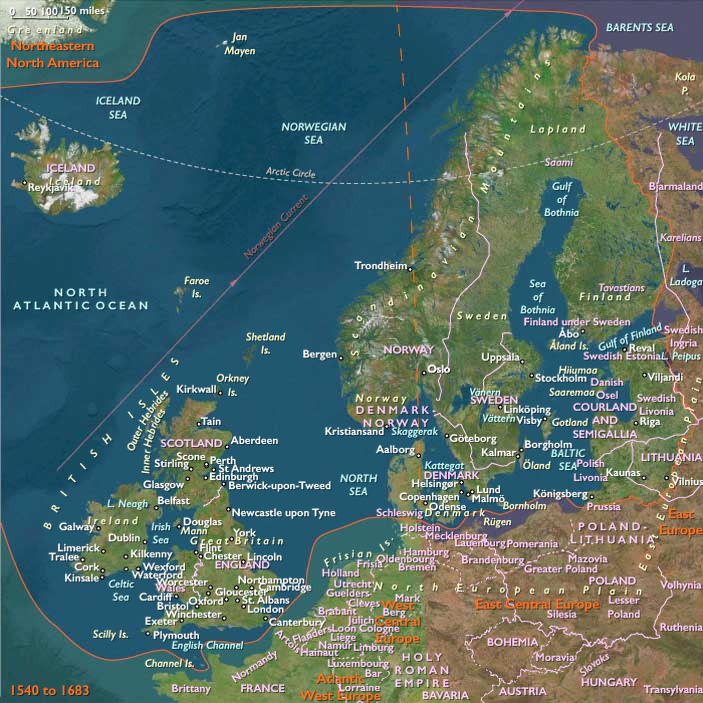
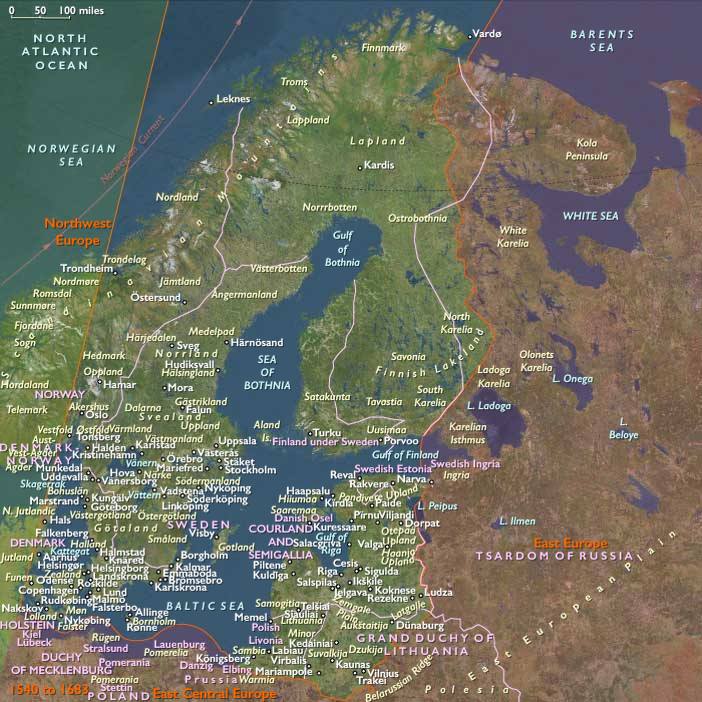
Commerce had developed in Livonia rapidly because Estonia's larger urban centers at this time—Tallinn, Tartu, Parnu, and Narva—are all members of the Hanseatic League, an organization established by merchants of various, mostly German, cities to protect their mutual trading interests.
Still, foreign rivalries over the strategic Livonian region begin to reemerge in the mid-sixteenth century as the fighting capacity of the Germans diminishes and that of neighboring Muscovy begins to increase.
The ensuing twenty-five-year struggle for control of Livonia is precipitated by an invasion by Ivan IV (the Terrible) (r. 1533-84) in 1558.
The advancing Russians wipe out the disintegrating forces of the Teutonic Knights and nearly succeed in conquering the whole area.
However, Swedish and Polish intervention reverses the Russian gains and forces Ivan eastward, back behind Lake Peipus.
Peace between Sweden and Poland in Livonia is also slow in coming, with Sweden eventually winning most of the territory by 1629.
By this time, decades of war have caused huge population losses (in some areas, over fifty percent), affecting urban and rural areas alike.
Locations
People
Groups
- Latvians, or Letts (Eastern Balts)
- Estonians
- Germans
- Livs
- Poles (West Slavs)
- Swedes (Scandinavians)
- Livonian Order
- Russians (East Slavs)
- Estonian Swedes
- Hanseatic League
- Poland of the Jagiellonians, Kingdom of
- Sweden, (second) Kingdom of
- Russia, Tsardom of
- Livonia, Duchy of (Polish Estonia and Latvia)
- Estonia, Duchy of (Swedish Estonia)
- Polish-Lithuanian Commonwealth (Commonwealth of the Two Nations)
- Livonia, Kingdom of
Topics
Subjects
Regions
Subregions
Years: 1540 - 1683
Locations
People
Groups
- Latvians, or Letts (Eastern Balts)
- Estonians
- Germans
- Livs
- Poles (West Slavs)
- Swedes (Scandinavians)
- Livonian Order
- Russians (East Slavs)
- Estonian Swedes
- Hanseatic League
- Poland of the Jagiellonians, Kingdom of
- Sweden, (second) Kingdom of
- Russia, Tsardom of
- Livonia, Duchy of (Polish Estonia and Latvia)
- Estonia, Duchy of (Swedish Estonia)
- Polish-Lithuanian Commonwealth (Commonwealth of the Two Nations)
- Livonia, Kingdom of
Topics
Subjects
Regions
Subregions