
Eric of Pomerania, Denmark's king, appears in …
Years: 1424 - 1424
Eric of Pomerania, Denmark's king, appears in contemporary sources as intelligent, visionary, energetic and a firm character.
That he is also a charming and well-spoken man of the world is shown by a great European tour of the 1420s.
Negatively, he seems to have had a hot temper, a lack of diplomatic sense, and an obstinacy that borders on mulishness.
Almost the whole of Eric’s sole rule is affected by his long-standing conflict with the Counts of Holstein.
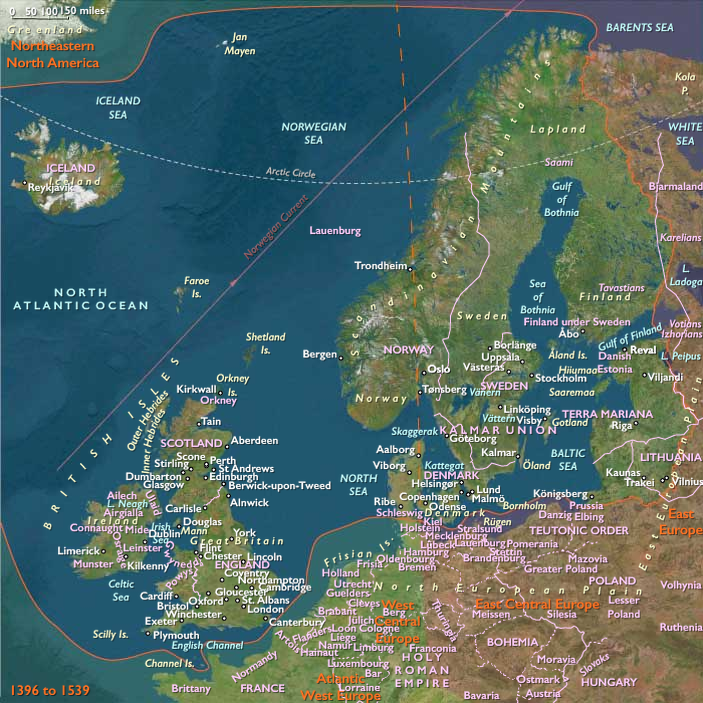
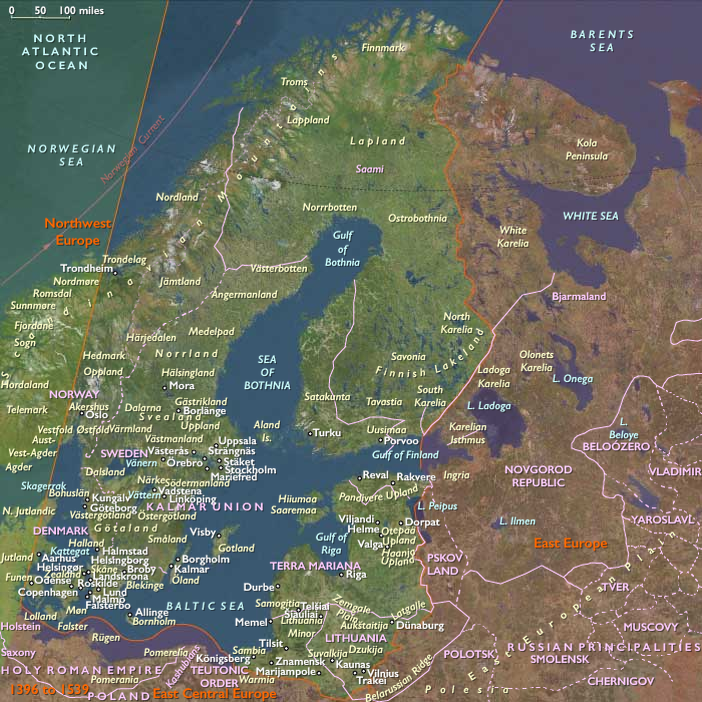
He tries to regain South Jutland (Schleswig) which Margaret had been winning but he has chosen a policy of warfare instead of negotiations.
The result is a devastating war that will not only end without conquests but also lead to the loss of the South Jutlandic areas that he had already obtained.
During this war he shows much energy and steadiness, but also a remarkable lack of adroitness.
The long war is a strain on the Danish economy as well as on the unity of the north.
Sigismund, King of Germany, issues a verdict of the Holy Roman Empire in 1424 recognizing Eric as the legal ruler of South Jutland.
The Holsteiners ignore it.
Locations
People
Groups
- Danes (Scandinavians)
- Holstein, County of
- Schleswig, Duchy of
- Holy Roman Empire
- Kalmar Union (of Denmark, Norway and Sweden)
Topics
Commodoties
Subjects
Regions
Subregions
Related Events
Filter results
Showing 10 events out of 42140 total
The Yongle Emperor dies on August 5, 1424, at age sixty four.
Succeeded by his son Zhu Gaozhi as the Hongxi Emperor, Yongle is given the posthumous temple name Cheng Zu.
Alain Chartier’s La Belle Dame sans Merci (1424): A Poetic Debate on Love and Rejection
Alain Chartier (c. 1385–1430), a French poet and diplomat, composed his most famous poem, "La Belle Dame sans Merci," around 1424. This lyrical debate on love and abandonment became one of the most influential works of late medieval French poetry, inspiring later writers, including François Villon.
I. Structure and Style of La Belle Dame sans Merci
- The poem is written in octaves (huitains), meaning each stanza contains eight lines.
- Each line is octosyllabic (eight syllables per line), a popular meter in medieval French poetry.
- This structure is later used by François Villon in his Ballade des dames du temps jadis (Ballad of the Ladies of Times Past), composed later in the 15th century.
II. The Poem’s Themes: A Debate on Love and Rejection
- The poem is a dialogue between a Lover and a Lady, structured as a debate about courtly love.
- The Lover argues for the idealized, faithful devotion typical of chivalric tradition.
- The Lady rejects him, emphasizing independence and skepticism toward love’s permanence.
- The alternating octaves delineate their arguments, creating a rhythmic back-and-forth exchange that mirrors the emotional tension between the characters.
III. Influence and Legacy
- La Belle Dame sans Merci was widely read and imitated in France and beyond, influencing later courtly poetry.
- Its themes of unfulfilled love and the rejection of romantic idealism resonated with Renaissance and Romantic-era poets.
- The title was later borrowed by John Keats for his famous 19th-century English poem of the same name, though Keats’ version is a much darker, supernatural retelling.
IV. Conclusion: A Masterpiece of Late Medieval Poetry
Chartier’s La Belle Dame sans Merci (1424) remains a landmark of medieval French poetry, blending lyrical beauty with a sophisticated exploration of love’s illusions and disappointments. Its debate structure, poetic form, and enduring themes solidified its place as one of the most influential poems of its time.
This revision enhances clarity, strengthens readability, and fully contextualizes Chartier’s poem within its historical and literary significance. Let me know if you’d like any refinements!
Scottish Reinforcements Arrive in France: Buchan and Douglas Strengthen the Dauphin’s Cause (1424)
At the beginning of 1424, John Stewart, Earl of Buchan, returned to France with 6,500 additional Scottish troops to bolster the French Dauphin Charles VII’s forces against the Anglo-Burgundian alliance. Accompanying him was Archibald Douglas, 4th Earl of Douglas, one of Scotland’s most powerful noblemen, bringing military expertise and political weight to the Scottish intervention in France.
I. Composition of the Scottish Reinforcements
- The army totaled 6,500 men, consisting of:
- 2,500 men-at-arms (heavily armored cavalry and foot soldiers).
- 4,000 longbowmen, renowned for their skill in warfare.
- This was a significant reinforcement, as the Scottish-French alliance had already been pivotal at the Battle of Baugé (1421), where the Scots inflicted England’s first major defeat since Agincourt.
II. Arrival at Bourges and the Boost to the Dauphin’s Cause (April 24, 1424)
- On April 24, 1424, the Scottish army entered Bourges, where they were received at the Dauphin’s court.
- Their arrival raised the spirits of Charles VII, who had been struggling to maintain resistance against the English forces led by John of Lancaster, Duke of Bedford.
- The reinforcements gave Charles VII renewed confidence, reinforcing the Franco-Scottish military cooperation.
III. The Importance of Buchan and Douglas in the War
- John Stewart, Earl of Buchan, had already proven himself a capable leader at Baugé, and his return signaled Scotland’s ongoing commitment to the French cause.
- Archibald Douglas, 4th Earl of Douglas, was among the most influential nobles in Scotland, lending prestige and leadership to the campaign.
- Their presence strengthened Franco-Scottish military operations, paving the way for further engagements against the English.
IV. Consequences and the Next Phase of the War
- The Scottish troops would soon engage the English again, leading to the Battle of Verneuil (August 17, 1424)—a brutal confrontation that would test the resilience of the Franco-Scottish alliance.
- The Dauphin’s forces were now reinforced, making him more capable of resisting the English advance.
The arrival of Buchan and Douglas in France in 1424 reinforced Scotland’s commitment to the French cause, giving Charles VII the military support needed to continue his struggle against the English occupation of France.
The Franco-Scottish Army Prepares for Battle: The Campaign Leading to Verneuil (August 1424)
By August 1424, the newly reinforced Franco-Scottish army was ready to take action against the English forces of John of Lancaster, Duke of Bedford. Their initial objective was to relieve the castle of Ivry, near Le Mans, which was under siege by the English. However, before they could arrive, Ivry surrendered, forcing the allied commanders to reconsider their strategy.
I. The Franco-Scottish Army Marches to Relieve Ivry
- The army was led by:
- Archibald Douglas, Earl of Douglas (now Duke of Touraine).
- John Stewart, Earl of Buchan.
- They left Tours on August 4, 1424, aiming to join forces with French commanders:
- John, Duke of Alençon.
- The Viscounts of Narbonne and Aumale.
However, before they could reach Ivry, the castle surrendered to the English, creating uncertainty over their next move.
II. The War Council: A Divided Strategy
- The allied commanders held a council of war, debating their next course of action:
- The Scots and younger French officers were eager to engage the English in battle, hoping for another decisive victory like Baugé (1421).
- The senior French nobility, led by Narbonne, remained cautious, recalling the disastrous French defeat at Agincourt (1415) and fearing another catastrophe.
- As a compromise, the allied leaders decided to target English-held fortresses along the Norman border, instead of directly confronting Bedford’s main army.
III. The Decision to Attack Verneuil
- The first target chosen was Verneuil, a key stronghold in western Normandy.
- The attack on Verneuil was intended to:
- Disrupt English control over Normandy.
- Draw Bedford’s army into a battle on favorable terms for the Franco-Scottish forces.
- This decision would lead directly to the Battle of Verneuil (August 17, 1424), a brutal confrontation that would prove to be one of the most decisive battles of the Hundred Years’ War.
IV. Consequences and the Path to Verneuil
- The decision to march on Verneuil set the stage for one of the bloodiest battles in the conflict, where the fate of the Scottish forces in France would be decided.
- The Franco-Scottish army, emboldened by previous victories, was determined to challenge English supremacy in northern France.
The march to relieve Ivry in August 1424 ended in failure, but the shift to attacking Verneuil led directly to one of the most significant battles of the war, where both Scotland and France would face their greatest test against the English under Bedford.
The Battle of Verneuil (August 17, 1424): A Decisive English Victory
The Battle of Verneuil, fought on August 17, 1424, was one of the bloodiest confrontations of the Hundred Years’ War, often referred to as “a second Agincourt” by the English. The battle saw the destruction of the Franco-Scottish army, leaving thousands dead, including Archibald Douglas, Earl of Douglas, and John Stewart, Earl of Buchan.
Despite their initial success in capturing Verneuil by deception, the Scottish and French forces, commanded by Douglas, Buchan, and the Viscount of Narbonne, suffered a catastrophic defeat at the hands of the English army led by John, Duke of Bedford.
I. The Capture of Verneuil and Bedford’s Response
- Before the battle, Scottish troops used deception to capture Verneuil:
- A group of Scots, leading fellow Scots as "prisoners," claimed to be English soldiers returning from a victory.
- The gates were opened, and Verneuil fell into French hands.
- On August 15, 1424, Bedford received news of Verneuil’s capture and immediately marched to retake the town.
II. The Battlefield and Initial Deployment
-
The Franco-Scottish army, under Sir John Stewart of Darnley, the Duke of Alençon, and the Earl of Douglas, took position a mile north of Verneuil.
-
The army was composed of:
- French troops under Narbonne on the left, supported by Milanese cavalry.
- Scottish troops under Douglas and Buchan on the right, supported by Lombard cavalry.
- Viscount Aumale held overall command.
-
The English army, led by John, Duke of Bedford, was organized in two divisions:
- Bedford commanded the right flank, facing the French forces.
- Sir Thomas Montacute, Earl of Salisbury, led the left flank against the Scots.
- A reserve of 2,000 English archers was placed at the rear to guard the baggage train.
III. The Battle Begins: A Disjointed Franco-Scottish Attack
- As Bedford brought his troops into arrow range, he halted to allow his longbowmen to drive their stakes into the ground—a defensive measure against cavalry.
- However, due to the baked summer ground, the stakes could not be driven in easily.
- Seeing an opportunity, the French cavalry charged prematurely, out of sync with the Scottish forces.
1. The French Charge and Collapse
- The French cavalry on the left broke through the English archers, possibly due to their improved tempered steel armor.
- Instead of pressing the attack, they continued toward the baggage train, hoping to seize loot.
- Meanwhile, Bedford’s men-at-arms counterattacked the French infantry, shattering Narbonne’s division.
- Narbonne and many French commanders were killed or drowned in the moat of Verneuil.
2. The Scots Stand Alone
- With the French defeated, Bedford halted the pursuit and turned back to the battlefield, where Salisbury was still fighting the Scots.
- The Lombard cavalry, hoping for loot, also charged toward the baggage train, but were driven off by Bedford’s reserve archers.
- Seeing the Lombards fleeing, the English reserve force entered the main battle, attacking the Scottish right wing.
IV. The Destruction of the Scots and the English Victory
-
Now almost completely surrounded, the Scots made a last stand, fighting to the last man.
-
The English shouted, "A Clarence! A Clarence!", invoking the death of Thomas, Duke of Clarence at the Battle of Baugé (1421), seeking revenge.
-
Over 4,000 Scots were killed, including:
- Archibald Douglas, Earl of Douglas.
- John Stewart, Earl of Buchan.
- Sir Alexander Buchanan, the man who had killed Clarence at Baugé.
-
English losses were relatively light, with only 1,600 men killed, including two men-at-arms and “a very few archers,” according to Bedford.
V. Aftermath and Consequences
- Verneuil was one of the most devastating defeats for the Franco-Scottish alliance, effectively eliminating Scottish military support for Charles VII.
- The English reestablished dominance in northern France, strengthening their hold over Normandy.
- Bedford’s victory ensured that England remained in control of France’s most economically and strategically vital regions.
The Battle of Verneuil (1424) was one of the bloodiest battles of the Hundred Years' War, delivering a crippling blow to the French and their Scottish allies, and ensuring that English control over northern France remained unchallenged for years.
ftermath of the Battle of Verneuil (1424): The Fate of the Scottish Army and the French Response
Despite suffering devastating losses at the Battle of Verneuil (August 17, 1424), the Army of Scotland was not completely annihilated. However, the defeat significantly weakened its role in future campaigns, as Scottish reinforcements to France drastically declined after this battle.
The Dauphin Charles VII, though devastated by the loss, continued to honor the Scottish survivors, recognizing their sacrifices in the fight against English domination.
I. The Diminished Role of the Scottish Army in France
- While the Franco-Scottish force had suffered enormous casualties, with over 4,000 Scots killed, some survivors remained active in the French cause.
- The battle marked a turning point, as Scotland could no longer provide large-scale military reinforcementsto France.
- The destruction of the Scottish contingent severely weakened Charles VII’s ability to challenge English control in northern France.
II. The Fate of the Captured Commanders
Among the high-ranking prisoners captured by the English were:
- John, Duke of Alençon, a key nobleman in the Dauphin’s army.
- Pierre, the Bastard of Alençon.
- Gilbert Motier de La Fayette, Marshal of France, who had fought alongside the Scots.
Their captivity further disrupted the French war effort, depriving Charles VII of important commanders.
III. Charles VII’s Response and the Recognition of Scottish Survivors
- Charles VII, though greatly saddened by the catastrophe at Verneuil, continued to honor the remaining Scottish troops who had fought for him.
- One such survivor was John Carmichael of Douglasdale, the chaplain to the slain Archibald Douglas, Earl of Douglas.
- In recognition of his service and the sacrifice of the Scottish troops, Carmichael was appointed Bishop of Orléans, a symbolic gesture of gratitude toward Scotland.
IV. Consequences for the Hundred Years' War
- Verneuil marked the effective end of large-scale Scottish involvement in the Hundred Years' War.
- The French were forced to rely more on native troops and diplomacy in their continued resistance against English rule.
- The defeat solidified English control over northern France, making the task of reconquering lost territories even more difficult for Charles VII.
The Battle of Verneuil (1424) was a disaster for the Franco-Scottish alliance, effectively ending Scotland’s ability to send major reinforcements and further weakening Charles VII’s military position. However, the recognition of Scottish survivors, like John Carmichael, showed that their sacrifices were not forgotten, as France continued its long struggle for independence from English rule.
Aftermath of Verneuil (1424): Bedford Secures Normandy and Repels French Resistance
Following his decisive victory at the Battle of Verneuil (August 17, 1424), John, Duke of Bedford, returned in triumph to Paris, further consolidating English control over northern France.
The defeat of the Franco-Scottish forces at Verneuil eliminated much of the Dauphin's offensive capability, allowing the English to tighten their grip on Normandy and repel further French resistance.
I. Bedford’s Triumph and the Securing of Normandy
- After Verneuil, Bedford marched back to Paris, greeted as the defender of Lancastrian rule in France.
- With the French army in retreat, the English captured all border posts surrounding Lancastrian-controlled Normandy, further strengthening their hold on northern France.
- The only exception to English rule in Normandy was Mont Saint-Michel, where the monks continued to resist.
II. The French Withdrawal and the Failure to Retake Rouen
- La Hire, one of the Dauphinist captains, withdrew eastward, avoiding direct confrontation with Bedford’s victorious forces.
- A French plan to retake Rouen by undermining its defenses (mining the walls) was thwarted due to Bedford’s strategic success at Verneuil.
- The English solidified their defenses in key strongholds, ensuring that Rouen and other major cities remained under English control.
III. Consequences and English Dominance in France
- With Normandy firmly in English hands, the Dauphin Charles VII was forced onto the defensive, struggling to maintain his influence south of the Loire.
- The loss at Verneuil and Bedford’s subsequent conquests weakened French morale, delaying any serious counteroffensive against the English for years.
- The continued resistance at Mont Saint-Michel, however, stood as a symbol of defiance against English rule, even though it had little strategic impact.
IV. Conclusion: Bedford’s Position Strengthened
- The victory at Verneuil and the subsequent English consolidation of Normandy marked a high point in Bedford’s rule.
- His return to Paris in triumph reaffirmed English authority, further delaying the possibility of a French resurgence.
- Although French forces, such as those led by La Hire, still remained active, they were largely on the defensive until the later stages of the war.
The English success in securing Normandy after Verneuil (1424) deepened their hold on northern France, reinforcing Bedford’s control and leaving Charles VII struggling to recover lost territory.
Murdoch Stewart, now aged fifty-eight, had finally inherited the Dukedom of Albany on the death of his father, Robert, in 1420.
He also inherited the Earldom of Fife and the Earldom of Menteith, and at last became Governor of Scotland in his own right.
He has held this position from 1420 to 1424, while King James I is still held captive in England.
Few serious attempts appear to have been made by Duke Albany to return James to Scotland, but eventually political pressure had compelled Murdoch to agree to a general council.
It had been agreed in August 1423 that an embassy should be sent to England to negotiate James's release.
A ransom treaty of sixty thousand marks (an enormous sum) is agreed at Durham on March 28, 1424, to which James attaches his own seal—he and his queen accompanied by an escort of English and Scottish nobles proceeded to Melrose Abbey arriving on April 5, where he meets Albany to receive the governor's seal of office.
Upon the return of James I to Scotland, Albany loses his position as Regent.
James now begins to consolidate his position.
His coronation takes place on May 21, 1424, at Scone.
At his coronation parliament the king—probably with the intent of securing a cohesive political community loyal to the crown—knights eighteen prominent nobles, including Albany's son Alexander Stewart.
At this stage, it is probable that the king feels unable to move against the Albany Stewarts while Murdoch's brother, John Stewart, Earl of Buchan, and Archibald Douglas, 4th Earl of Douglas, are fighting the English in France alongside their Dauphinist French allies.
Buchan is a soldier with an international reputation, and commands the large Scottish army of around six thousand men, a formidable force.
In addition he is Constable of France, making him the effective commander of the entire French army.
However, both he and Douglas are killed at the Battle of Verneuil in August 1424 and the Scottish army is routed—the loss of these Albany allies with their fighting force leaves Murdoch politically exposed.
James moves swiftly against his Albany Stewart relatives soon afterwards.
The Hongxi Emperor orders that the capital be moved back to Nanjing from Beijing (which had been made the capital by the Yongle Emperor in 1421).
However, he dies, probably of a heart attack, a month later in May 1425.
His son had been declared heir apparent and becomes the Xuande Emperor at age twenty-six.
Although the Hongxi Emperor had had a short reign, he is credited with reforms that made lasting improvements, and his liberal policies are continued by his son.
Vasily II is the youngest son of Vasily I of Moscow by Sophia of Lithuania, the only daughter of Vytautas the Great, and the only son to survive his father (his elder brother Ivan had died in 1417 at the age of twenty-two).
On his father's death at fifty-four in 1425, ten-year-old Vasily is proclaimed Grand Duke.
His mother acts as a regent.
His uncle, Yuri of Zvenigorod (Prince of Galich-Mersky), and his two sons, Vasily the Cross-Eyed and Dmitry Shemyaka, seize on the opportunity to advance their own claims to the throne.
These claims are based on the Testament of Dmitri Donskoi, Yuri's father and Vasily's grandfather, who had stated that if Vasily I died Yuri would succeed his appanage.
However, Dmitri had written the testament when Vasily I had no children of his own, and it might be argued that this provision had been made only for the case of Vasily's childless death.
Vasily's claim is supported by Vytautas, his maternal grandfather, and by the boyars.
Years: 1424 - 1424
Locations
People
Groups
- Danes (Scandinavians)
- Holstein, County of
- Schleswig, Duchy of
- Holy Roman Empire
- Kalmar Union (of Denmark, Norway and Sweden)
