
Upper East Asia (2637 – 910 BCE): …
Years: 2637BCE - 910BCE
Upper East Asia (2637 – 910 BCE): Highlands, Deserts, and Steppe Crossroads
Geographic and Environmental Context
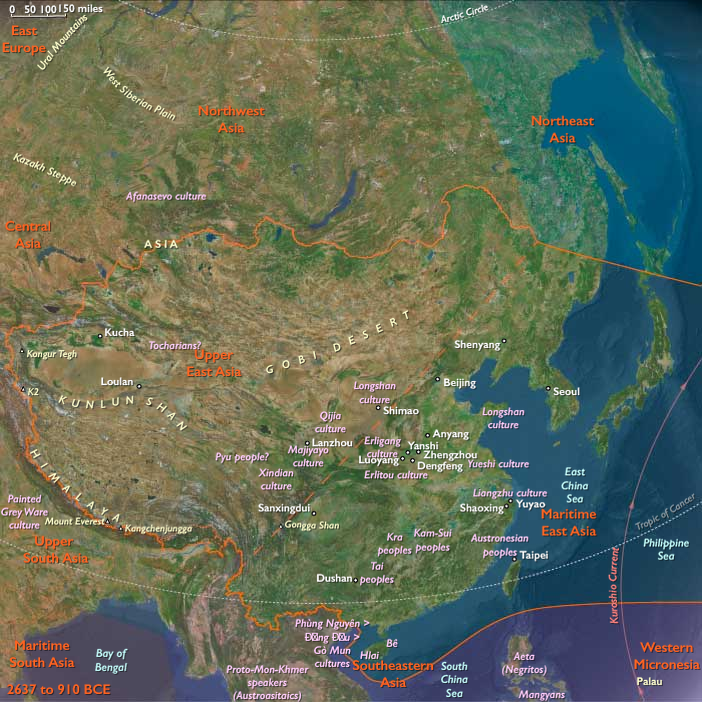
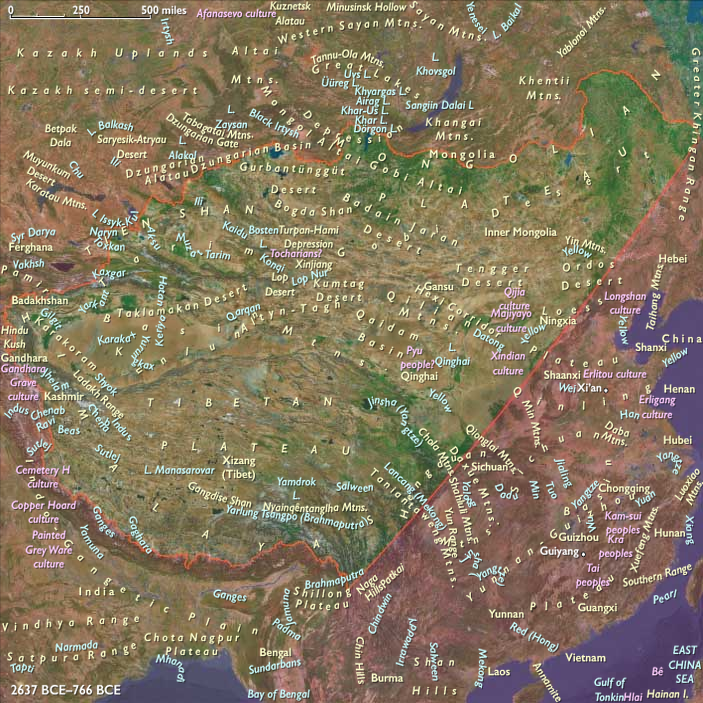
Upper East Asia—including Mongolia and the broad highland and basin regions of western China (Tibet, Xinjiang, Qinghai, Gansu, Ningxia, Inner Mongolia, and western Heilongjiang)—was a landscape of extreme contrasts. Towering ranges like the Altai, Tien Shan, Kunlun, and Himalayas enclosed plateaus, desert basins such as the Tarim and Qaidam, and vast open steppe. The climate was sharply continental and often arid, with long cold winters, short summers, and sharply limited growing seasons outside irrigated oases.
Subsistence and Mobility
By the mid–third millennium BCE, most of the open steppe and semi-arid basins were the domain of pastoral nomads herding sheep, goats, cattle, and horses, with seasonal mobility ensuring access to fresh pastures. In oases and river valleys—especially in the Tarim Basin and along the upper Yellow River—irrigated farming supported wheat, barley, and millet, often alongside orchard crops.
Hunting of wild ungulates, gazelle, and antelope supplemented pastoral and agricultural production, while in high-altitude Tibet and Qinghai, herders adapted to low-oxygen environments with yak domestication, integrating wool, milk, and transport into their economies.
Technological and Cultural Developments
Upper East Asia’s position between Central Asia and East Asia made it a conduit for major technological shifts. Early bronze metallurgy arrived from the west via steppe exchange networks, producing tools, weapons, and ornaments that blended Central Asian and local styles. Pottery traditions ranged from plain utilitarian wares in nomadic camps to finely decorated vessels in settled farming communities.
In the Ordos and Altai regions, early evidence of chariotry and horse gear appears in the late third to early second millennium BCE, paralleling developments in the Andronovo and Seima–Turbino horizons further west.
Cultural Networks and Population Movements
Archaeological and genetic evidence suggests that Upper East Asia was a zone of population exchange. Bronze and stone artifacts from the Chemurchek culture of western Mongolia show affinities with both steppe metallurgical centers and Xinjiang oasis cultures. Movement along the Hexi Corridor connected these highland and steppe groups with the early Qijia culture of Gansu, an important link between steppe pastoralists and early Chinese farming societies.
Burials and Symbolism
Burial practices in Mongolia and Xinjiang often involved stone slab cists or circular enclosures, sometimes with anthropomorphic stelae. These monuments, often aligned to celestial events, reflect both social prestige and ritual cosmology. In the Tarim Basin, early cemeteries—such as those of the Xiaohe culture—featured wooden coffins, woolen textiles, and grave goods indicating far-flung trade connections, including materials of Central Asian and even West Asian origin.
Trade and Exchange Routes
Upper East Asia’s oases and valleys formed early nodes in what would become the Silk Road. Goods such as jade from the Kunlun Mountains moved east toward the Yellow River, while metal, horses, and livestock products traveled west into Central Asia. The Altai–Tien Shan corridor funneled cultural and technological innovations in both directions.
Environmental Adaptation and Resilience
Pastoralists optimized survival in marginal climates through mobility, herd diversification, and knowledge of seasonal pastures. Oasis farmers used irrigation channels and floodwater diversion to stabilize yields. In the high plateaus, yak herding, insulated dwellings, and seasonal transhumance allowed communities to endure harsh winters and thin air.
Transition to the Early First Millennium BCE
By 910 BCE, Upper East Asia was firmly embedded in trans-Eurasian exchange networks. Its peoples combined the mobility of the steppe with the resource management of settled oasis farmers, creating a cultural mosaic that would later play a central role in the Silk Road’s formative centuries.
Groups
Topics
Commodoties
Subjects
Regions
Subregions
Years: 2637BCE - 910BCE
Groups
Topics
Commodoties
Subjects
Regions
Subregions