David Garrick holds the first Shakespeare Festival …
Years: 1769 - 1769
October
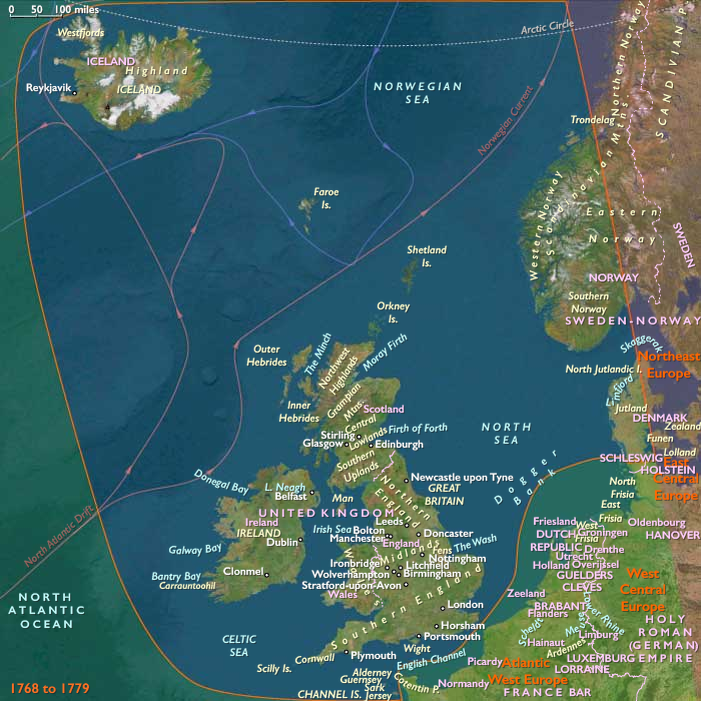
David Garrick holds the first Shakespeare Festival at Stratford-upon-Avon from September 6 through 9, 1769, for his Jubilee Celebrations of this year to mark Shakespeare's birthday.
The theater built by Garrick, a temporary wooden affair built not far from the site of the present Royal Shakespeare Theatre and the town’s first, is almost washed away in two days of torrential rain that results in terrible flooding.
Locations
People
Groups
Subjects
Regions
Subregions
Related Events
Filter results
Showing 10 events out of 26017 total
Once King Taksin notices the action, he sends his army to help capturing Nakhon Si Thammarat and finally wins.
In dealing with the Prince of Nakhon Si Thammarat, who is taken prisoner by the loyal Governor of Pattani, the King not only pardons him but also favors him with a residence at Thonburi.
Many noble factions have risen against the sultan’s power and will proceed to break away from the Ottoman Empire.
In addition to this decentralization of the Empire the Ottomans are also faced with the revival of a unified Persia, which has risen to oppose the Turks in Iraq.
Upon the outbreak of the Russo-Turkish War the Ottomans seem to have the upper hand in the face of Russia's lethargy and the threat of financial ruin as a consequence of Russia's involvement in the Seven Years' War.
The Turkish Navy capitalizes on Russia's naval inferiority, despite employing British officers to resolve this weakness, to dominate the Black Sea, giving it the advantage of shorter supply lines.
The Ottomans are also able to levy troops from their vassal state, the Crimean Khanate, to fight the Russians, but their effectiveness is undermined by constant Russian destabilization of the area.
In the years preceding the war the Ottoman Empire had enjoyed the longest period of peace with Europe in its history (1747–1768).
Despite peace with Europe during this period the Ottoman Empire had faced internal division, rebellion and corruption compounded by the re-emergence of a unified Persian leadership, under Nader Shah.
One clear advantage for the Ottoman Empire is its superior numbers as the Ottoman army is three times the size of its Russian counterpart; however, the new Grand Vizier Mehmed Emin Pasha will prove himself to be incompetent militarily.
For a long time the Ottoman military has been considered to be more technologically advanced than Europe, however, the period of peace that preceded the war meant that the Ottomans fell behind in this regard.
Russia masses her army along the borders with Poland and the Ottoman Empire, which makes it difficult for Ottomans troops to make inroads into Russian territory.
The famine in Bengal, which kills ten million people, a third of the population, in four years, is the worst natural disaster in human history in terms of lives lost.
The Maharajah of Mysore, Bettada Chamaraja Wadiyar VIII, forces the British to agree a treaty of mutual assistance in view of the famine, but the British East India Company increases its demands on the Bengali people to keep profits up.
Genoa, seeing as futile any attempts to dislodge Pasquale Paoli, who in 1755 had proclaimed the Corsican Republic, had sold Corsica in 1764 by secret treaty to the duc de Choiseul, then minister of the French Navy, who had bought the island on behalf of the crown.
French troops have quietly and gradually replaced Genoese in the citadels.
After preparations had been made, an open treaty with Genoa in 1768 had ceded Corsica to France in perpetuity with no possibility of retraction and the Duc appoints a Corsican supporter, Buttafuoco, as administrator.
The island rises in revolt.
Paoli fights a guerrilla war against fresh French troops under a commander, Comte de Marbeuf, but is defeated on May 8, 1769, in the Battle of Ponte Novu and has to go into exile in Vienna, then London.
The Italian city of Brescia is devastated when the Church of San Nazaro is struck by lightning.
The resulting fire ignites two hundred thousand pounds (ninety thousand kilograms) of gunpowder being stored there, causing a massive explosion which destroys one sixth of the city and kills three thousand people.
The disaster prompts the Roman Catholic Church to abandon their religious objection to using lightning rods to protect their property.
The Jesuits had By 1768 been expelled from Portugal and from all the Bourbon courts: France, Spain, Naples, and Parma.
Pope Clement XIII had issued a strong protest (monitorium) against the anti-Jesuit policy of the Parmese government; the question of the investiture of Parma has aggravated his troubles.
The Bourbon kings espouse their relative's quarrel, seize Avignon, Benevento and Pontecorvo, and in January 1769 unite in a peremptory demand for the total suppression of the Jesuits.
The Pope, driven to extremes, consents to call a consistory to consider the step, but on February 2, the very eve of the day set for its meeting he dies, not without suspicion of poison, of which, however, there appears to be no conclusive evidence.
Giovanni Vincenzo Antonio Ganganelli, who had been appointed by this Pope to investigate the issue of the traditional blood libel regarding the Jews, which he found to be untrue, is at this time the only Franciscan friar in the College of Cardinals.
The faction called the "court cardinals", who are generally opposed to the encroaching secularism of the Enlightenment, are opposed by the diminished pro-Jesuit faction, the Zelanti ("zealous"), now urge the general suppression of the order.
Ganganelli is installed on June 4 as the 249th pope, largely due to support of the Bourbon courts, which expect that he will suppress the Society of Jesus, after a conclave that had been sitting since February 15, heavily influenced by the political maneuvers of the ambassadors of Catholic sovereigns who are opposed to the Jesuits.
He takes the name Clement XIV.

Nicolas-Joseph Cugnot demonstrates a steam-powered artillery tractor in France in 1769.
He is believed to have built the first self-propelled mechanical vehicle, but this claim is disputed by some sources, which suggest that Ferdinand Verbiest, as a member of a Jesuit mission in China, may have been the first to build a 'car' around 1672.
Richard Arkwright invents the spinning frame, which he patents on July 3, 1769.
Later renamed the water frame following the transition to water power, it is a machine that produces a strong twist for warps, substituting metal cylinders for human fingers.
This makes possible inexpensive yarns to manufacture cheap calicoes, on which the subsequent great expansion of the cotton industry will be based.
Arkwright and John Smalley set up a small horse-driven factory at the textile center of Nottingham.
A self-made man, Arkwright is to be a leading entrepreneur of the Industrial Revolution.
Arkwright's achievement is to combine power, machinery, semiskilled labor, and a new raw material (cotton) to create, more than a century before Ford, mass production.
His mechanical abilities and, above all, his genius for organization make him, more than anyone else, the creator of the modern factory system.
The governor of Massachusetts is instructed to collect evidence of said treason, and the threat causes widespread outrage, though it is not carried out.
The Guajiro rebels themselves are not unified.
Sierra's relatives among the Indians take up arms against the rebels to avenge his death.
A battle between the two groups of Wayuus is fought at Soledad.
This, and the arrival of the Spanish reinforcements, causes the rebellion to fade away, but not before the Guajiro have regained much territory.