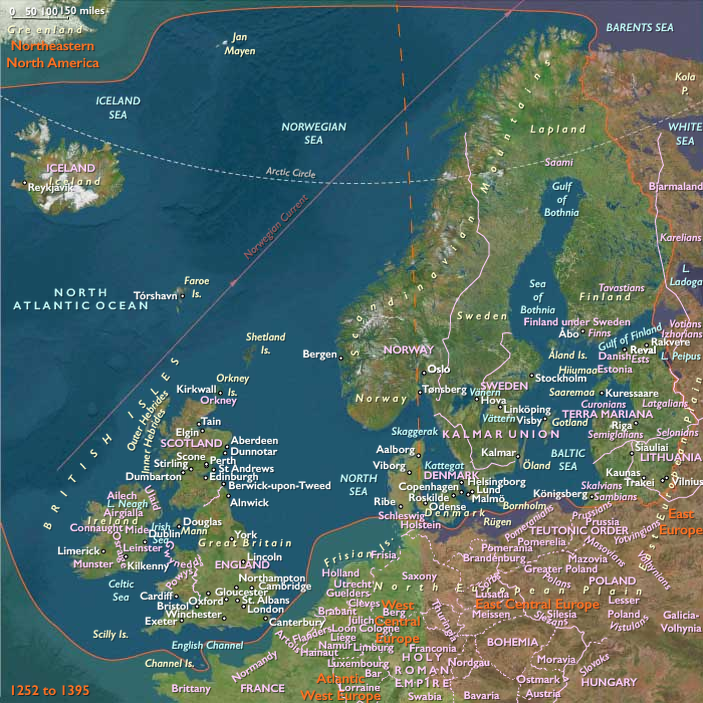
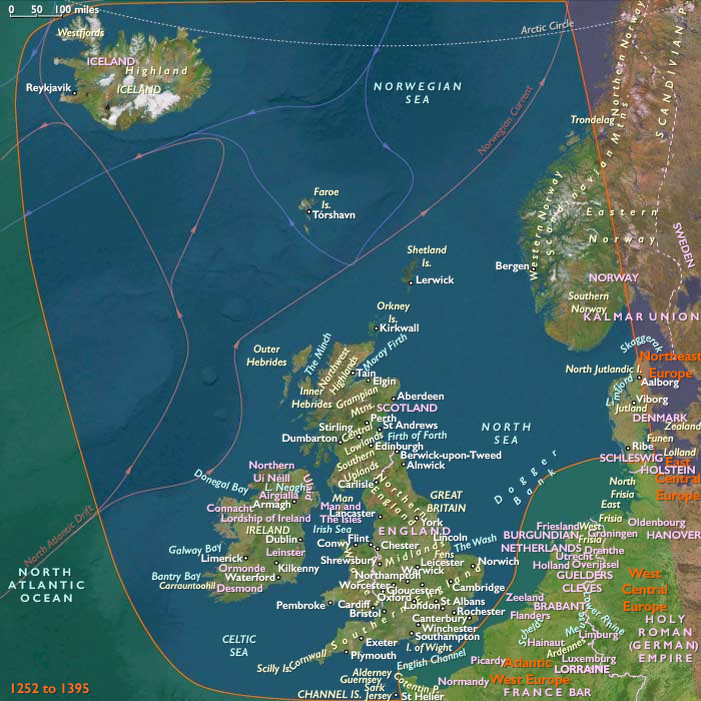
A Peasants' Revolt led by Wat Tyler …
Years: 1252 - 1395
It is suppressed by Richard II, with the death of fifteen hundred rebels.
People
Groups
Topics
Subjects
Regions
Subregions
Related Events
Filter results
Showing 10 events out of 18 total
The Earl of Galway leads another attempt on Madrid in 1707, but Berwick roundly defeats him at the Battle of Almansa on April 25.
In another attempt on Madrid, his army is severely defeated by the Marquis de Bay at the Battle of La Gudina, being forced to withdraw its troops from Spain.
The war in Spain settles hereafter nto indecisive skirmishing from which it would not subsequently emerge.
England is in 1707 united with the Kingdom of Scotland to form Great Britain, negotiations having started the previous year.
Great Britain therefore replaces England as a party to the war.
Also in 1707, the War briefly intersects with the Great Northern War, which is being fought simultaneously in Northern Europe.
A Swedish army under Charles XII arrives in Saxony, where he had just finished chastising the Elector Augustus II and forcing him to renounce his claims to the Polish throne.
Both the French and the Allies send envoys to Charles's camp, and the French hope to encourage him to turn his troops against the Emperor Joseph I, who Charles feels had slighted him by his support for Augustus.
However, Charles, who likes to see himself as a champion of Protestant Europe, greatly dislikes Louis XIV for his treatment of the Huguenots, and is generally uninterested in the western war.
He turns his attention instead to Russia, ending the possibility of Swedish intervention.
Prince Eugene leads an allied invasion of southern France from Italy later in 1707, but is stalled by the French army.
Marlborough, in the meantime, remains in the Low Countries, where he is caught up in capturing an endless succession of fortresses.

French Invasion of the Basque Provinces (1719) and Its Failure
Following the discovery of the Cellamare Conspiracy (1718)—a Spanish plot to overthrow the Duke of Orléans, Regent of France—Philip V of Spain sought to weaken France by engaging in aggressive military campaigns. In response, Orléans ordered the French army under the Duke of Berwick to invade the Basque provinces of Spain in April 1719 as part of the War of the Quadruple Alliance (1718–1720).
The French Invasion and Spanish Resistance
✔ Initial French Advance
- The Duke of Berwick, a seasoned commander, led French forces into northern Spain, targeting the Basque provinces.
- The French army faced little organized military resistance, as Spain was already weakened by multiple fronts.
❌ Heavy Losses Due to Disease
- Despite the initial success, the campaign faltered due to outbreaks of disease.
- French forces suffered heavy casualties from sickness, forcing a retreat back into France.
Outcome and Consequences
- The French offensive ultimately failed, as disease caused more losses than combat.
- The Spanish Basque provinces remained under Spanish control, though Spain was still losing the war overall.
- The Quadruple Alliance remained firmly in control of the conflict, and Spain was eventually forced to negotiate peace in 1720.
Conclusion: A Failed French Attempt to Undermine Spain
The 1719 invasion of the Basque provinces was part of France’s broader strategy to weaken Spain, but the unexpected toll of disease prevented any lasting gains. While the French military remained dominant in the war, this particular campaign highlighted the challenges of warfare beyond the battlefield, as disease and logistics could be just as decisive as direct combat.
British Retaliation and the Capture of Vigo (1719)
In October 1719, a British fleet, responding to Spanish support for the Jacobite uprising in Scotland, launched a retaliatory assault on Vigo, swiftly capturing the city before advancing inland...
The incursion sent shockwaves through Spanish authorities, who suddenly recognized the vulnerability of their coastline to Allied amphibious attacks. The raid underscored the potential for Britain to open a new front far from the heavily fortified French frontier, forcing Spain to reconsider its defensive priorities.
The Polish throne, vacant upon the death of Augustus II of Saxony on February 1, 1733, is claimed by both his son, Augustus III, and by Stanisław Leszczyński, father in law of King Louis XV of France.While a body double ostensibly leaves Brest by sea, Stanisław crosses Germany incognito to arrives at Warsaw on September 8.
Stanislas is elected king of Poland by the diet on September 12.
Russia and Austria, both of whom back Augustus III, immediately invade Poland.
Stanisław, who does not have a proper army, has to take refuge by September 22 in Danzig (now known as Gdansk), there to await the French help he has been promised.
Augustus III, protected by Russian forces at Warsaw, is proclaimed king on October 5.
Great Britain, the Dutch Republic, Sweden, Denmark and the Republic of Venice, recognizing that Austro-Russian aggression against Poland is the casus belli, pledge to remain neutral.
Spain, coveting the Kingdom of Naples and Sardinia, which the Duke of Milan wants, sides with France.
French and Savoyard troops numbering over fifty thousand under the command of Charles Emmanuel enters Milanese territory as early as October 24, against minimal resistance, as the Austrian forces in the duchy number only about twelve thousand.
The city of Milan itself has by November 3 surrendered, although the Austrian governor, Count Wirich Philipp von Daun, still holds the fortress.
France's great general, the Duke de Villars, joins Charles Emmanuel in Milan on November 11.
While Villars wants to immediately move to secure the Alpine passes against Austrian reinforcements by moving against Mantua, Charles Emmanuel, mistrustful of his French allies and their dealings with Spain, seeks to secure Milan.
The army will spend the next three months eliminating Austrian opposition from the remaining fortified towns in the duchy.
Villars attempts to interest Don Carlos of Parma in joining the expedition against Mantua, but Carlos is focused on the campaign into Naples.
Villars begins to move against Mantua, but Charles Emmanuel resists, and the army makes little progress.
In early May, an Austrian army of forty thousand under Count Claude Florimond de Mercy crosses the Alps and threatens to close in on the French army's rear by a flanking maneuver.
Villars responds by retreating from Mantua and attempts without success to interrupt the Austrian army's crossing of the Po River.
Villars, frustrated by Charles Emmanuel's delaying tactics, quits the army on May 27. (He will fall ill on the way back to France and on June 17 will die in Turin.)
The Austrians, choosing a strategy of defending a large number of fortresses, are soundly defeated in southern Italy.
Don Carlos has assembled an army composed primarily of Spaniards, but also including some troops from France and Savoy.
Moving south through the Papal States, his army had flanked the frontline Austrian defense at Mignano, forcing them to retreat into the fortress at Capua.
He was then practically welcomed into Naples by the city fathers, as the Austrian viceroy had fled toward Bari, and the fortresses held by the Austrians in the city were quickly captured.
While maintaining a blockade of the largest Austrian holdings at Capua and Gaeta, a large portion of the allied army had given chase to the remaining Austrian forces.
These finally attempt a stand in late May, and are defeated at Bitonto.
Mercy's forces make repeated attempts to cross the Parma River in June, but it is not until late in this month that they are able to cross the river and approach the city of Parma, where the allied forces, now under the command of French marshals de Broglie and Coigny, are entrenched.
In a bloody battle near the village of Crocetta on June 29, the Austrians are beaten back, Mercy is killed, and Frederick of Württemberg, his second, is wounded.
Charles Emmanuel returns the next day to retake command, and resumes his delaying tactics by failing to immediately pursue the retreating Austrians.
The Austrians retreate to the Po, where they are reinforced by additional troops and placed under the command of Field Marshal Königsegg.
Gdańsk, besieged since February 1734, after the failure of a French expedition to relieve the city, is taken on June 30 by a Russian-Saxon army that has come under the overall command of Field Marshal Burkhard Christoph von Münnich.
Stanisław flees, first to Königsberg, and eventually to France.
This ends major military activity in Poland itself, although it continues to be occupied by foreign troops as Augustus deals with partisan supporters of Stanisław.