
The Treaty of Sablé and the End …
Years: 1488 - 1488
The Treaty of Sablé and the End of Breton Independence (1488)
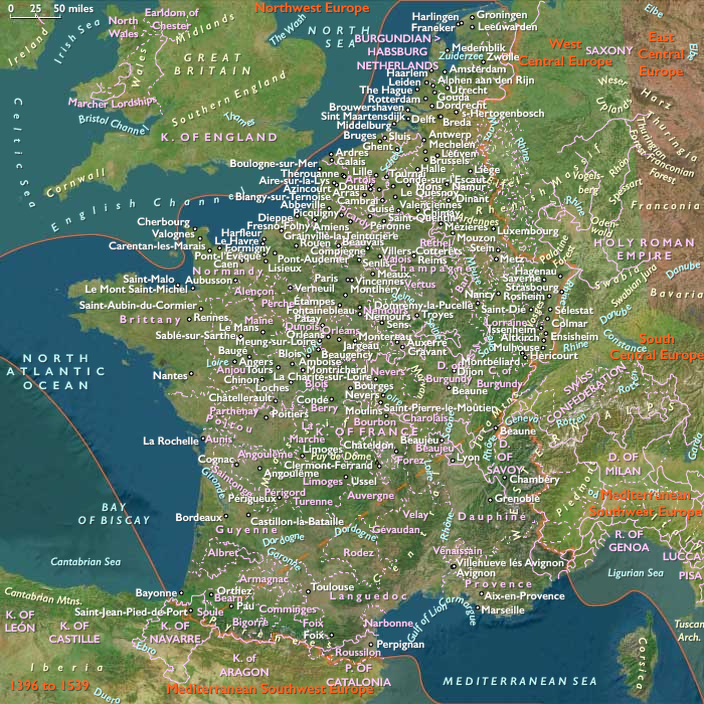
The Treaty of Sablé, signed in August 1488, marked a decisive turning point in the centuries-long struggle between Brittany and the French crown. The treaty, resulting directly from Brittany’s catastrophic defeat at Saint-Aubin-du-Cormier, stripped away the duchy’s remaining political autonomy and set the stage for its annexation into France. This pivotal agreement reshaped the political and territorial landscape of late medieval Atlantic West Europe.
Terms of the Treaty
Under the Treaty of Sablé, England, whose support Brittany had previously counted upon, was forced to withdraw entirely from Breton affairs. The key terms severely curtailed Breton independence:
- Foreign troops, particularly the English, were compelled to leave Brittany, ending direct foreign involvement.
- Anne of Brittany, the young daughter and heir of Duke Francis II, was expressly forbidden to marry without the permission of the French king, Charles VIII, a stipulation intended to ensure Brittany’s absorption into France through marriage rather than force.
- Brittany’s military independence was severely limited, and its foreign policy was explicitly subordinated to French oversight.
Death of Francis II and Charles VIII's Move
Just two weeks after the treaty’s ratification, Duke Francis II of Brittany died on September 9, 1488, leaving his eleven-year-old daughter, Anne of Brittany, vulnerable and politically isolated. Capitalizing quickly on these circumstances, King Charles VIII of France promptly asserted direct claims over Brittany, insisting upon his right to determine Anne’s marriage—and ultimately aiming to wed her himself, thus definitively uniting Brittany with the French crown.
Geopolitical Consequences
The sudden death of Francis II enabled Charles VIII to swiftly press his advantage. His claim over Anne and her duchy marked the effective end of independent Breton sovereignty, triggering a political realignment in Western Europe. This outcome decisively thwarted English ambitions in Brittany, consolidating French territorial and dynastic power while further isolating England diplomatically.
Charles's strategic maneuver ensured a significant expansion of French royal power and removed a persistent thorn from France’s western flank, thereby dramatically strengthening the monarchy’s geopolitical position.
Long-Term Historical Significance
The Treaty of Sablé (1488) and subsequent annexation of Brittany were pivotal events in the formation of early modern France. By absorbing Brittany through marriage rather than outright conquest, Charles VIII skillfully legitimized the integration of the duchy into the French state. This not only reinforced royal centralization but also set a precedent for future territorial annexations through marital diplomacy—an approach characteristic of late medieval and early modern European statecraft.
The treaty also marked a critical defeat for England, ending decades of diplomatic and military attempts to maintain Brittany as a strategically independent counterweight to French power. The loss solidified French dominance in Western Europe, laying the groundwork for future conflicts, alliances, and territorial expansions that defined European politics for the next century.
Thus, the events surrounding the Treaty of Sablé fundamentally altered the geopolitical balance of power in late medieval Atlantic West Europe, accelerating the transition from a mosaic of semi-independent principalities toward a centralized, unified French monarchy.
Locations
People
Groups
Topics
Commodoties
Subjects
Regions
Subregions
Years: 1488 - 1488
Locations
People
Groups
Topics
Commodoties
Subjects
Regions
Subregions